Author: ilsehaider

Augenspiel

Margit Zuckriegl

CV

Margit Zuckriegl         

was born in 1955 in Salzburg/Austria and studied art history, archeology and philosophy in Salzburg and Rome. She graduated from the University of Salzburg in 1983, followed by  studies in the USA and Barcelona/Spain. Curator of contemporary art at the Collection of the Province of Salzburg “Rupertinum”, Museum der Moderne Salzburg and director of the National Collection of Fine Art Photography of Austria from 1982 until 2016  2004 and 2005 docent at the Institute of Art History at the University of Salzburg. 2006 International Award of Photography/craf/Spilimbergo (Italy). Docent at the University of Fine Arts Mozarteum, Salzburg from 2011 until 2014. Lectureship at the University of Applied Art Vienna 2017/18. She has published numerous texts concerning modern and contemporary art. She lives in Salzburg and Vienna.

Margit Zuckriegl

geboren 1955 in Salzburg/Österreich, studierte Kunstgeschichte, Archäologie und Philosophie in Salzburg und Rom, 1983 Promotion. Studienaufenthalte in den USA und Barcelona. Von 1982 bis 2016 Kuratorin für zeitgenössische Kunst an den Salzburger Landessammlungen Rupertinum, Museum der Moderne Salzburg und seit 1985 Leiterin der Österreichischen Fotogalerie. 2004 und 2005 Lehrauftrag am Kunsthistorischen Institut der Universität Salzburg. 2006 Preisträgerin des International Award of Photography, verliehen von craf/Spilimbergo (I). Von 2011 bis 2014 Lektorin für Kunstgeschichte an der Kunstuniversität Mozarteum Salzburg. 2017/18 Lehrauftrag an der Universität für Angewandte Kunst Wien. Zahlreiche Publikationen zur modernen und zeitgenössischen Kunst. Lebt in Salzburg und Wien.

EN

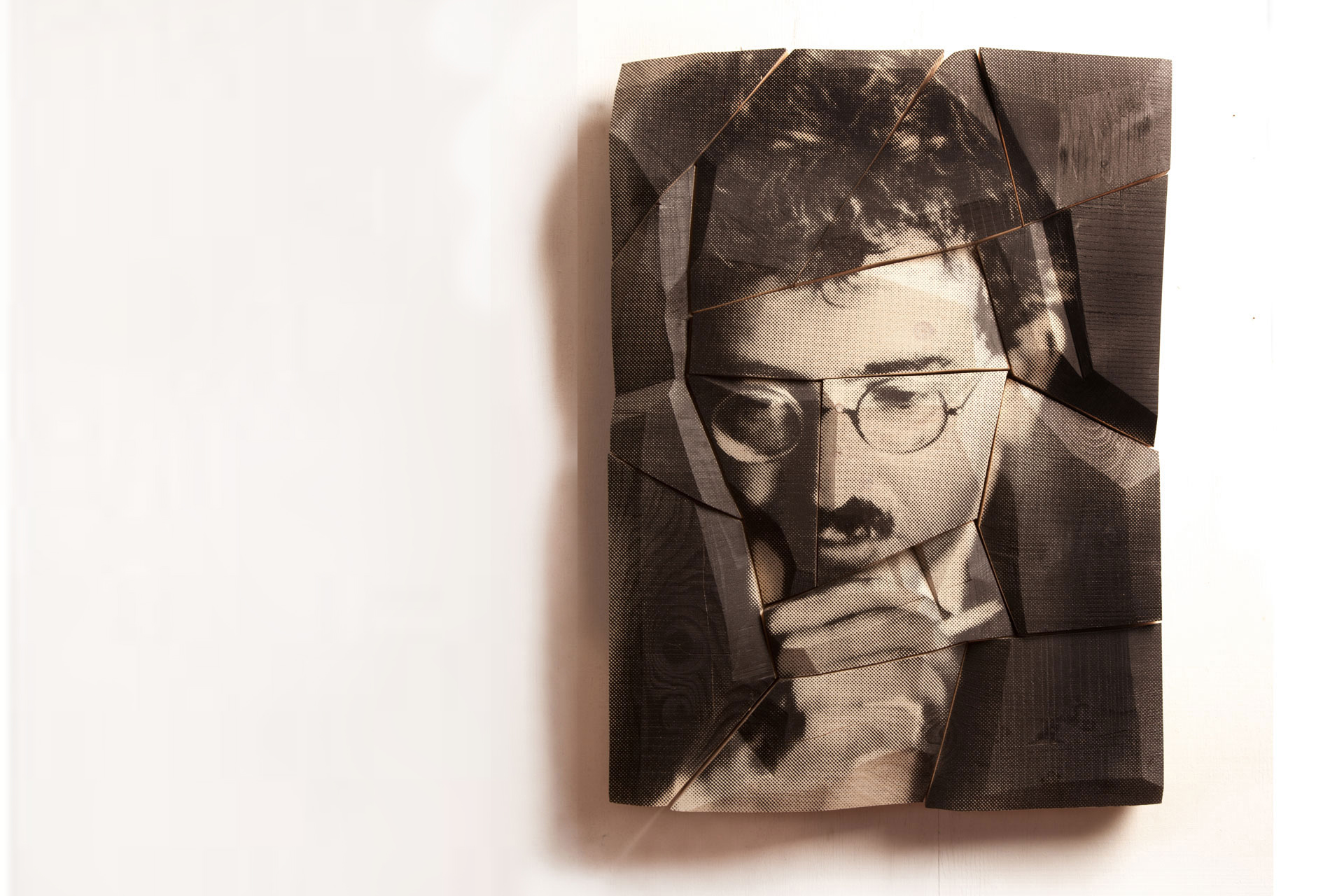
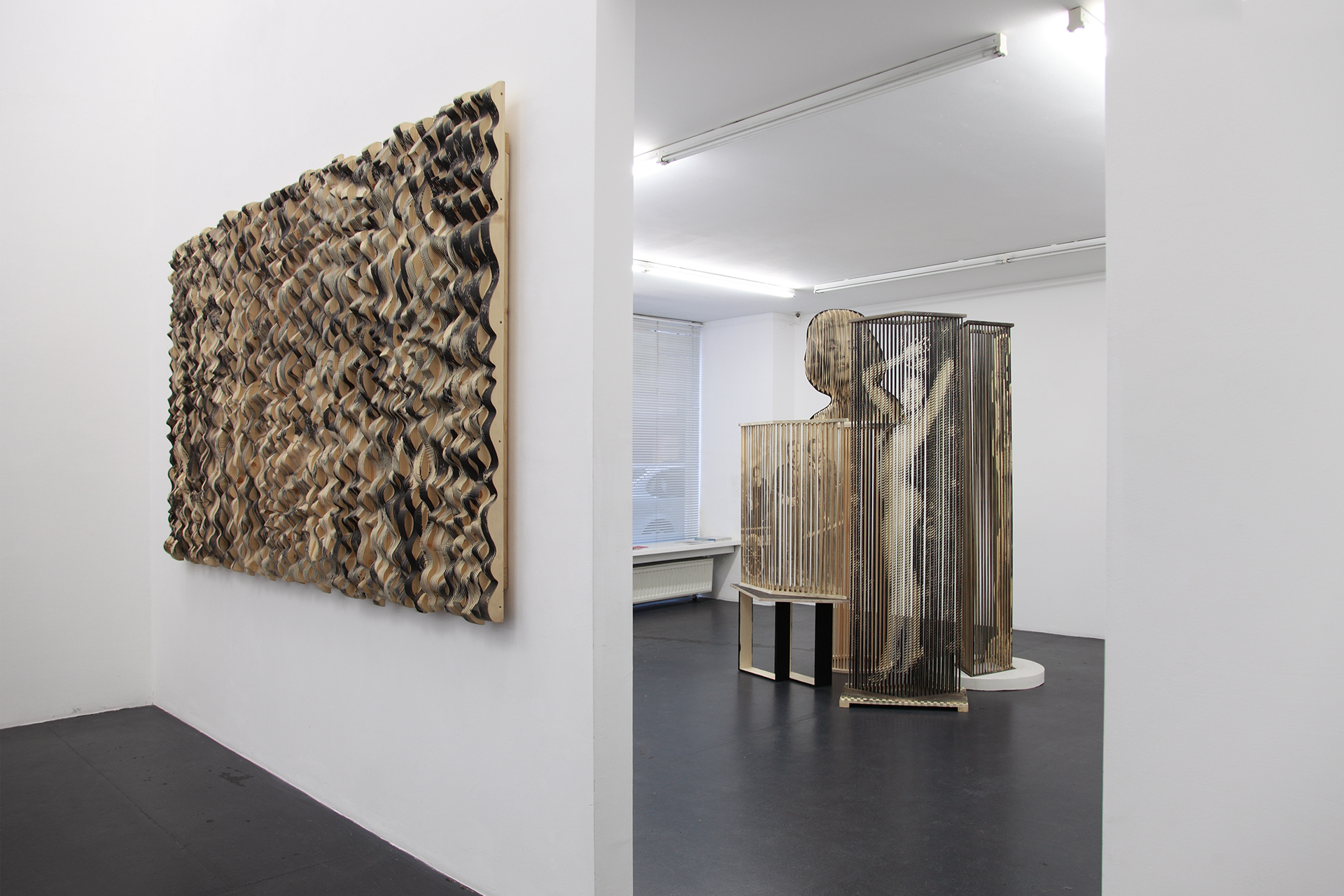
Ilse Haider formulates her photographic images as three-dimensional objects in space: portraits of actors from the golden age of Hollywood, renowned personalities from literary history, philosophy, and visual culture.

A special technique

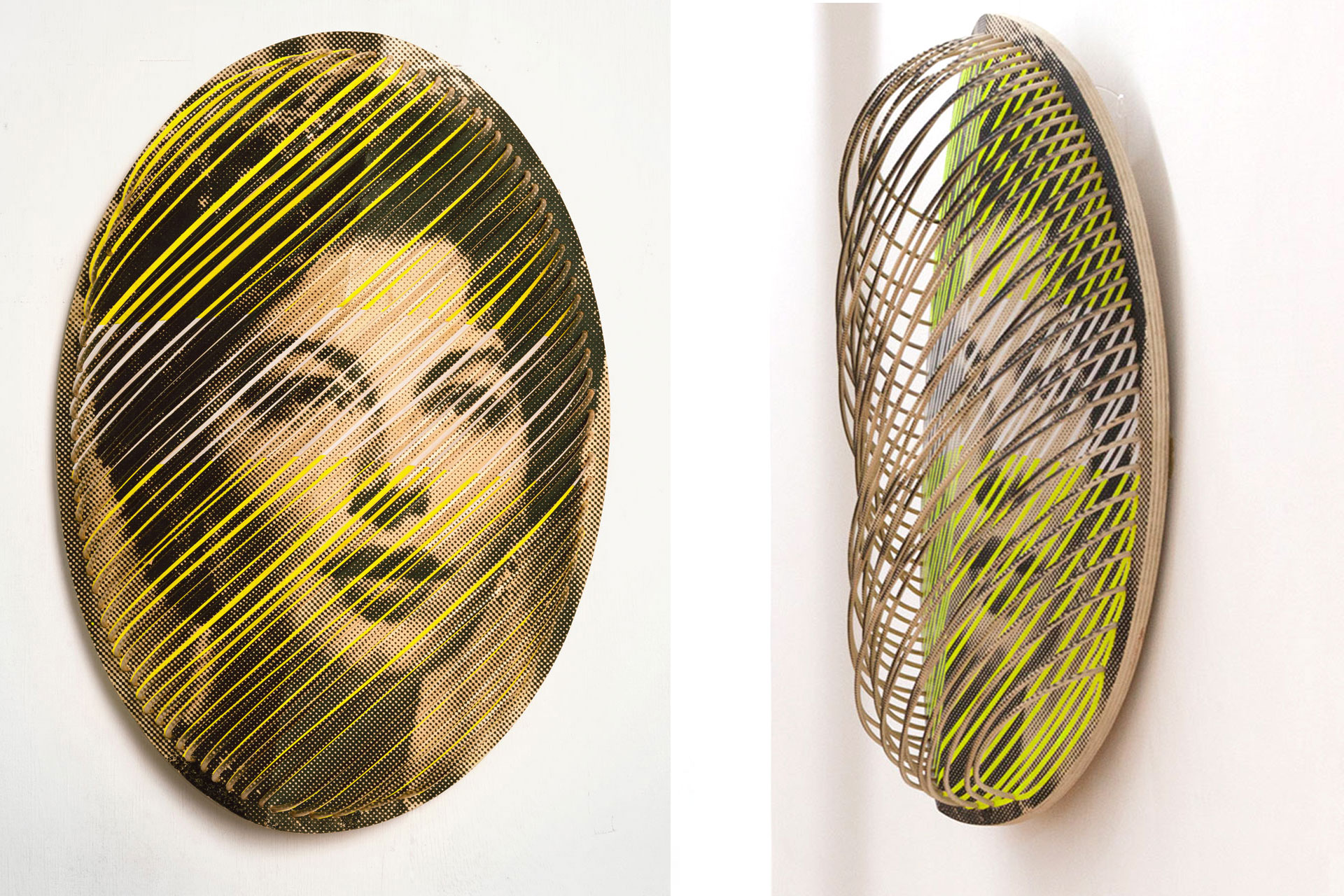
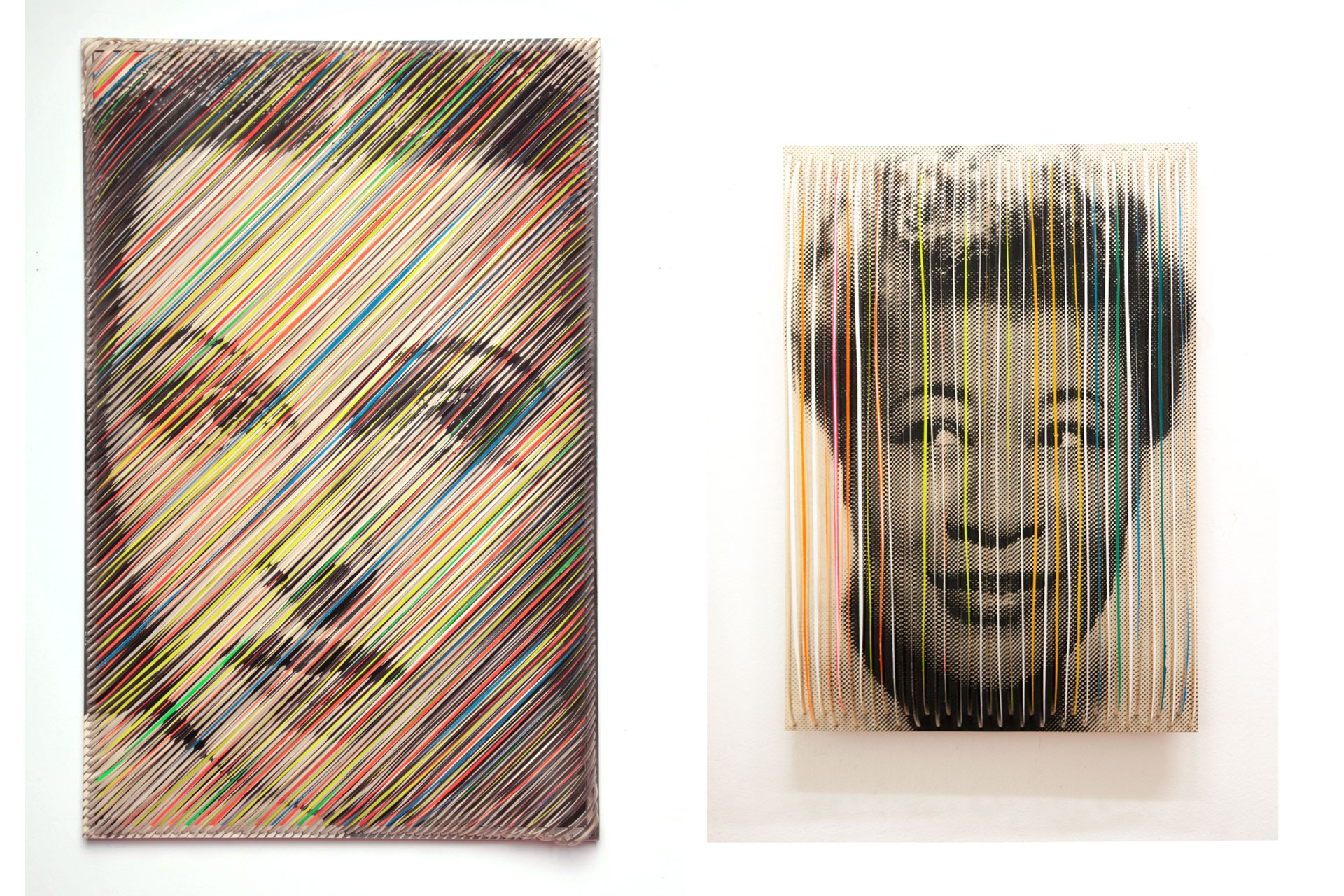
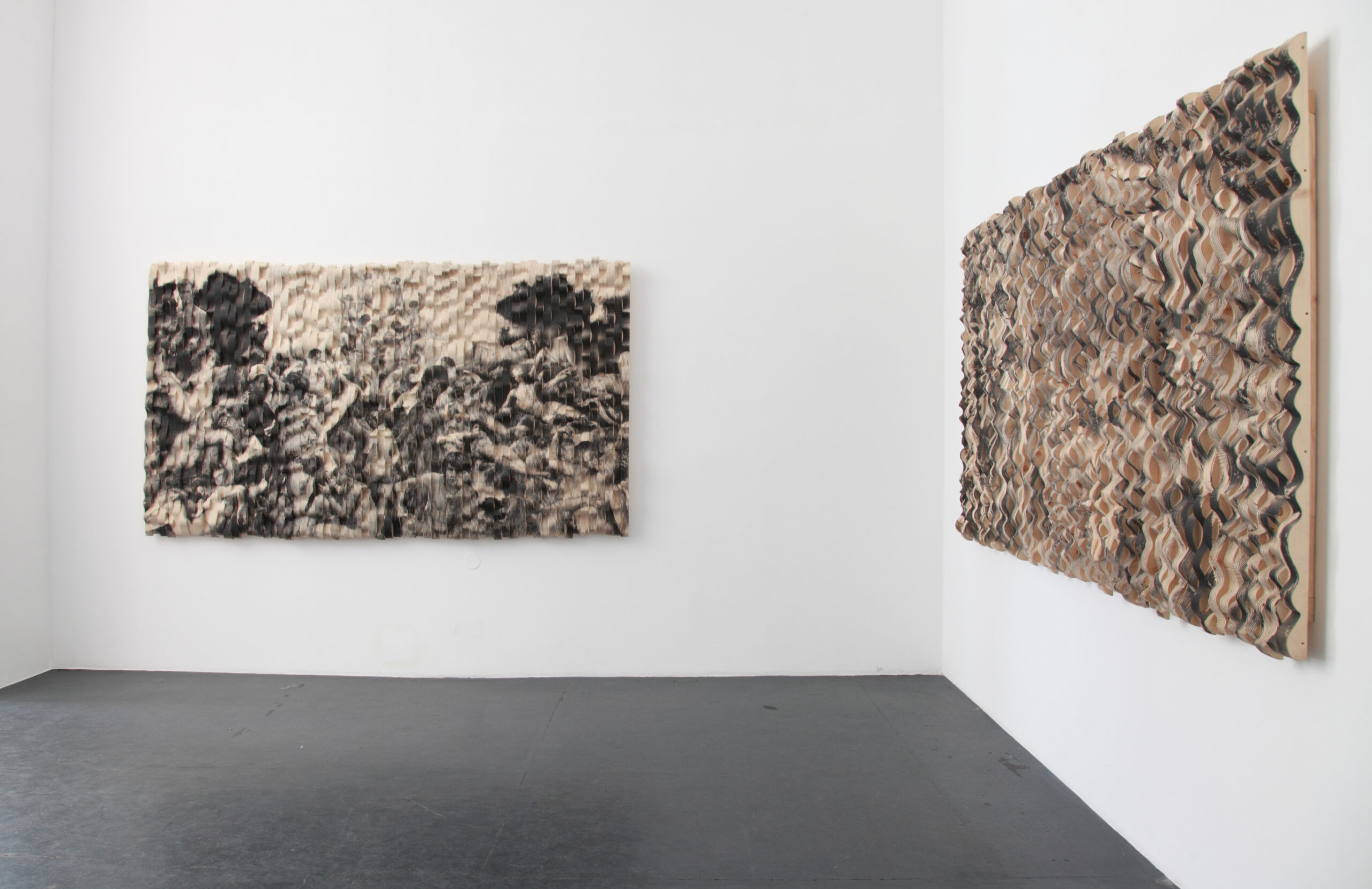
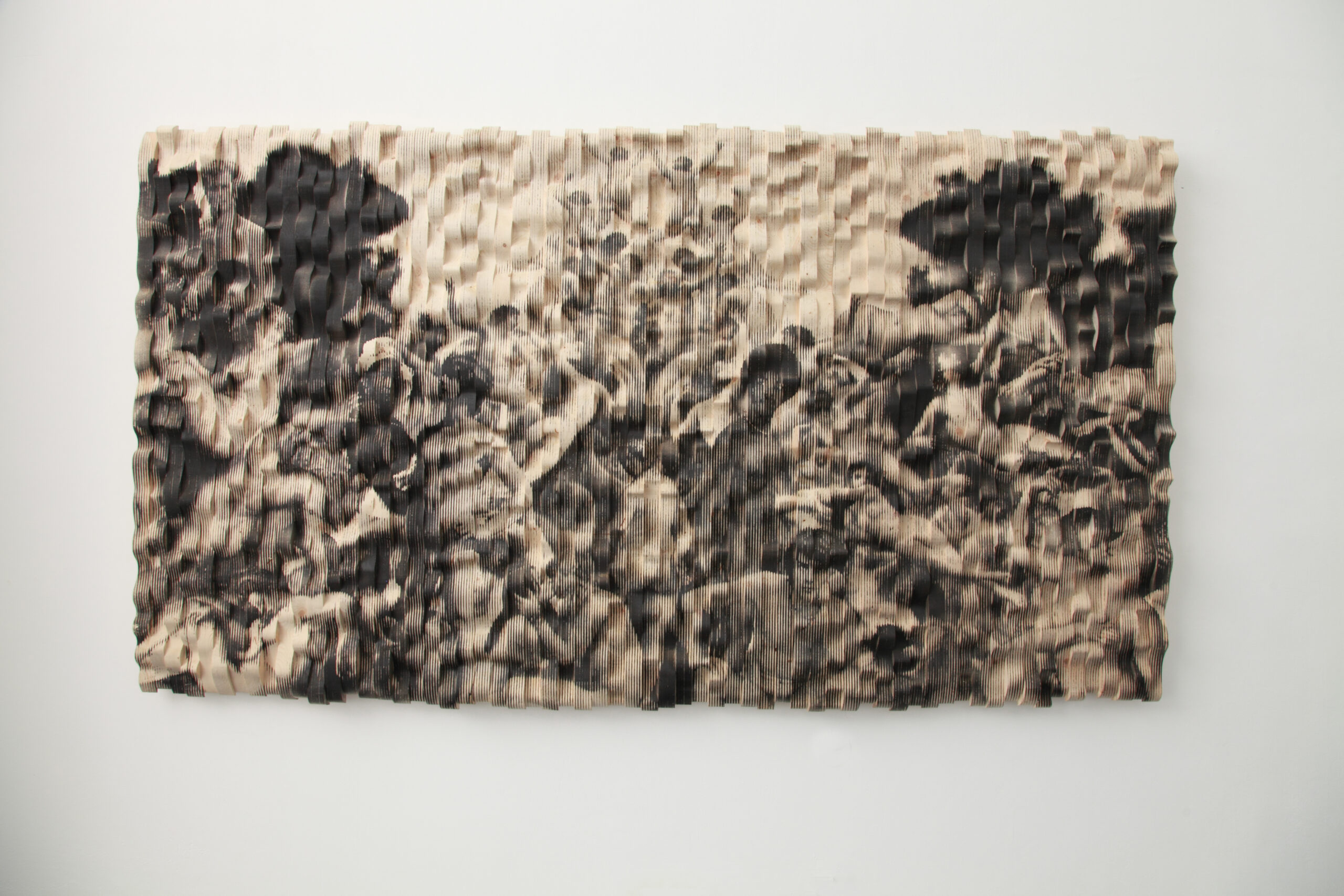
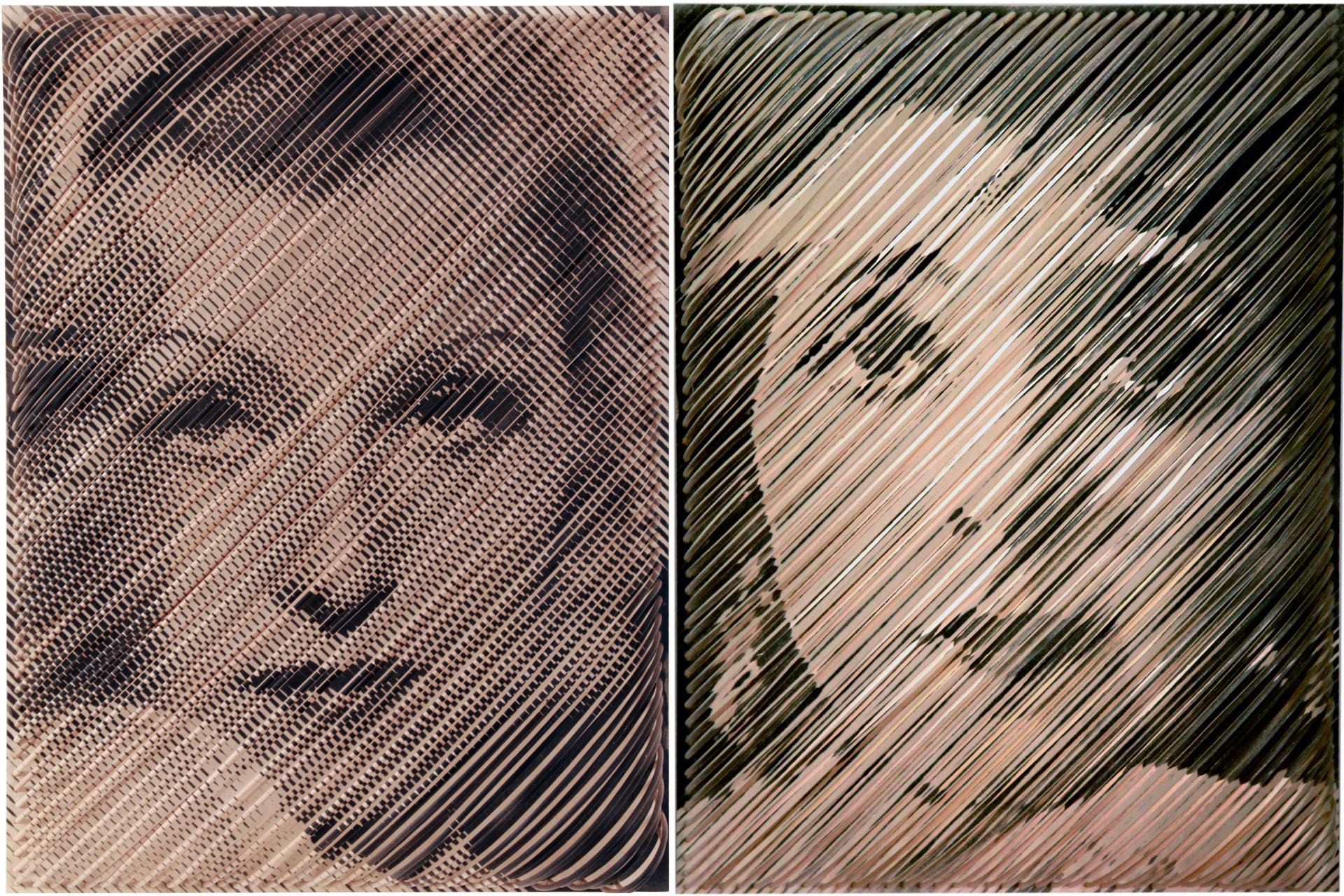
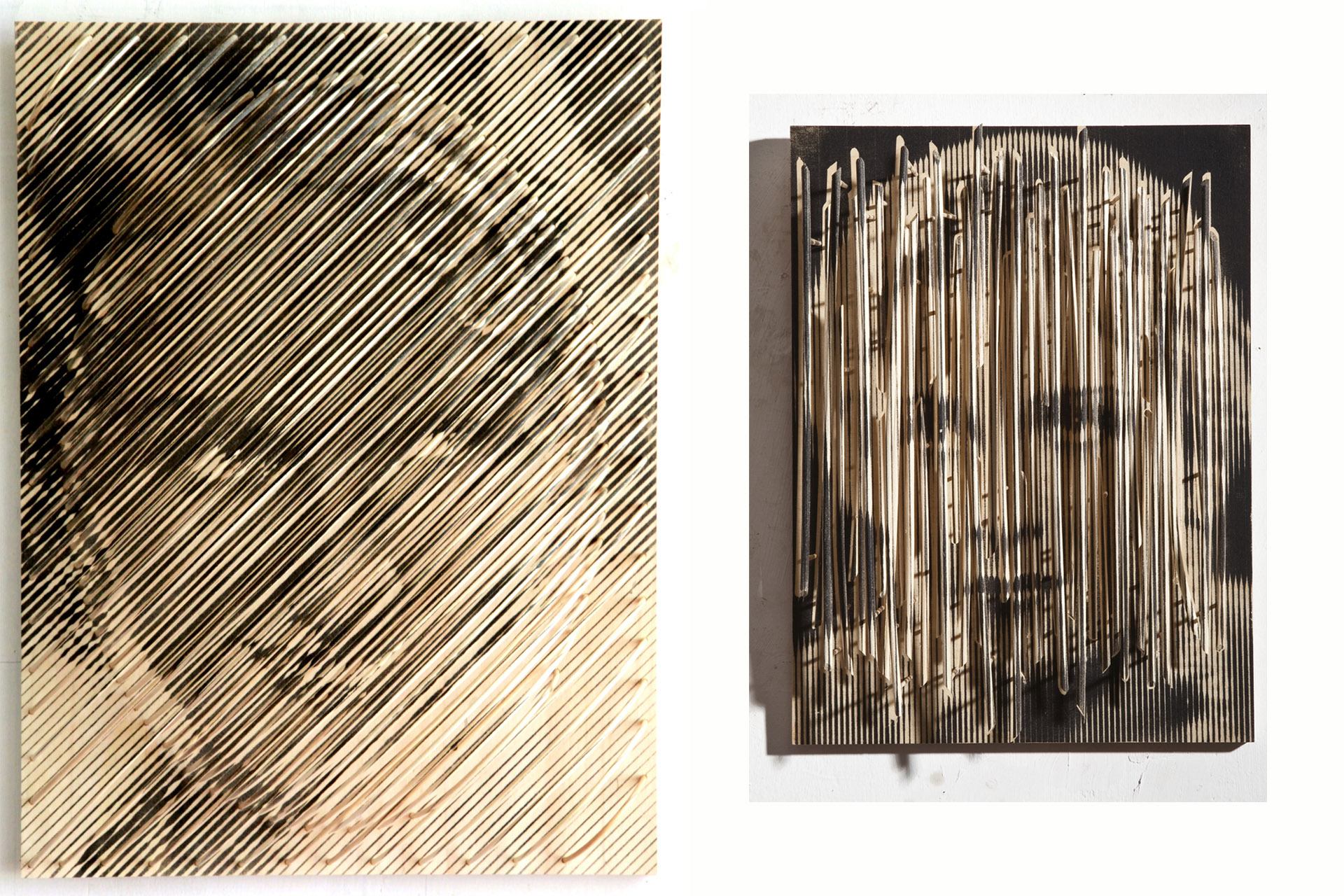
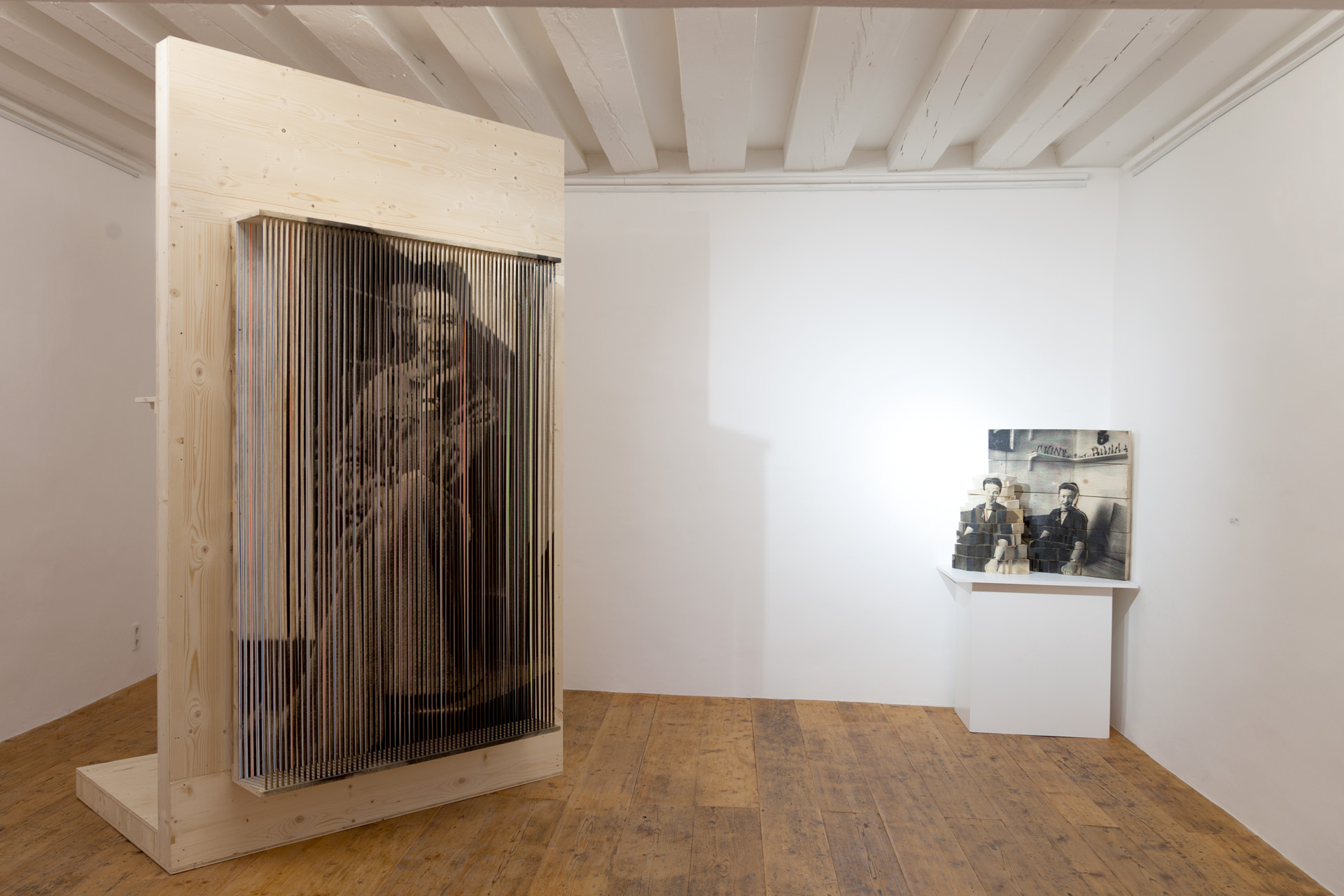
Haider’s personal technique is based on a combination of carrier medium, usually wood or wicker, and the application of photo emulsion, which allows the image to appear in fractal resolution. The photo-sculptures are unique pieces arising in an elaborate process between darkroom and workshop.

Different points of view

The work of seeing the image as a whole is first enacted by the viewer—preferably, one in motion—who supplements the photographic image with a spatial, almost temporal dimension: the perception of the objects and installations calls for different standpoints on the object, enabling a dialogue of viewer and viewed.

Augenspiel (The Play of the Eyes)

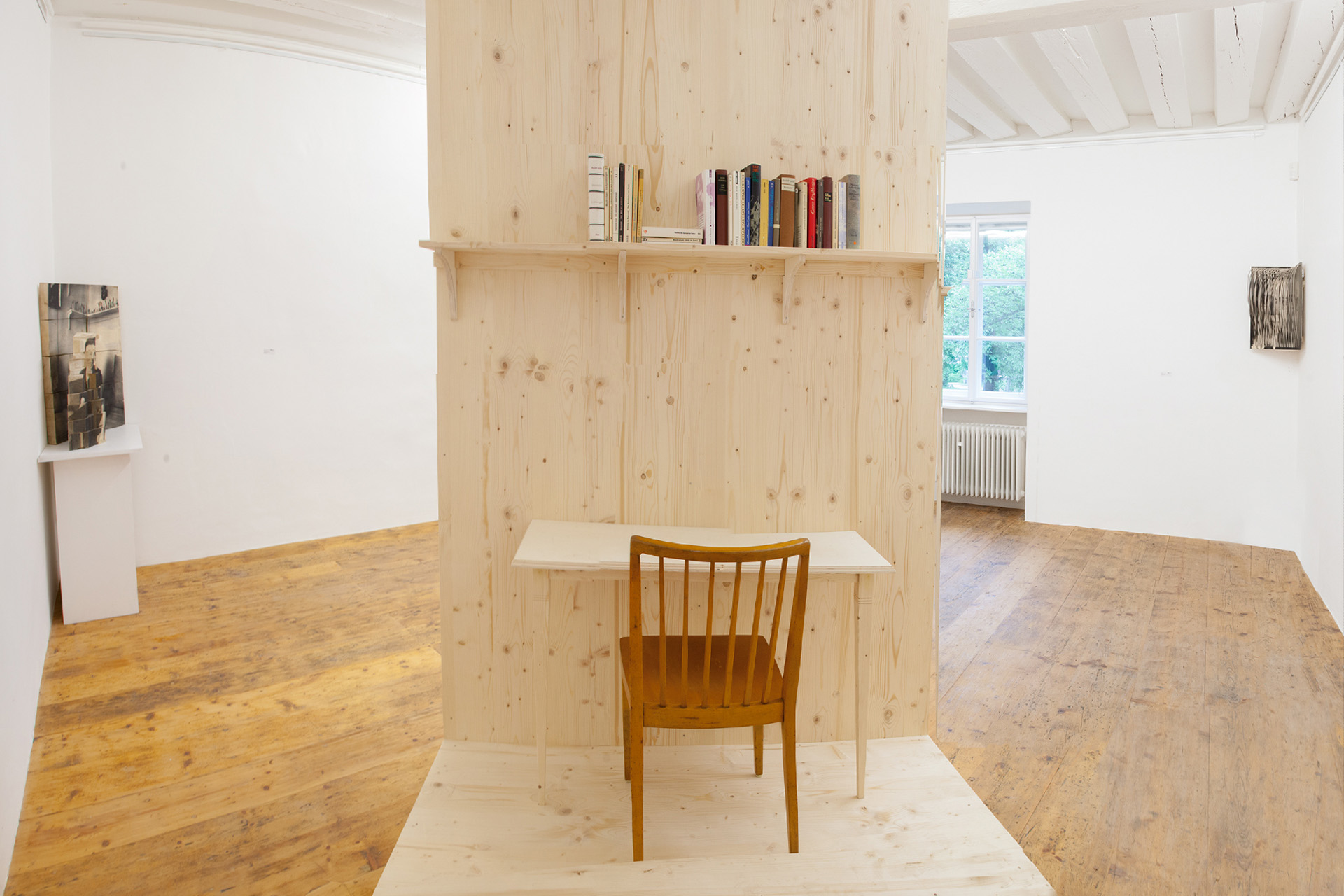
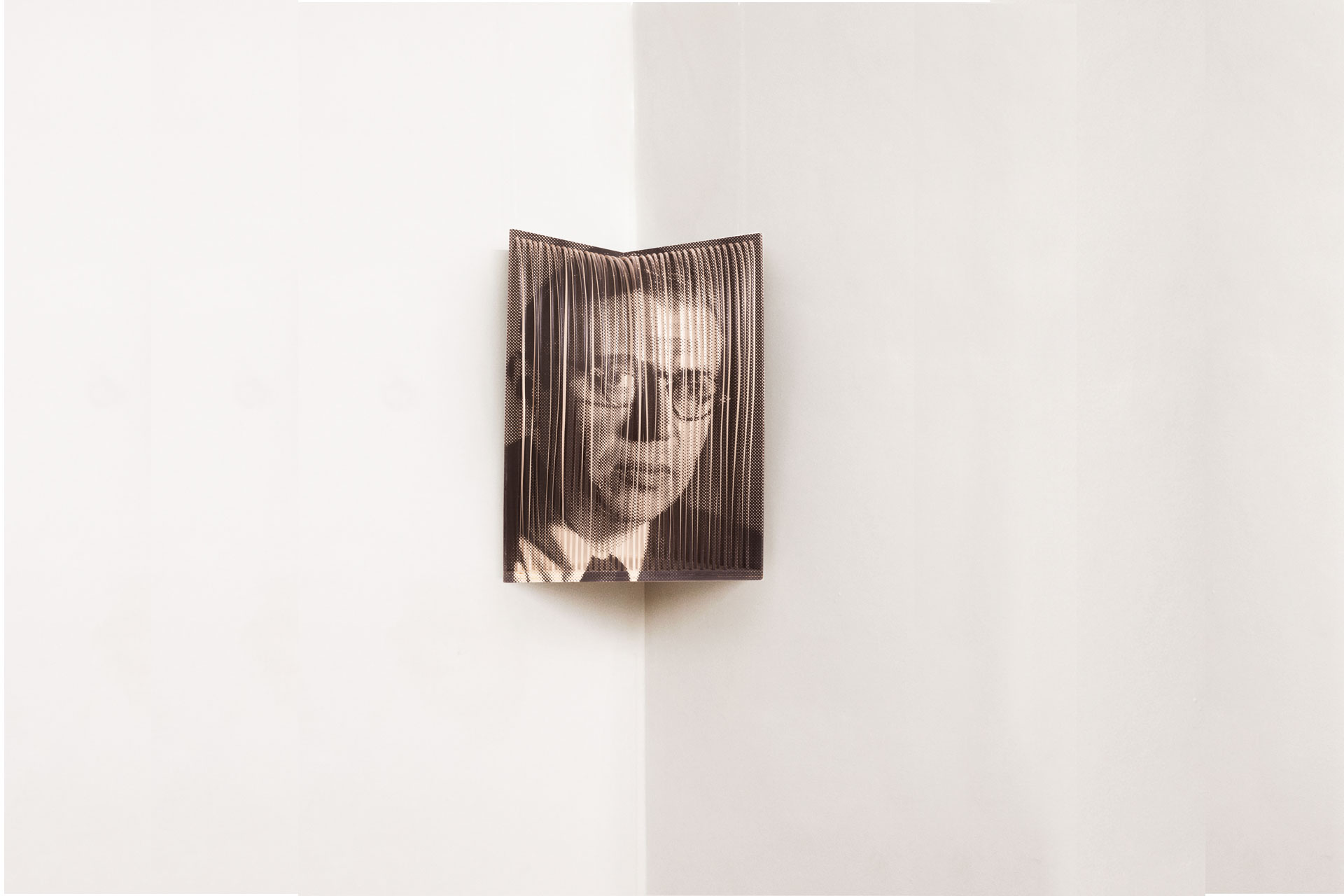
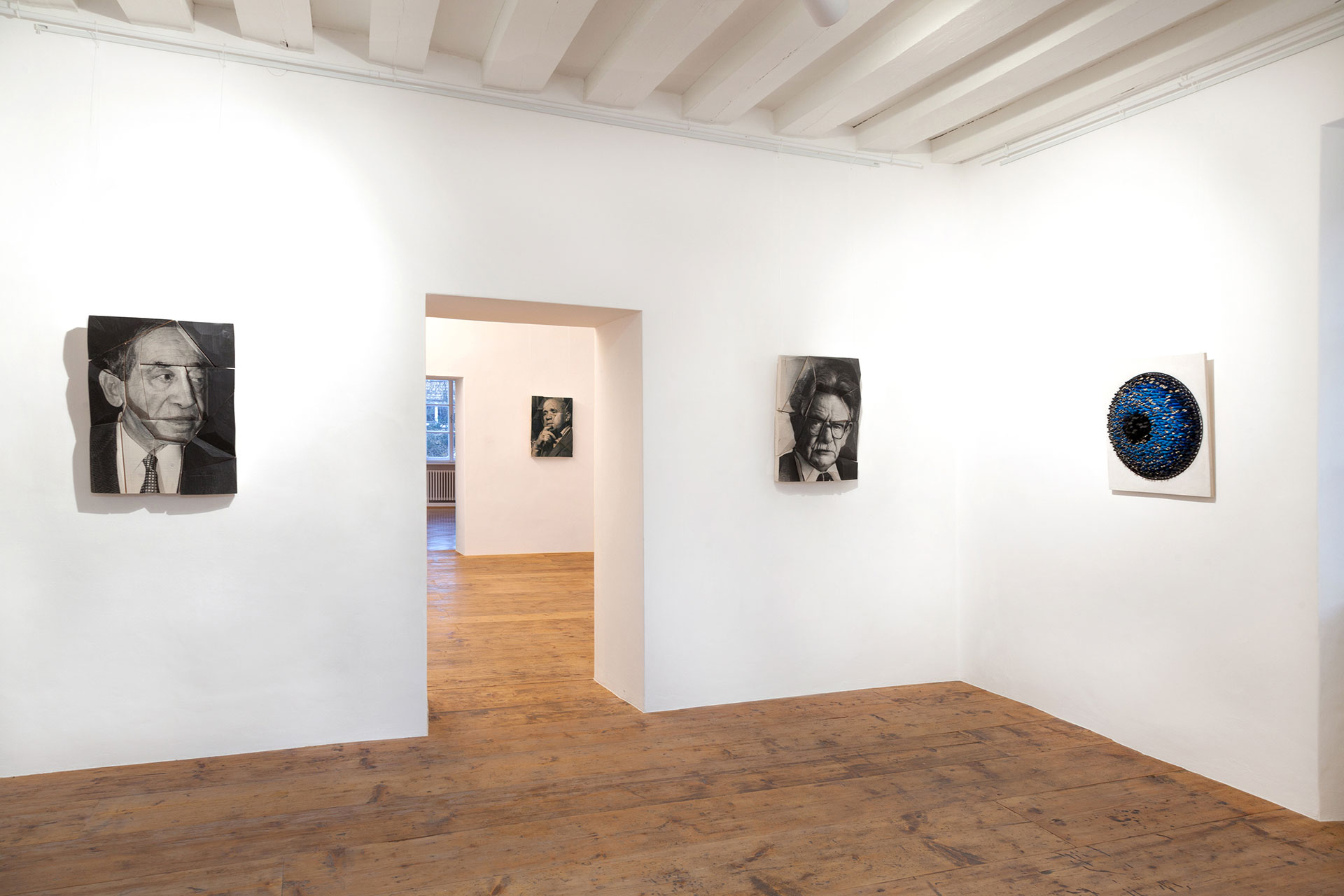
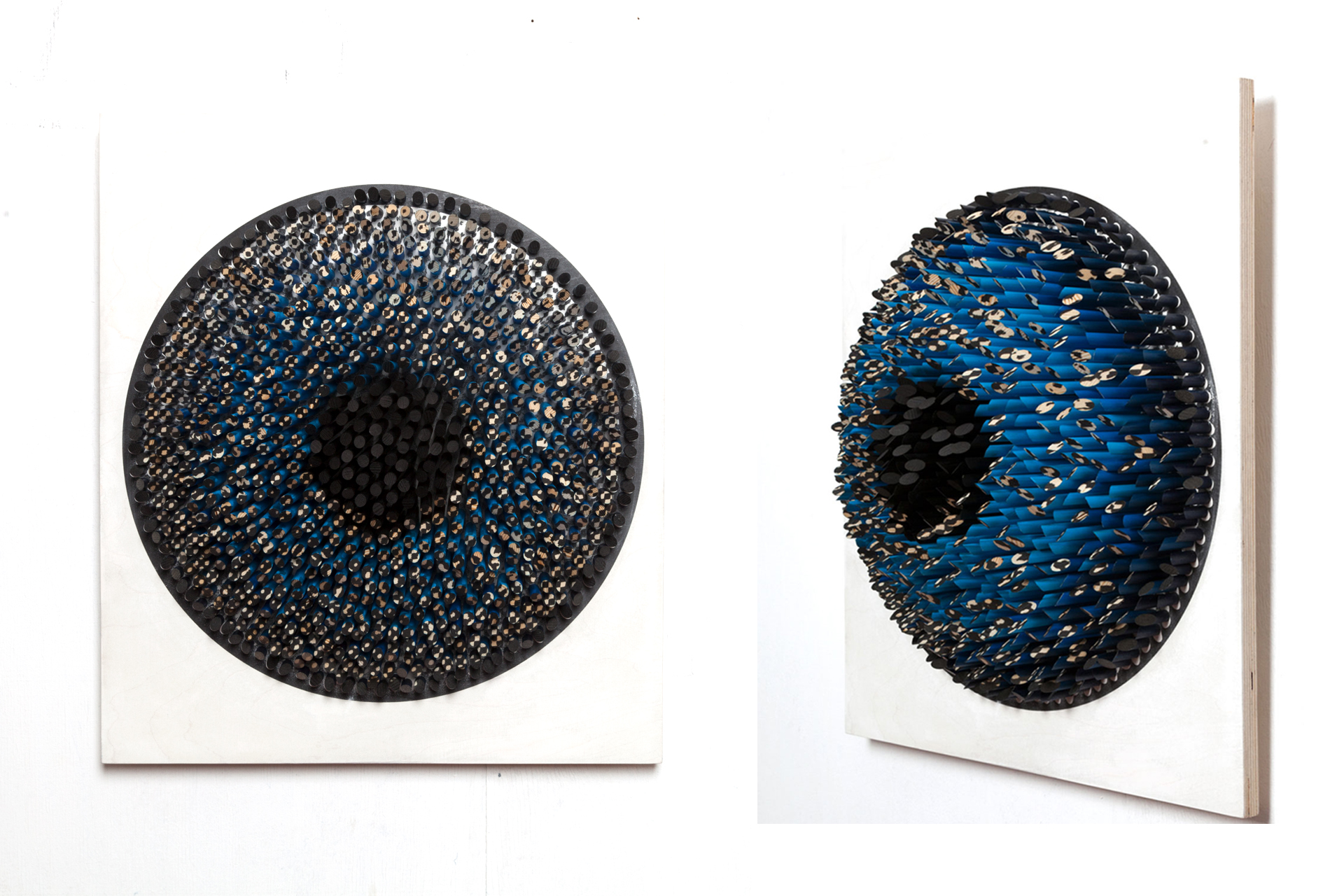
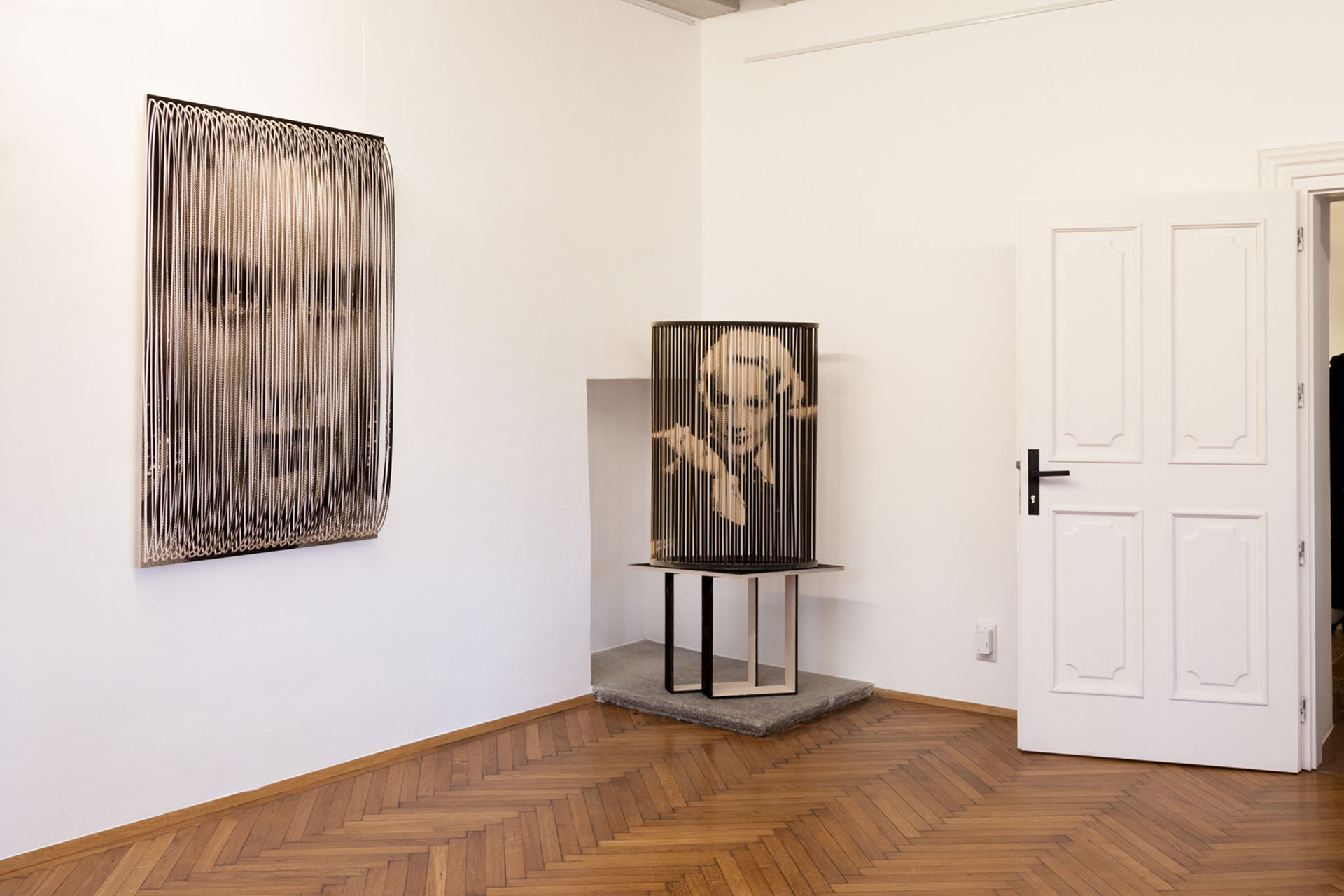
For the presentation in Schloss Wiespach, Ilse Haider borrows the title of Elias Canetti’s memoirs: seeing is not the same as perceiving. The eyes of a vis-à-vis are fascinating for Canetti, but also dangerous as they can make demands, penetrate, and injure. Ilse Haider’s “Augenspiel”, her “play of the eyes,” is about seeing and perceiving people; faces that have become icons of visual culture. She plays with the interaction of portrait and viewer, with the sphere in between and the surrounding space.

Play space / literary space / image and space

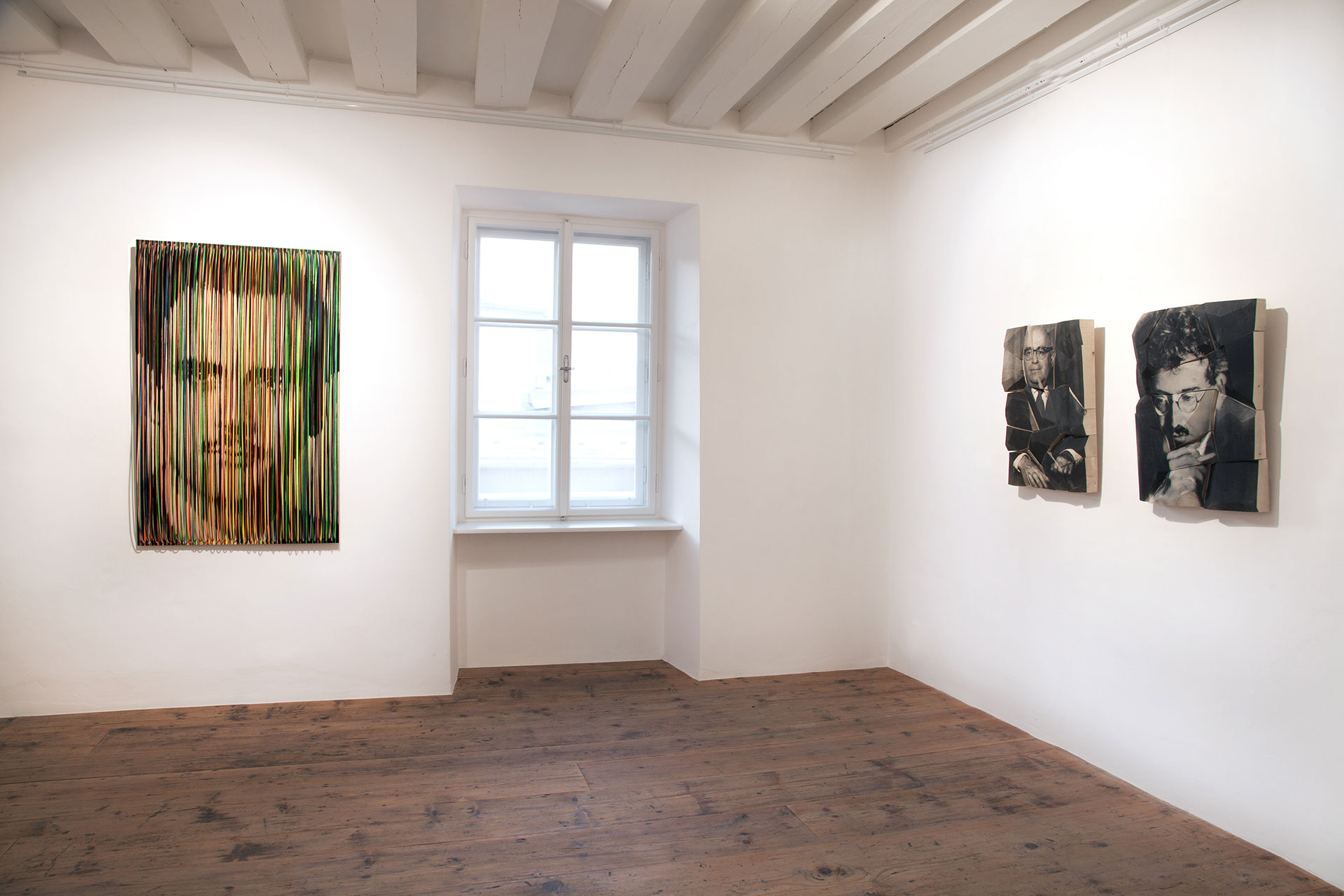
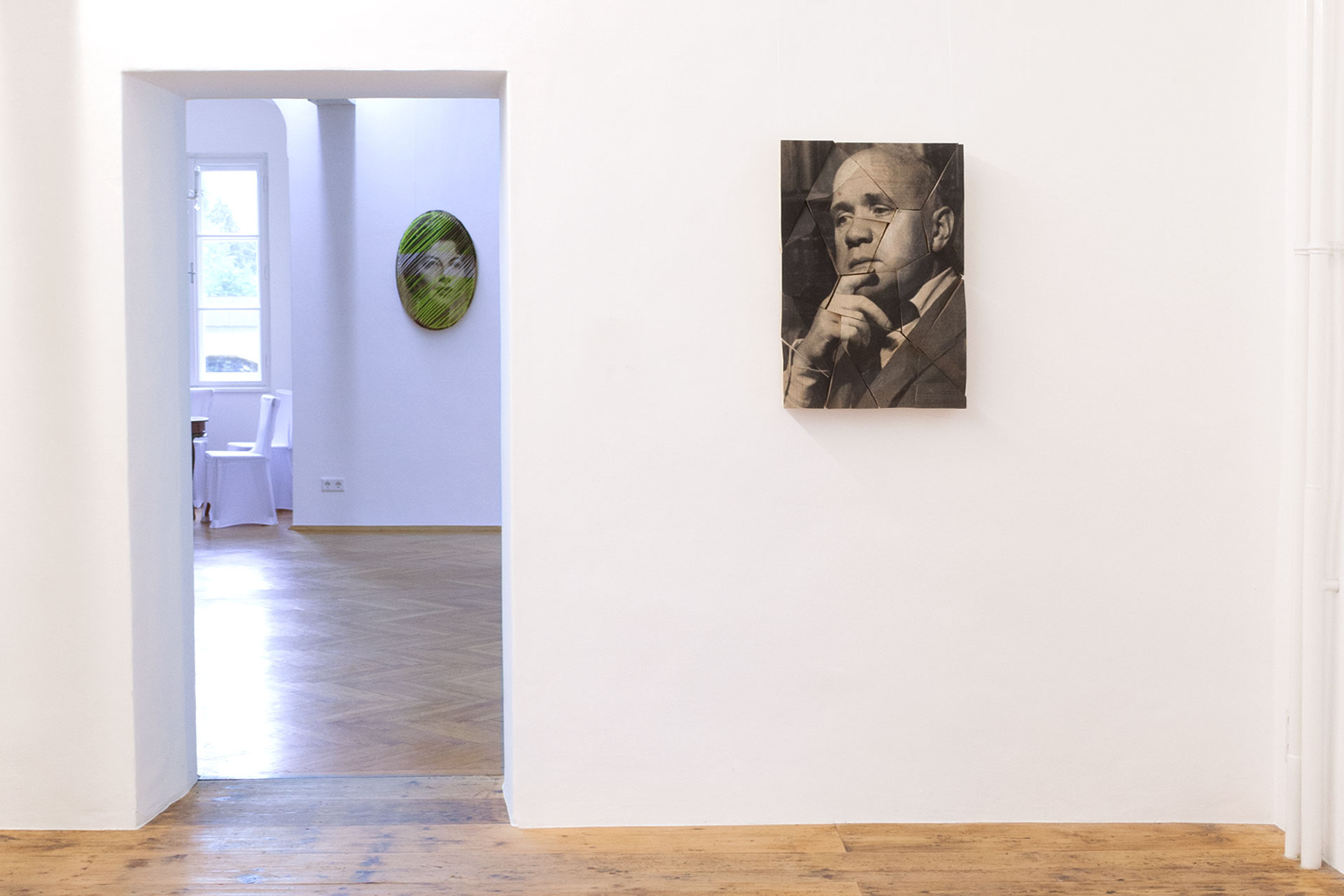
Margit Zuckriegl, curator of the exhibition, places one workgroup in each of the three exhibition spaces in Schloss Wiespach: in “play space,” one meets emblematic faces, celebrities from the worlds of film and entertainment who appear both fragile and eternal, glamorous and breakable. Entering the “literary space,” one approaches Simone de Beauvoir, staged with her intellectual surroundings: the “fille rangée” is surrounded by Sartre, Genet, Gide—and Elias Canetti. Canetti subsequently leads into the thematic “image and space,” where in addition to the relief Augenspiel, symbolizing acute moments of piercing and sharp gazes, gathered are the masters of perception theory: Walter Benjamin, Marshall McLuhan, and Siegfried Kracauer.

Based on a selection of more than twenty works from the last two years, insight into the current work of the 2011 Otto Breicha prize winner is offered; presenting an artist who links people’s medial image with their intellectual and visual spaces.

(translation: Lisa Rosenblatt)

DE

Porträts von Schauspielerinnen der goldenen Hollywood-Ära, bedeutende Persönlichkeiten der Literaturgeschichte, der Philosophie und Bildwissenschaft – Ilse Haider formuliert ihre fotografischen Bilder als dreidimensionale Objekte im Raum.

Eine spezielle Technik

Die ihr eigene Technik basiert auf der Kombination von Trägermaterial, meist Holz oder Peddigrohr, und aufgebrachter Fotoemulsion, die das Bild in fraktaler Auflösung erscheinen lässt. Die fotografischen Skulpturen sind Unikate und in aufwändigem Prozess zwischen Dunkelkammer und Werkstatt entstanden.

Unterschiedliche Betrachtungsweisen

Erst der Betrachter – und dieser vorzugsweise in Bewegung begriffen – leistet die Arbeit des Zusammensehens und ergänzt das Fotobild um eine räumliche, wie eine zeitliche Dimension: Die Wahrnehmung der Objekte und Installationen erfordert unterschiedliche Standpunkte zum Objekt und ermöglicht einen Dialog von Betrachter und Betrachtetem.

Augenspiel

Von Elias Canettis Erinnerungsbuch entlehnt Ilse Haider den Titel der Präsentation in Schloss Wiespach: Sehen ist nicht gleich Erkennen. Für Canetti sind die Augen eines Gegenüber faszinierend, aber auch gefährlich, da sie vereinnahmen, durchschauen, verletzen können. In Ilse Haiders “Augenspiel“ geht es um das Sehen und Wahrnehmen von Menschen, von Gesichtern, die zu Ikonen der visuellen Kultur geworden sind. Sie spielt mit der Interaktion von Porträt und Betrachter, mit der Sphäre dazwischen und dem umgebenden Raum.

Spiel-Raum / Der Literarische Raum / Bild und Raum

In den 3 Ausstellungsräumen von Schloss Wiespach versammelt die Kuratorin der Ausstellung, Margit Zuckriegl, je 1 Werkgruppe: Im Spiel-Raum trifft man auf emblematische Gesichter, bekannte Celebrities der Kino- und Entertainment-Welt, die gleichzeitig fragil und ewig, glamourös und zerbrechlich erscheinen. Den literarischen Raum betritt man in Annäherung an Simone de Beauvoir, die mit ihrem geistigen Umfeld inszeniert wird: Die “fille rangée“ ist umgeben von Sartre, Genet, Gide – und Elias Canetti. Dieser führt anschließend in das Thema Bild und Raum, wo neben dem Relief “Augenspiel“, das die akuten Momente von bohrenden oder spitzen Blicken symbolisiert, Meister der Wahrnehmungstheorie versammelt: Walter Benjamin, Marshall McLuhan, Siegfried Kracauer.

Anhand von über 20 ausgewählten Werken der letzten beiden Jahre wird eine Einblick in das aktuelle Werk der Otto-Breicha-Preisträgerin von 2011 geboten und eine Künstlerin präsentiert, die das mediale Erscheinungsbild des Menschen mit seinen geistigen und visuellen Räumen verknüpft.

Continue reading

Augenspiel

Augenspiel

Galerie Schloss Wiespach, 2018

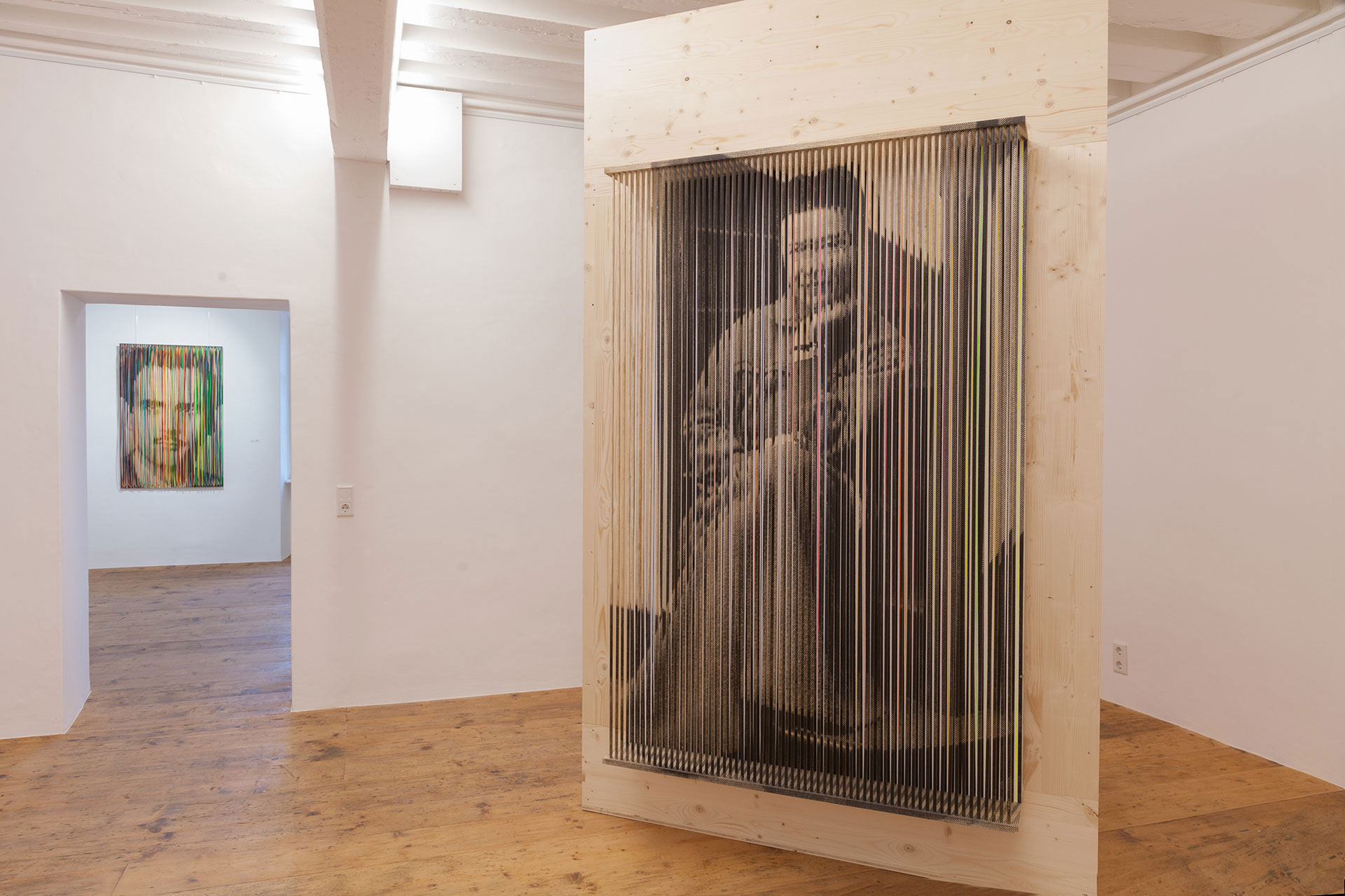
  • Simone de Beauvoir, 2017, Simone de Beauvoir versetzt, 2018

    200 x 130 x 25cm (l), 78 x 76 x 30cm (r), photographic emulsion on wood / acrylic paint

    Original (l/r): S. de Beauvoir, 1957, Jack Nilsberg/Roger Violet/APA-PictureDesk, photo credits: ©Ilse Haider

    > text

  • Simone de Beauvoir, 2017

    200 x 130 x 25cm, backside

    photo credits: ©Ilse Haider

    > text

  • Jean Paul Sartre, 2018

    62 x 31 x 45cm, photographic emulsion on wood / acrylic paint

    Original: J. P. Sartre, 1947, Henri Martinie/Roger Violet/APA-PictureDesk, photo credits: ©Ilse Haider

    > text

  • Simone de Beauvoir, 2017

    200 x 130 x 25cm, photographic emulsion on wood / acrylic paint

    Original: S. de Beauvoir, 1957, Jack Nilsberg/Roger Violet/APA-PictureDesk, photo credits: ©Ilse Haider

    > text

  • Marshall McLuhan, Theodor W. Adorno and Walter Benjamin, 2017/18

    Photographic emulsion on wood / acrylic paint

    photo credits: ©Ilse Haider

    > text

  • Walter Benjamin, 2018

    100 x 80 x 10cm, photographic emulsion on wood

    Original: W. Benjamin, 1925, Imagno/Austrian Archives, photo credits: ©Ilse Haider

    > text

  • Siegfried Kracauer, Elias Canetti and Augenspiel, 2018

    70 x 50 x 10cm (l), 70 x 50 x 10cm (m), 40 x 50 x 20cm (r), photographic emulsion on wood / acrylic paint

    Original (l): S. Krakauer, Jack Nilsberg/Roger Violet/APA-PictureDesk, Original (m): E. Canetti, 1975, Horst Tappe/Ullstein Bild/APA-PictureDesk, photo credits: ©Ilse Haider

    > text

  • Augenspiel, 2018

    40 x 50 x 20cm, photographic emulsion on wood / acrylic paint

    photo credits: ©Ilse Haider

    > text

  • Jean Genet, 2017

    70 x 50 x 10cm, photographic emulsion on wood

    Original: J. Genet, 1959, Ullstein Bild/APA-PictureDesk, photo credits: ©Ilse Haider

    > text

  • Ava Gardner, 2017

    70 x 50 x 10cm, photographic emulsion on wood / acrylic paint

    Original: A. Gardner, 1950s, Everett Collection/APA-PictureDesk, photo credits: ©Ilse Haider

    > text

  • Bild

    Ingrid Bergman, 2018, Marlene Dietrich, 2013/15

    140 x 90 x 20cm, 100 x 70 x 30cm, photographic emulsion on wood / acrylic paint

    Original (l): I. Bergman, 1946, Everett Collection/APA-PictureDesk, Original (r): M. Dietrich, 1933, Scherl/Süddeutsche Zeitung, photo credits: ©Ilse Haider

    > text

  • Hedy Lamarr, 2018, Ella Fitzgerald, 2017

    140 x 90 x 25cm, 85 x 60 x 15cm, photographic emulsion on wood / acrylic paint

    Original (l): H. Lamarr, Clarence Bull/Everett Collection/APA-PictureDesk, Original (r): E. Fitzgerald, SZ Photo/APA-PictureDesk, photo credits: ©Ilse Haider

    > text

Overview

  • Simone de Beauvoir, 2017, Simone de Beauvoir versetzt, 2018

    200 x 130 x 25cm (l), 78 x 76 x 30cm (r), photographic emulsion on wood / acrylic paint

    Original (l, r): S. de Beauvoir, 1957, Jack Nilsberg/Roger Violet/APA-PictureDesk, photo credits: ©Ilse Haider

    > text

  • Simone de Beauvoir, 2017

    200 x 130 x 25cm, backside

    photo credits: ©Ilse Haider

    > text

  • Jean Paul Sartre, 2018

    62 x 31 x 45cm, photographic emulsion on wood / acrylic paint

    Original: J. P. Sartre, 1947, Henri Martinie/Roger Violet/APA-PictureDesk, photo credits: ©Ilse Haider

    > text

  • Simone de Beauvoir, 2017

    200 x 130 x 25cm, photographic emulsion on wood / acrylic paint

    Original: S. de Beauvoir, 1957, Jack Nilsberg/Roger Violet/APA-PictureDesk, photo credits: ©Ilse Haider

    > text

  • Marshall McLuhan, Theodor W. Adorno and Walter Benjamin, 2017/18

    Photographic emulsion on wood / acrylic paint

    photo credits: ©Ilse Haider

    > text

  • Walter Benjamin, 2018

    100 x 80 x 10cm, photographic emulsion on wood

    Original: W. Benjamin, 1925, Imagno/Austrian Archives, photo credits: ©Ilse Haider

    > text

  • Siegfried Kracauer, Elias Canetti, Augenspiel, 2018

    70 x 50 x 10cm (l), 70 x 50 x 10cm (m), 40 x 50 x 20cm (r), photographic emulsion on wood / acrylic paint

    Original (l): S. Krakauer, Jack Nilsberg/Roger Violet/APA-PictureDesk, Original (m): E. Canetti, 1975, Horst Tappe/Ullstein Bild/APA-PictureDesk, photo credits: ©Ilse Haider

    > text

  • Augenspiel, 2018

    40 x 50 x 20cm, photographic emulsion on wood / acrylic paint

    photo credits: ©Ilse Haider

    > text

  • Jean Genet, 2017

    70 x 50 x 10cm, photographic emulsion on wood

    Original: J. Genet, 1959, Ullstein Bild/APA-PictureDesk, photo credits: ©Ilse Haider

    > text

  • Ava Gardner, 2017

    70 x 50 x 10cm, photographic emulsion on wood / acrylic paint

    Original: A. Gardner, 1950s, Everett Collection/APA-PictureDesk, photo credits: ©Ilse Haider

    > text

  • Bild

    Ingrid Bergman, 2018, Marlene Dietrich, 2013/15

    140 x 90 x 20cm, 100 x 70 x 30cm, photographic emulsion on wood / acrylic paint

    Original (l): I. Bergman, 1946, Everett Collection/APA-PictureDesk, Original (r): M. Dietrich, 1933, Scherl/Süddeutsche Zeitung, photo credits: ©Ilse Haider

    > text

  • Hedy Lamarr, 2018, Ella Fitzgerald, 2017

    140 x 90 x 25cm, 85 x 60 x 15cm, photographic emulsion on wood / acrylic paint

    Original (l): H. Lamarr, Clarence Bull/Everett Collection/APA-PictureDesk, Original (r): E. Fitzgerald, SZ Photo/APA-PictureDesk, photo credits: ©Ilse Haider

    > text

Continue reading

“Desiring images”

Margit Zuckriegl

CV

Margit Zuckriegl         

was born in 1955 in Salzburg/Austria and studied art history, archeology and philosophy in Salzburg and Rome. She graduated from the University of Salzburg in 1983, followed by  studies in the USA and Barcelona/Spain. Curator of contemporary art at the Collection of the Province of Salzburg “Rupertinum”, Museum der Moderne Salzburg and director of the National Collection of Fine Art Photography of Austria from 1982 until 2016  2004 and 2005 docent at the Institute of Art History at the University of Salzburg. 2006 International Award of Photography/craf/Spilimbergo (Italy). Docent at the University of Fine Arts Mozarteum, Salzburg from 2011 until 2014. Lectureship at the University of Applied Art Vienna 2017/18. She has published numerous texts concerning modern and contemporary art. She lives in Salzburg and Vienna.

Margit Zuckriegl

geboren 1955 in Salzburg/Österreich, studierte Kunstgeschichte, Archäologie und Philosophie in Salzburg und Rom, 1983 Promotion. Studienaufenthalte in den USA und Barcelona. Von 1982 bis 2016 Kuratorin für zeitgenössische Kunst an den Salzburger Landessammlungen Rupertinum, Museum der Moderne Salzburg und seit 1985 Leiterin der Österreichischen Fotogalerie. 2004 und 2005 Lehrauftrag am Kunsthistorischen Institut der Universität Salzburg. 2006 Preisträgerin des International Award of Photography, verliehen von craf/Spilimbergo (I). Von 2011 bis 2014 Lektorin für Kunstgeschichte an der Kunstuniversität Mozarteum Salzburg. 2017/18 Lehrauftrag an der Universität für Angewandte Kunst Wien. Zahlreiche Publikationen zur modernen und zeitgenössischen Kunst. Lebt in Salzburg und Wien.

EN

“Desiring Images”

Ilse Haider is an artist who in her own artistic production refers to existing pictorial worlds. She peruses the images of art history and Hollywood films, immerses herself in the glamor magazines of past decades, researches portraits of the famous and beautiful, of stars and intellectuals, or picks up the camera herself. She lives out her desire for images, mainly for those in which poetry and radiance, but also strength and authenticity can be found.

However, her artistic action comprises not only lifting these pictorial treasures from the invisibility of the past, but also subjecting these prime images to a process of reinterpretation and transformation, in which the visual presence and sculptural dimension of the protagonists play a fundamental role.   

Ilse Haider grapples with the process of seeing and perceiving: the image of reality is created on our retina in the eye; we perceive the world and its images through the process of looking and beholding, we move in order to be able to perceive things precisely and from all sides. Therefore, there is never only one way of seeing or only one point of view: Ilse Haider’s objects were originally two-dimensional images that through the artist’s working process, mutated into three-dimensional, expansive objects, reliefs, sculptures, and installations that the viewer must walk around, inspect.

The viewer’s gaze “unmasks” the content of these photo objects: undressing and displaying are also moments from film history, are attitudes of models in front of the artist, of screen stars in front of the camera. At the same time, Haider is not solely concerned with the formulation of nudity in the sense of eroticism or obscenity, but also with connotations of human nudity with the essential: Adam and Eve as the first human couple, the naked man as the authentic view of a self-confident individual, unclothed people as beings in their natural innocence.  

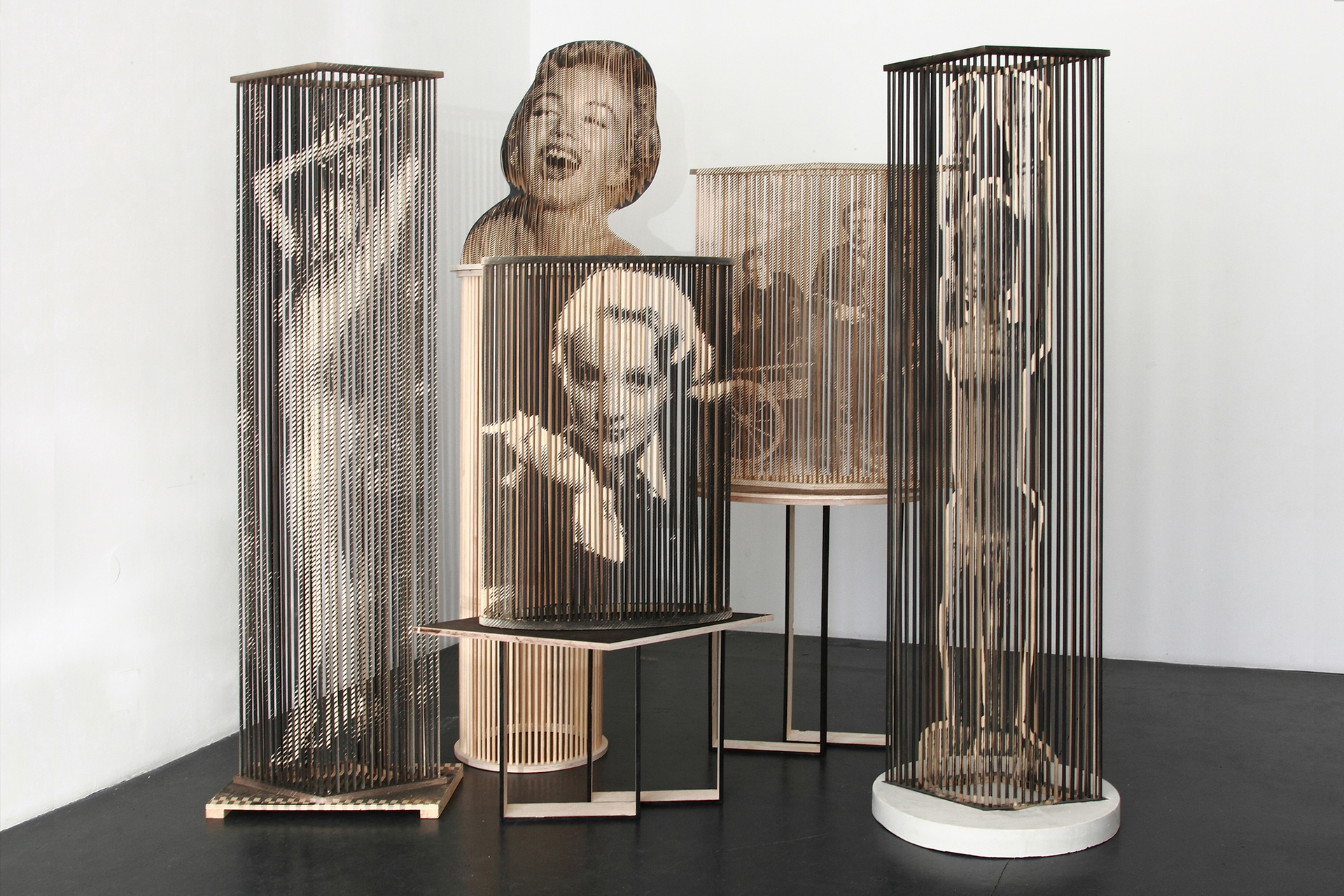
The images, that can be found in Ilse Haider’s sculptures are photos of people who have already appeared in a media context: portraits, historical paintings, autograph cards, and movie stills. They are stripped of their own historicity and integrated into a contemporary reference. The objects are the result of a complex creation process: the fractally broken images are subjected to a deconstruction process; they are quasi cut up, projected onto grids, rods, rattan, and amalgamated into a new structure. What we see is the memory of original images, seen through the artist’s innovative creative process and perceived through our visual movement in front of and with the object.

(translation: Lisa Rosenblatt) 

DE

“Desiring Images”

Ilse Haider ist eine Künstlerin, die mit ihrer eigenen künstlerischen Produktion auf vorhandene Bildwelten Bezug nimmt. Sie sieht sich im Bilderfundus der Kunstgeschichte und der Hollywood-Filme um, sie taucht ein in die Glamour-Magazine vergangener Dekaden, forscht nach Porträts von Berühmten und Schönen, von Stars und Intellektuellen, oder greift selbst zur Kamera. Sie lebt ihre Sehnsucht nach Bildern, vor allem nach solchen, in denen Poesie und Strahlkraft, aber auch Stärke und Authentizität zu orten sind.

Ihr künstlerisches Handeln ist aber nicht nur das Heben dieser Bild-Schätze aus der Unsichtbarkeit der Vergangenheit, sondern es unterzieht diese Primärbilder einem Umdeutungs- und Verwandlungsprozess, wobei die optische Präsenz und die skulpturale Dimension der Protagonisten eine fundamentale Rolle spielen. 

Ilse Haider setzt sich mit dem Vorgang des Sehens und Wahrnehmens auseinander: Das Bild von Wirklichkeit entsteht auf unserer Netzhaut im Auge; wir nehmen die Welt und ihre Bilder durch den Vorgang des Betrachtens und Schauens wahr, wir bewegen uns, um die Dinge genau und von allen Seiten wahrnehmen zu können. Somit gibt es nie nur eine Sichtweise oder nur einen Standpunkt: Die Objekte von Ilse Haider waren ursprünglich zweidimensionale Bilder und mutieren durch den Verarbeitungsprozess der Künstlerin zu dreidimensionalen, raumgreifenden Objekten, Reliefs, Skulpturen und Installationen, die der Betrachter umrunden, abschreiten muss.

Der Blick des Betrachters “entlarvt“ die Inhalte dieser Foto-Objekte: Das Entkleiden und Zur-Schau-Stellen sind auch Momente aus der Filmgeschichte, sind Attitüden von Modellen vor dem Künstler, von Leinwandstars vor der Kamera. Und es geht Ilse Haider dabei nicht allein um das Formulieren von Nacktheit im Sinne von Erotik oder Obszönität, sondern um die Konnotation der Nacktheit des Menschen mit dem Existenziellen: Adam und Eva als erstes Menschenpaar, der nackte Mann als der authentische Anblick eines selbstbewussten Individuums, unbekleidete Menschen als Wesen in ihrer unschuldigen Natürlichkeit.

Die Bilder, die sich in Ilse Haider’s Skulpturen wiederfinden, sind Fotografien von Personen, die im medialen Kontext schon einmal aufgetaucht sind: Porträts, historische Gemälde, Autogrammkarten, Filmstills. Sie werden ihrer eigenen Geschichtlichkeit entrissen und in einen aktuellen Gegenwartsbezug integriert. Die Objekte verdanken sich einem komplexen Entstehungsvorgang: Die fraktal gebrochenen Bilder werden einem Dekonstruktionsprozess unterzogen, sie werden gleichsam zerschnitten, auf Raster, Stäbe, Peddigrohr projiziert und zu einer neuen Struktur amalgamiert. Was wir sehen, ist die Erinnerung an originäre Bilder, gesehen durch den innovativen Schaffensprozess der Künstlerin und wahrgenommen durch unsere Sehbewegung vor und mit dem Objekt.

Continue reading

le circuit héroesque

Sabrina Steinek

EN

le circuit héroesque

With the exhibition le circuit héroesque at Galerie Steinek, Ilse Haider presents new works that are not only located at the interface of photography and sculpture, but also call for viewers’ peripatetic perception.  

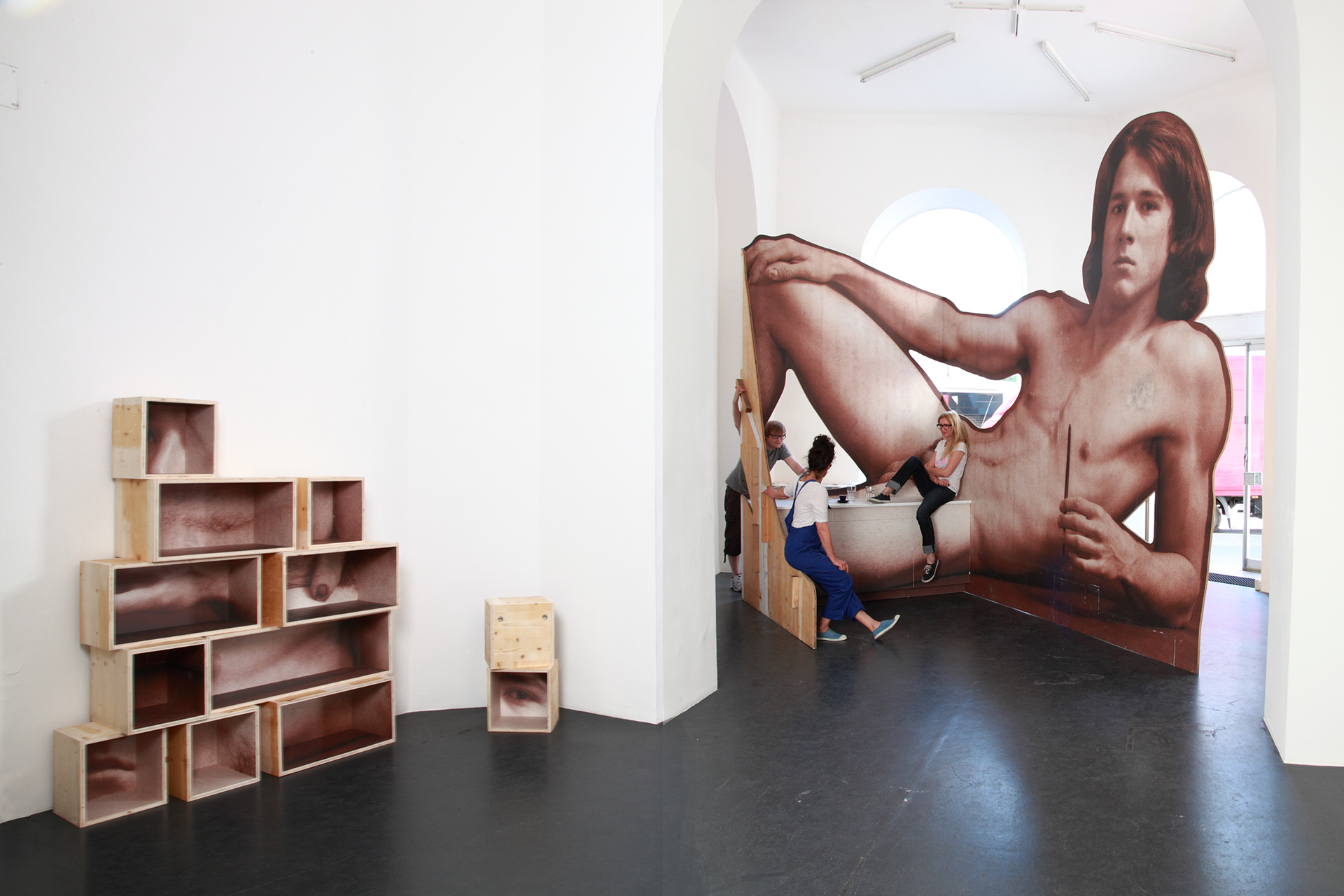
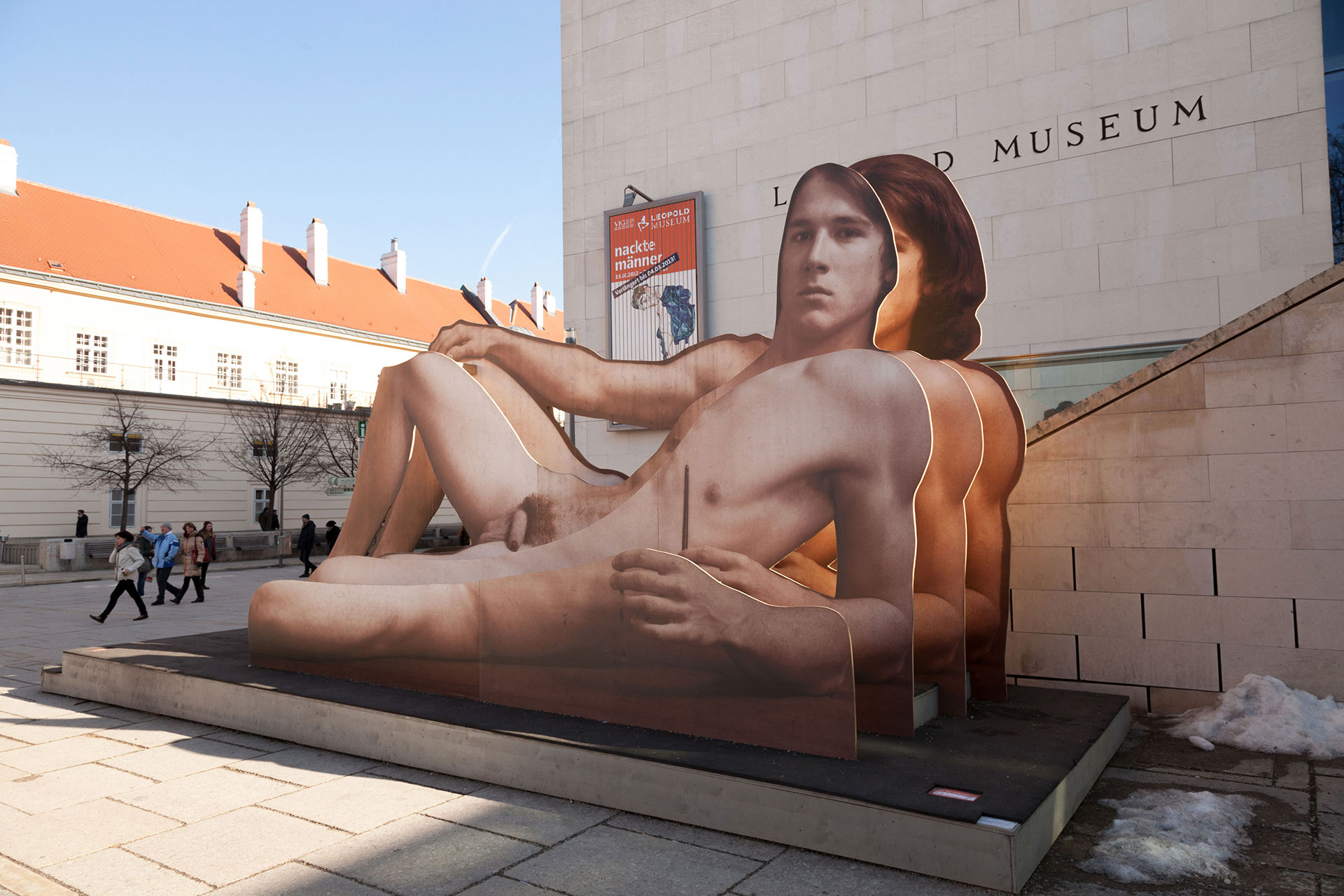
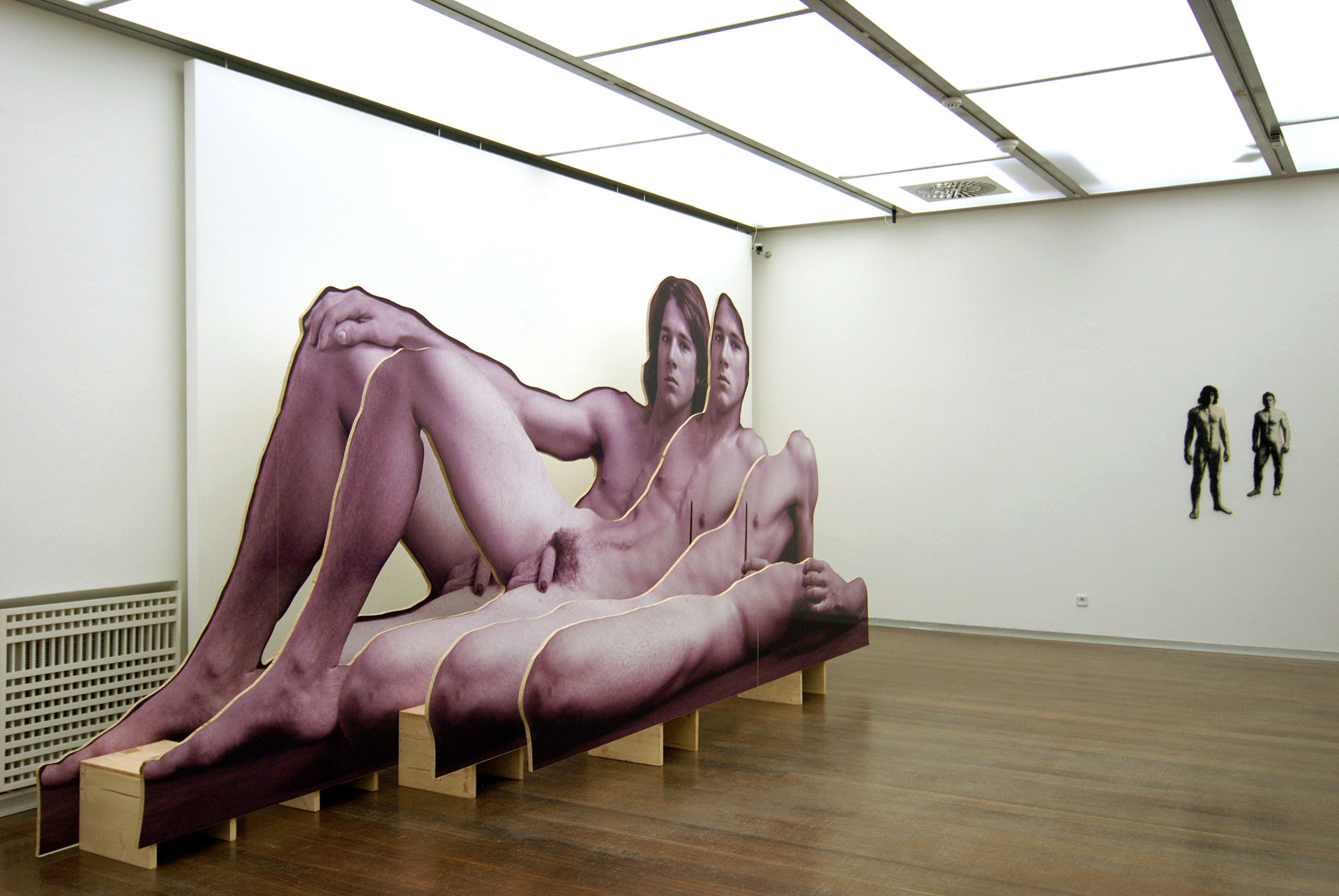
Something capable of generating moments of disturbance in public space is subjected to a significantly more shielded perception in the closed spaces of galleries and museums. The colossal, walk-in photo sculpture of a naked man became one of these objects of attention in autumn 2012: Mr. Big refers not only to the exhibition nackte männer at the Leopold Museum, but also becomes a paradigm of cultural constructions of identities and gender roles. The name itself cross-references a prime example of this construct of masculinity: Mr. Big, the utterly desirable character from Sex and the City, who is not only self-centered, but also appears consistently unapproachable. The monumentality elevates the sculpture to a topos of masculinity. But what happens when the work is robbed of its surfaces and its ostentation? How can a 900  x 300 x 420cm hulk be translated into the rather confining spaces of a gallery?

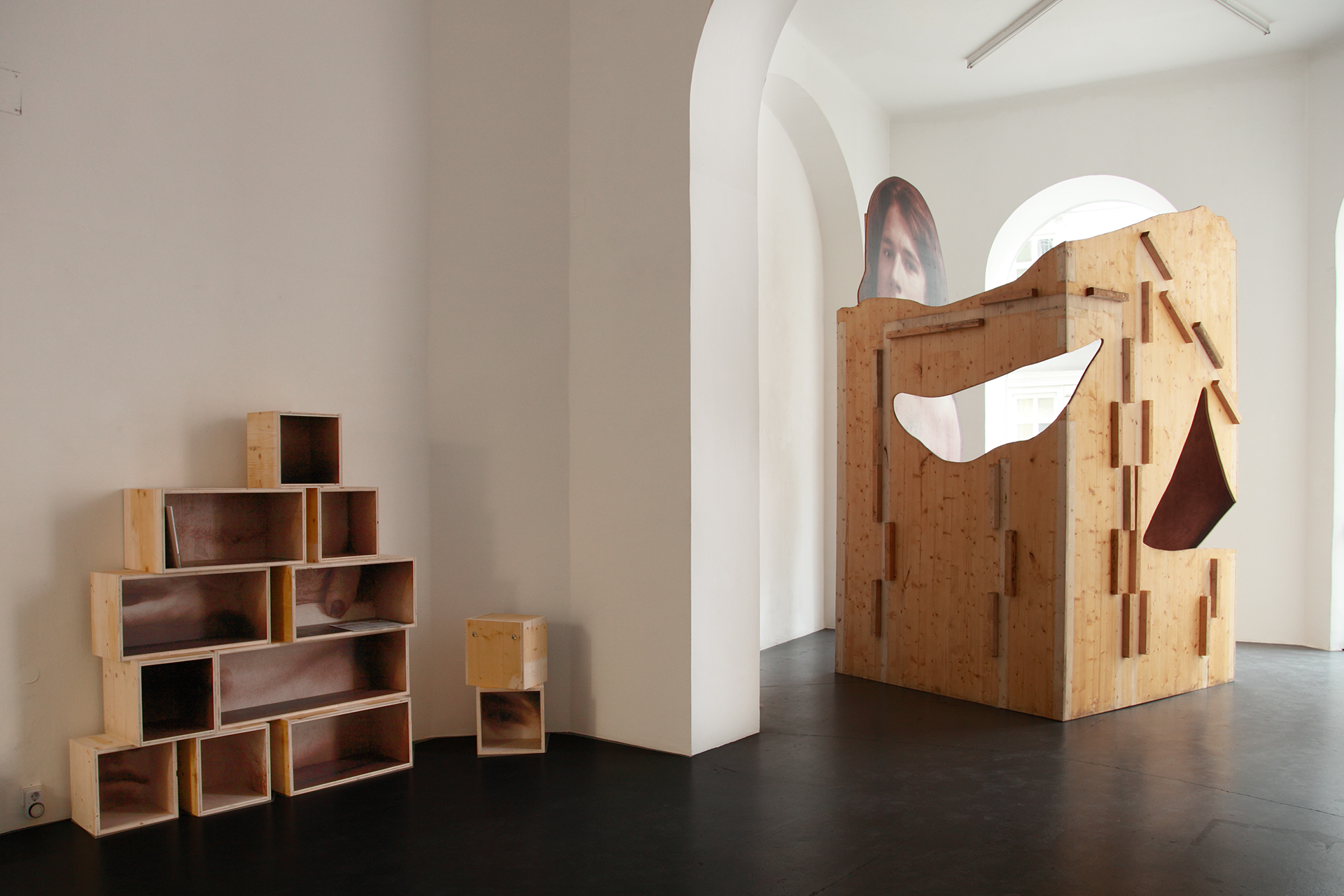
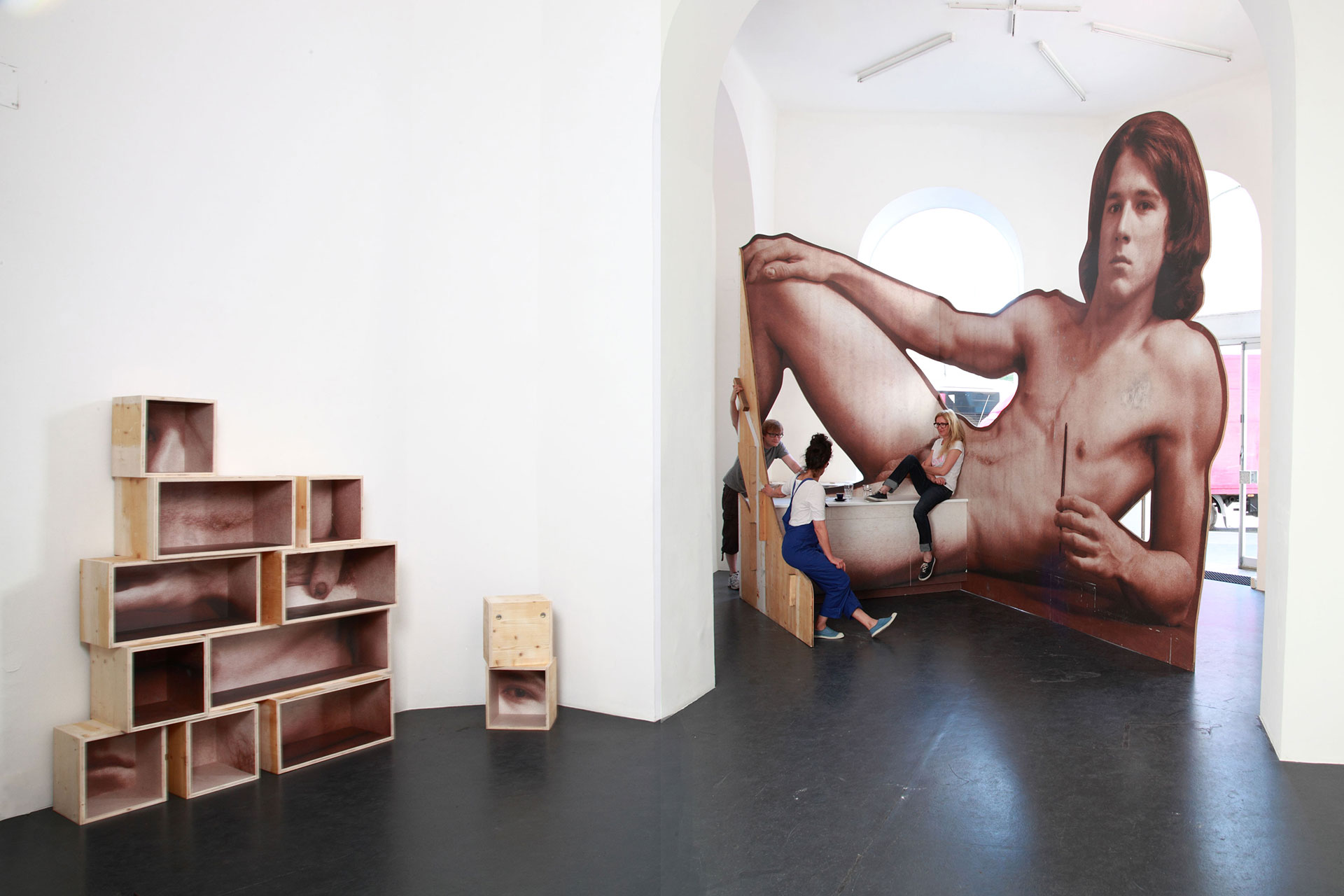
Ilse Haider submits her personal superhero Mr. Big to new ideas of standardization, which are not characterized by gender-specificity, but instead, are motivated by material, craftsmanship, and function. Mr. Big is dismantled and sawed into his individual parts in order to generate a new space within the space. The desirable thing thus becomes the basis and shell of a site of communication: the raw version of a kitchen. Haider leaves the functionality up to its future owner, so that a real use with equipment and further shelves is most definitely opportune. Some parts were permanently separated from Mr. Big, and placed elsewhere as shelves.

Mr. Big has been recycled.

Other heroes and heroines, who perhaps are not all characterized by heroic deeds, but have been extolled as icons of modernity or of the present, are also recycled in the exhibition. These are portraits of personalities who are multiply integrated into our era’s circulating images, have been frequently quoted, and nonetheless remain authentic: from Jeanne d’Arc to Marlene Dietrich through to Andy Warhol. Our society is inscribed with an ambivalence that is not only characterized by the desire for more authenticity, but simultaneously, records a  steady increase in idealizations. An ambivalence that Ilse Haider already referred to with Mr. Big, in that she criticized the cultural construction of masculinity.  “Le circuit héroesque” focuses on the return, the recycling of the heroic, of héroesque—a satirical art term developed by Haider—at the levels of form and also motif, and at the same time, refers to this existing ambivalence.

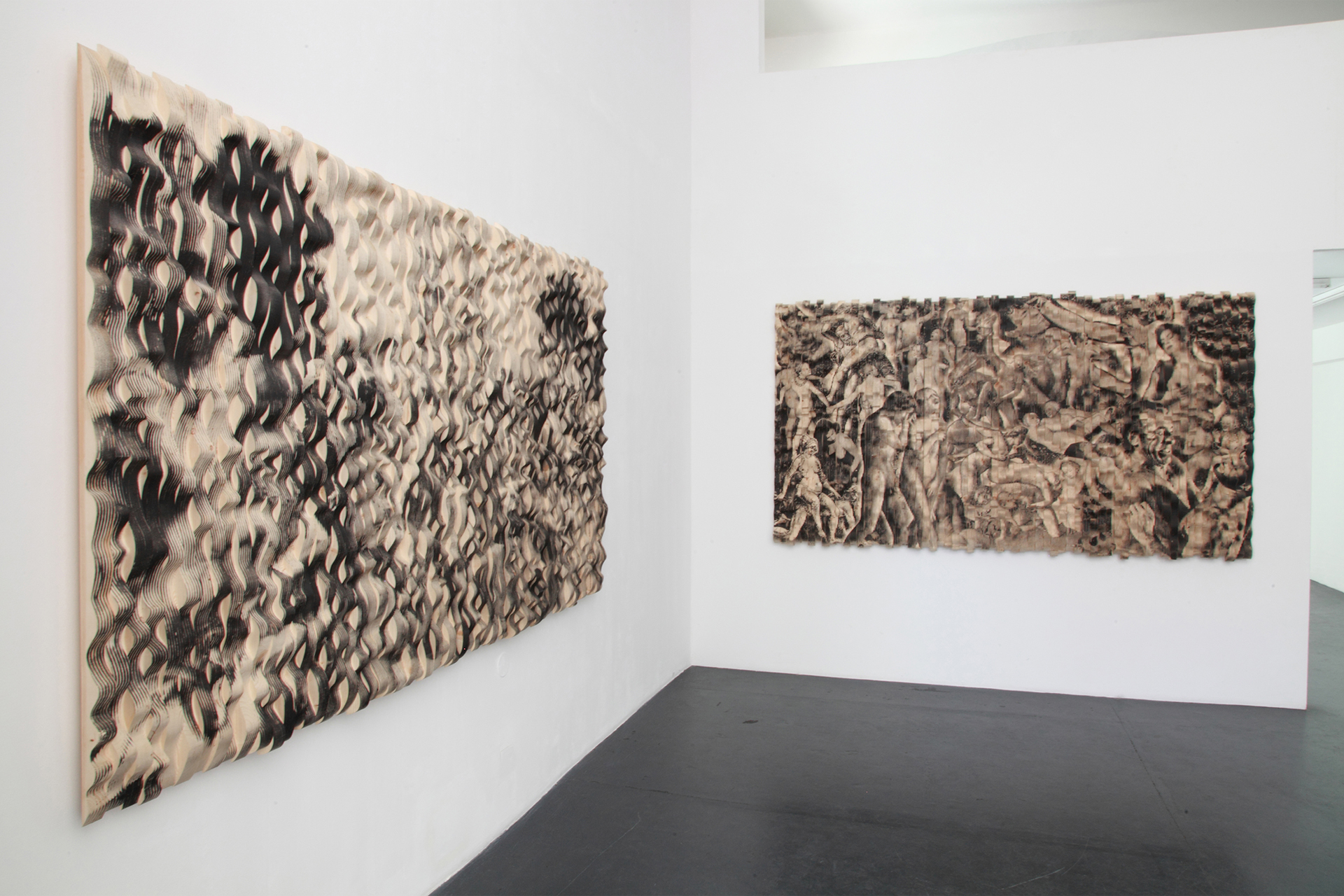
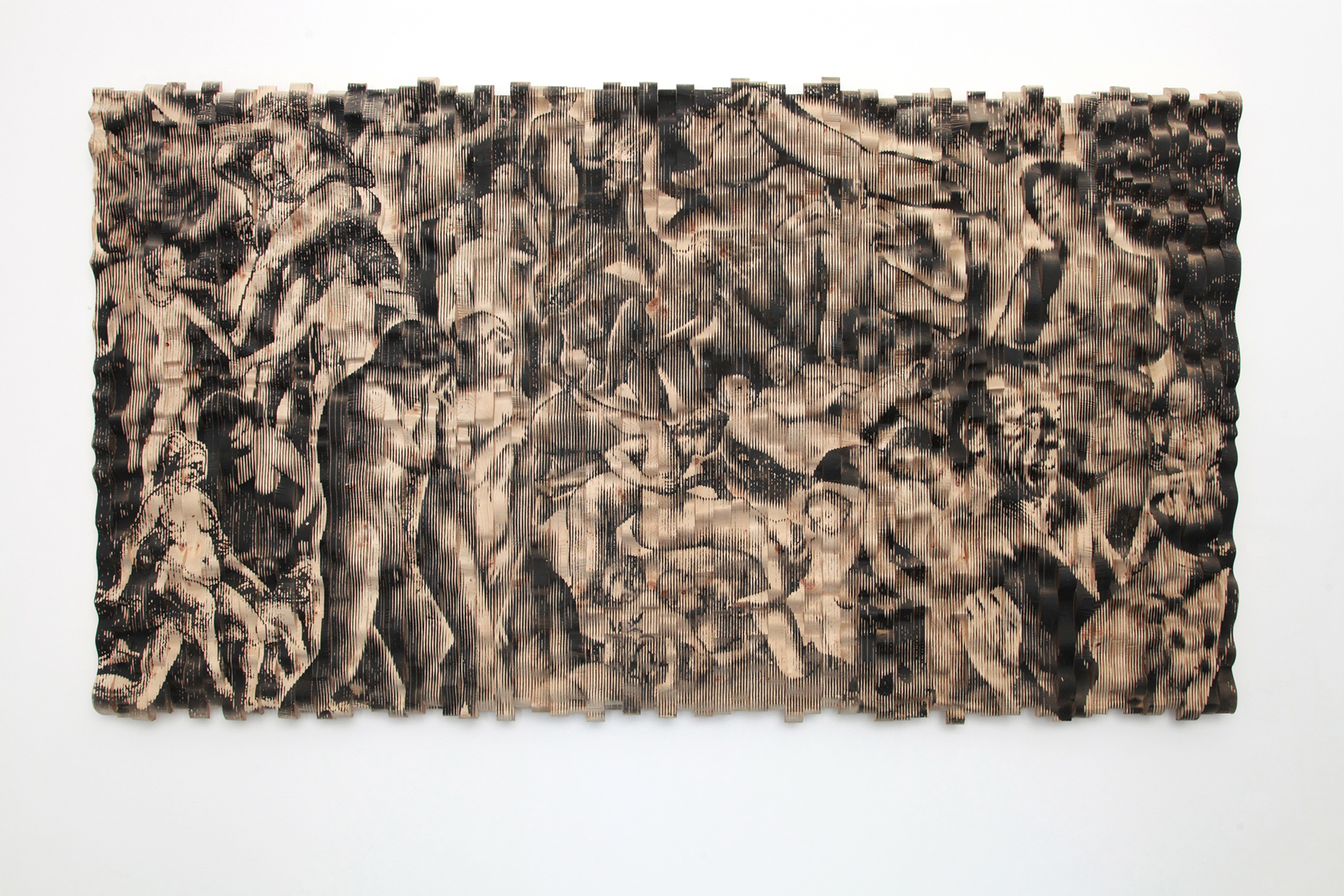
Nude scenes from art history become authentic motifs, coupled with idealizations from well-known glossy magazines. The translation of photography to sculpture takes place through the application of photo emulsion on wood. Indeed, Haider’s works are defined primarily through their surface structure: rattan, or—as in the most recent works—wavy, carved wood, seemingly huge woodcarvings. The base of the work with its structure, presents a challenge to the process of seeing, a play between clarity and ambiguity.  The photo sculptures cannot be grasped as a whole from any fixed standpoint, instead, they require a viewer who moves through the space: from left to right, from proximity to distance, or their combination. A peripatetic perception, through which the viewer is constantly in motion, the sculpture in permanent transformation, and at times the motif and other times the structure of the work exposed.  

The wavy structure of the work points to the return hinted at in the title: the circuit of waves knows no beginning and no end, and thereby practically becomes a héroesque element of the works. In the same manner as columns, which as architectural elements, are closely tied to the concept of idealization and in the exhibition are also furnished with authentic portraits.

(translation: Lisa Rosenblatt)

DE

le circuit héroesque

Ilse Haider präsentiert mit der Ausstellung le circuit héroesque in der Galerie Steinek neue Arbeiten, die sich nicht nur an der Schnittstelle zwischen Fotografie und Skulptur ansiedeln, sondern die peripatetische Wahrnehmung des Betrachters einfordern.    

Was im öffentlichen Raum Momente der Irritation zu generieren vermag, unterwirft sich in den geschlossenen Räumlichkeiten von Galerien und Museen einer wesentlich geschützteren Wahrnehmung. Die überdimensionale, begehbare Fotoskulptur eines nackten Mannes wurde im Herbst 2012 zu einem solchen Objekt der Aufmerksamkeit: Mr. Big verwies nicht nur auf die Ausstellung nackte männer im Museum Leopold, sondern wurde zu einem Paradigma kultureller Konstruktionen von Identitäten und Geschlechterrollen. Der Name selbst referiert dabei auf ein Paradebeispiel jener Männlichkeitskonstruktion: Mr. Big, der überaus begehrenswerte Charakter aus Sex and the City, der nicht nur selbstbezogen sondern stets unnahbar erscheint. Das Überdimensionale erhebt die Skulptur zu einem Topos der Männlichkeit. Doch was passiert, wenn man die Arbeit um ihre Fläche und ihre Zurschaustellung beraubt? Wie funktioniert die Übersetzung eines 900  x 300 x 420 cm Kolosses in die doch eher begrenzenden Räumlichkeiten einer Galerie?

Ilse Haider unterwirft ihren persönlichen Superhelden Mr. Big neuen Normierungsvorstellungen, die sich nicht durch eben jene Geschlechtsspezifität charakterisieren, sondern materiell, handwerklich und funktional motiviert sind. Mr. Big wird in seine Einzelteile zerlegt und zersägt, um im Raum einen neuen Raum zu genieren. Das Begehrenswerte wird damit zur Basis und Hülle eines Ortes der Kommunikation: Die Rohversion einer Küche. Die Funktionalität überlässt Haider ihrem künftigen Besitzer, sodass eine reale Nutzung mit Geräten und weiteren Regalen durchaus wünschenswert ist. Einige Teile werden von Mr. Big permanent separiert, finden als Regale einen Platz woanders.

Mr. Big wurde recycelt.

Recycelt werden in der Ausstellung auch andere Heldinnen und Helden, die sich vielleicht nicht alle durch heldenhafte Taten per se charakterisieren, doch zu Ikonen der Moderne oder Gegenwart erhoben wurden. Es sind Porträts von Persönlichkeiten, die vielfach im Bildkreislauf unserer Zeit eingebunden sind, vielfach zitiert werden, und dennoch authentisch sind: Von Jeanne d’Arc über Marlene Dietrich bis hin zu Andy Warhol. Tatsächlich ist unserer Gesellschaft eine Ambivalenz eingeschrieben, die sich nicht nur durch den Wunsch nach mehr Authentizität charakterisiert, sondern zeitgleich eine stetige Zunahme an Idealisierungen verzeichnet. Eine Ambivalenz, auf die Ilse Haider mit ihrem Mr. Big bereits verwies, indem sie die kulturelle Konstruktion der Männlichkeit kritisierte. “Le circuit héroesque“ thematisiert die Widerkehr, das Recycling des Heroischen, des héroesquen – ein von Haider entwickelter, persiflierender Kunstbegriff – auf formaler wie auch motivischer Ebene und verweist zeitgleich auf diese gegenwärtige Ambivalenz.

Nacktszenen aus der Kunstgeschichte werden zum authentischen Motiv, gepaart mit Idealisierungen aus bekannten Hochglanzmagazinen. Die Übersetzung der Fotografie in die Skulptur erfolgt durch das Auftragen von Fotoemulsion auf Holz. Doch definieren sich die Arbeiten von Haider vor allem durch ihre Oberflächenstruktur: Peddigrohr oder – wie in den neuesten Arbeiten – wellenartig geschnitztes Holz, scheinbar überdimensionale Holzschnitte. Der Grund der Arbeit mit seiner Struktur wird zu einer Herausforderung des Sehvorganges, zu einem Spiel zwischen Eindeutig- und Zweideutigkeit. Die Fotoskulpturen lassen sich von keinem fixierten Standpunkt aus als Ganzes erfassen, vielmehr erfordern sie einen Betrachter, der sich durch den Raum bewegt: Von links nach rechts, von Nähe zu Distanz, oder in deren Kombination. Eine peripatetische Wahrnehmung, durch die der Betrachter sich ständig in Bewegung befindet, die Skulptur sich permanent verändert, mal das Motiv an sich und mal die Struktur der Arbeit freigelegt wird.

Die wellenartige Struktur der Arbeiten verweist auf die im Titel angedeutete Wiederkehr; der Kreislauf der Wellen kennt keinen Anfang und kein Ende, wird damit selbst fast schon zu einem héroesquen Element der Arbeiten. Ebenso wie Säulen, die als architektonisches Element stark an den Begriff der Idealisierung gebunden sind und in der Ausstellung selbst mit authentischen Porträts versehen werden.

Continue reading

le circuit héroesque

  • Open Monuments

    Josephine, 2015, Marilyn, 2014, Marlene, 2013, Lou, Paul and Friedrich, 2015, Raised Arms, 2014

    Photographic emulsion on wood

    photo credits: ©Ilse Haider

    > press release

  • Open Monuments

    Balad of Mankind, 2014, Scéne Héroesque, 2015

    Photographic emulsion on wood

    photo credits: ©Ilse Haider

    > press release

  • Open Monuments

    The Pleasure of Art, its Spectators and Creators, 2014, Ballad of Mankind, 2014

    Photographic emulsion on wood

    photo credits: ©Ilse Haider

    >press release

  • Open Monuments

    The Pleasure of Art, its Spectators and Creators, 2014

    155 x 270 x 10cm, photographic emulsion on wood

    photo credits: ©Ilse Haider

    > press release

  • Open Monuments

    The Pleasure of Art, its Spectators and Creators, 2014, Balad of Mankind, 2014

    Photographic emulsion on wood

    photo credits: ©Ilse Haider

    > press release

  • Open Monuments

    Balad of Mankind, 2014

    155 x 270 x 10cm, photographic emulsion on wood

    photo credits: ©Ilse Haider

    > press release

  • Open Monuments

    Mr. Big refurnished, 2015

    Shelfs, kitchen: 4,2 x 2 x 2m, digital print on wood

    photo credits: ©Ilse Haider

    > press release

  • Open Monuments

    Mr. Big refurnished, 2015

    Shelfs, kitchen: 4,2 x 2 x 2m, digital print on wood

    photo credits: ©Ilse Haider

    > press release

Continue reading

The nude body

Herbert Schnepf

CV

Herbert Schnepf

(*1979 in der Steiermark/Ö, lebt und arbeitet in Wien) studierte Theater- und Filmwissenschaft/ Kunstsoziologie in Wien und Paris/ Nanterre. Anschließend Assistenz und Öffentlichkeitsarbeit für Filmfestivals, Filmproduktionen, Galerien und Künstler*innen; daneben im Sozialbereich u.a. als Trainer für Deutsch als Fremdsprache in Strafanstalten und Kunstakademien und in der Flüchtlingsbetreuung tätig. Arbeitet derzeit im Projektmanagement einer sozialen NGO und absolviert eine Ausbildung zum Psychotherapeuten. 

EN

Featuring the Unknown Author

Diary Collage from Media, 1945-1976, Video 2013 (12 min)

During the German postwar era the undressed Hildegard Knef in The Sinner succeeded in becoming the trigger for the moral outrage of a nation that saw itself as morally corrupt. This is also the time when a different kind of archive comes into existence that is processed in Ilse Haider’s video Featuring the Unknown Author: The Nude Body in Scrapbooks 1945 – 1976. More than 200 exercise books collaged with clippings from newspapers and movie magazines provide an overview of movie- and TV-stars of that era. Increasingly pornographic, the notebooks turned into an archive of media images of nudity. Ilse Haider acquired the notebooks at the flea market. The identity of the former owner remains in the dark. It can only be assumed that the person was a man. The exposition of these notebooks in the video also refers to their function as an archive of images and the primary material for the artist’s work.

(translation: Lisa Rosenblatt)

DE

Featuring the Unknown Author

Tagebuch-Collage aus Medien, 1945-1976, Video 2013 (12 min)

In der deutschen Nachkriegszeit konnte die unverhüllte Hildegard Knef in Die Sünderin zum Aufhänger für die moralische Entrüstung einer Nation werden, die sich selbst moralisch korrumpiert sah. In dieser Zeit setzt auch ein Bildarchiv ganz anderer Art ein, das im Video Ilse Haider Featuring the Unknown Author: The Nude Body in Scrapbooks 1945 – 1976 aufgearbeitet ist. Über 200 Schulhefte, collagiert mit Ausschnitten aus Zeitungen und Filmzeitschriften geben einen Überblick über die Film- und Fernsehstars der Zeit und wurden, zunehmend pornographisch, zu einem Archiv medialer Bilder von Nacktheit. Die Hefte sind am Flohmarkt in den Besitz Ilse Haiders gelangt; wer der Urheber dieser Sammlung ist, bleibt im Dunklen. Dass diese Person selbst ein Mann war, kann nur vermutet werden. Das Ausstellen dieser Hefte im Video stellt auch eine Referenz auf ihre Funktion als Bildarchiv und Ausgangsmaterial für die Arbeit der Künstlerin dar.

Continue reading

facebook_NS_revue and Crazy at any price!

Ernestine Bennersdorfer, Herbert Schnepf

CV

CV Ernestine Bennersdorfer

CV Herbert Schnepf

EN

facebook_NS_revue and Crazy at any price!

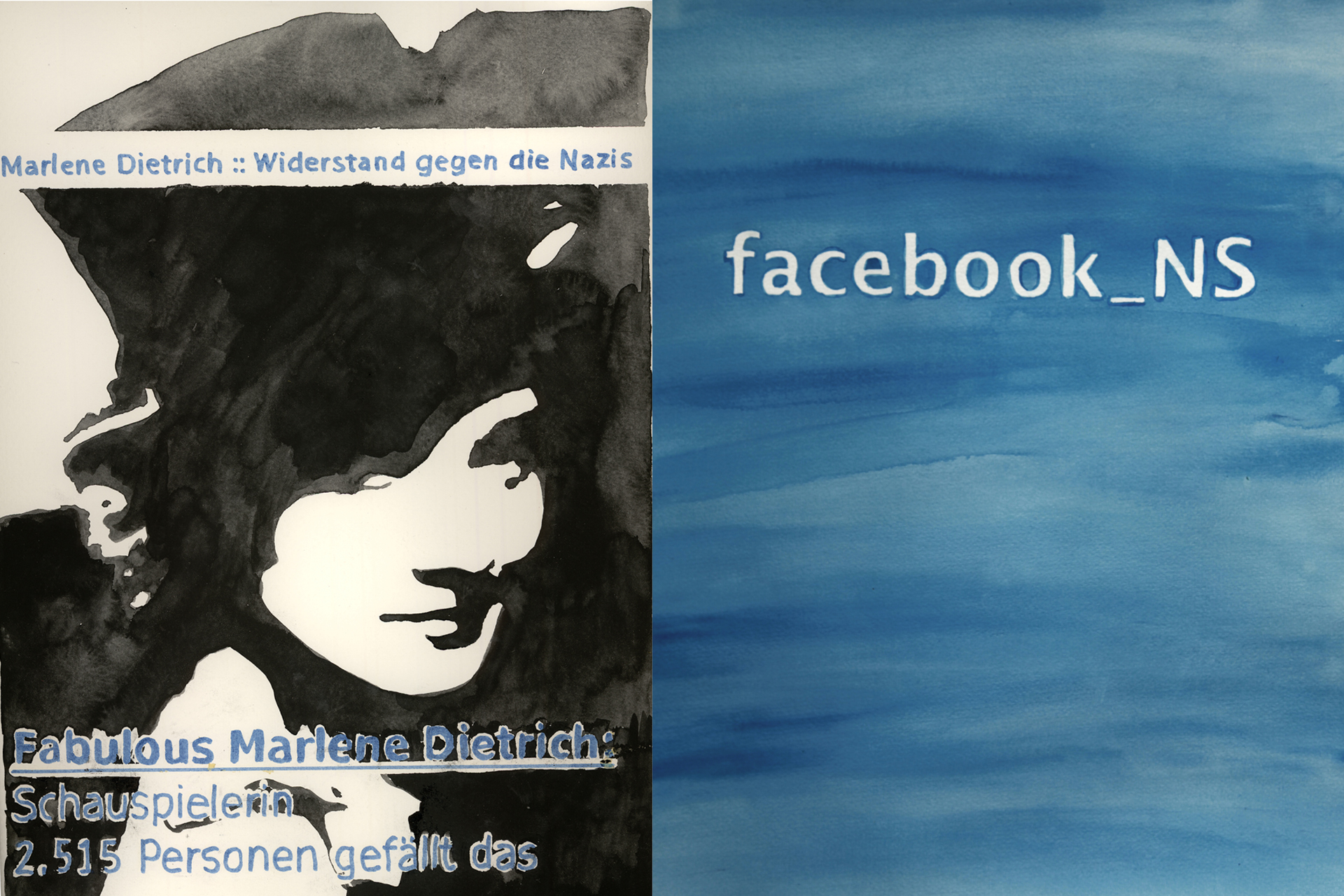
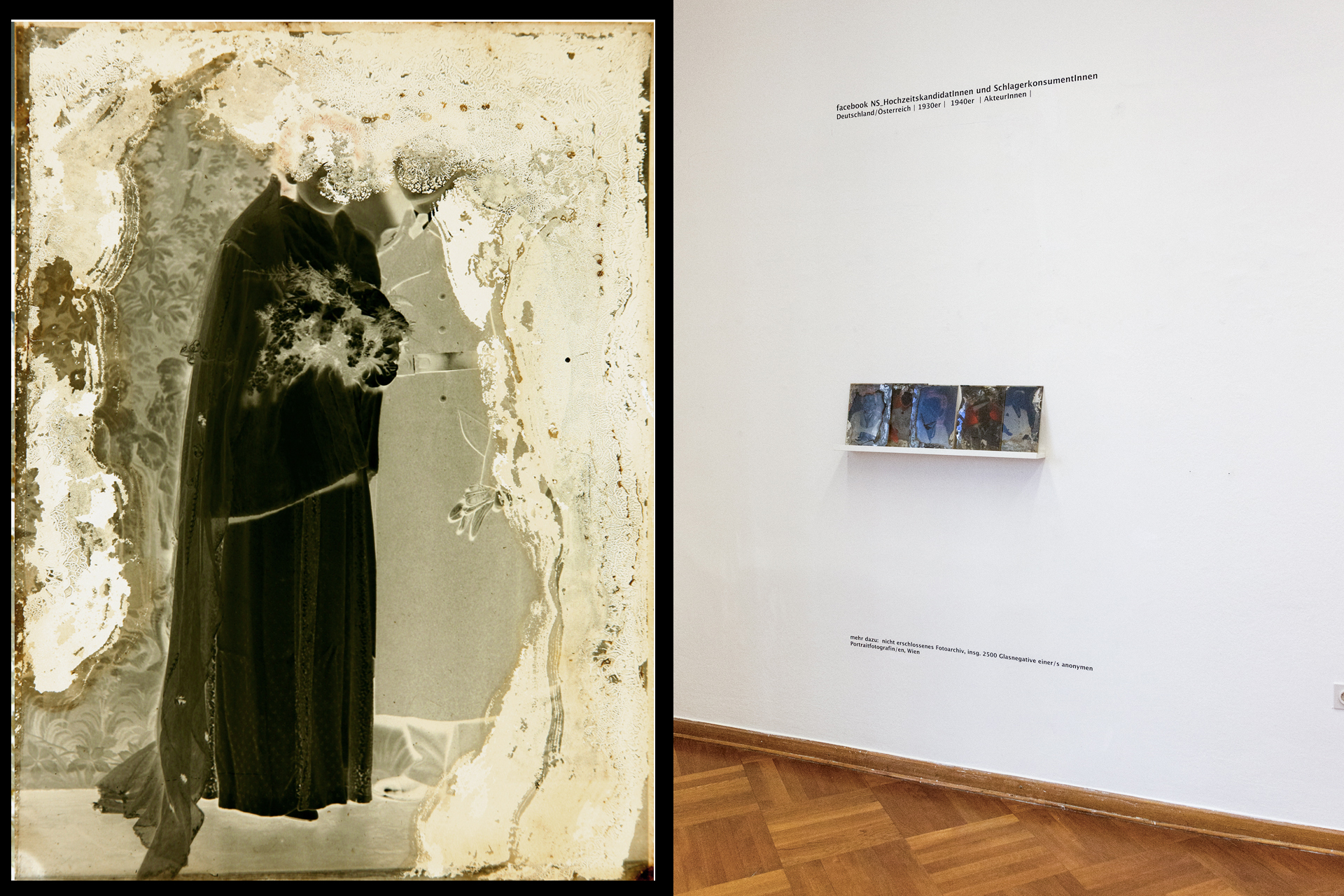
(…) Haider uses the Facebook matrix to connect the public with the private and refers to available knowledge about connections between the public actors of the time. Well-known Nazi celebrities presented themselves in public as virtuous statesmen and heads of families; awaiting them in private were secret lovers, sumptuous additions to their homes, and shared evenings watching American movies; Hitler steadfastly refused to pay taxes. These private details show the unjust state from its most banal side and mercilessly disenchant it.

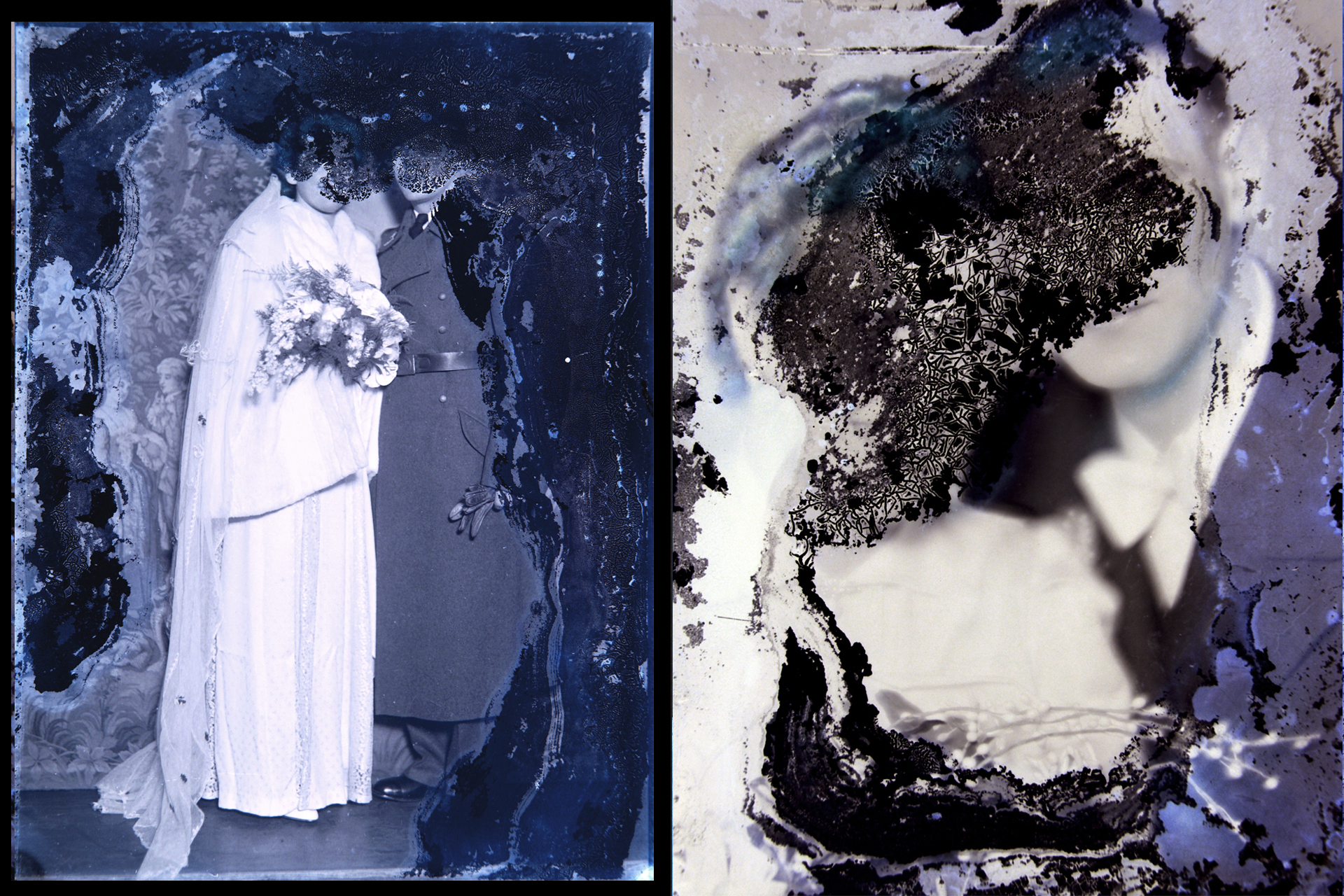
The mixing of the private and the political recurs in the video facebook_NS_revue with Wehrmacht uniforms in wedding photos. Here, however, the political seems rather inappropriate, even though the private remains completely unclear and browsing through the photographs degenerates into sifting. Unavoidably ordered by formalities, the archive has to be clicked through in front of the viewer’s eyes, to the beat of a rhythmic sound that could also be a trigger.

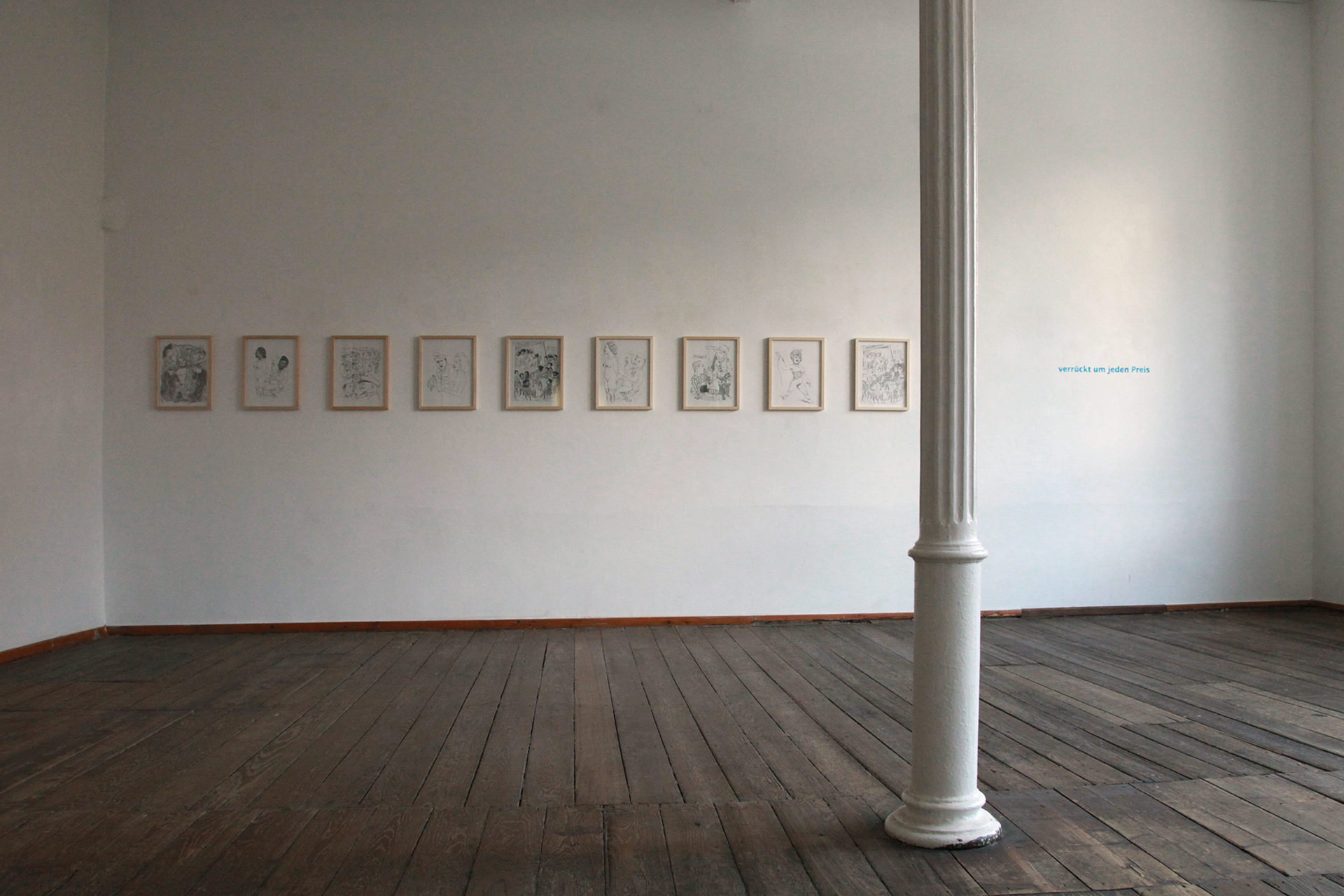
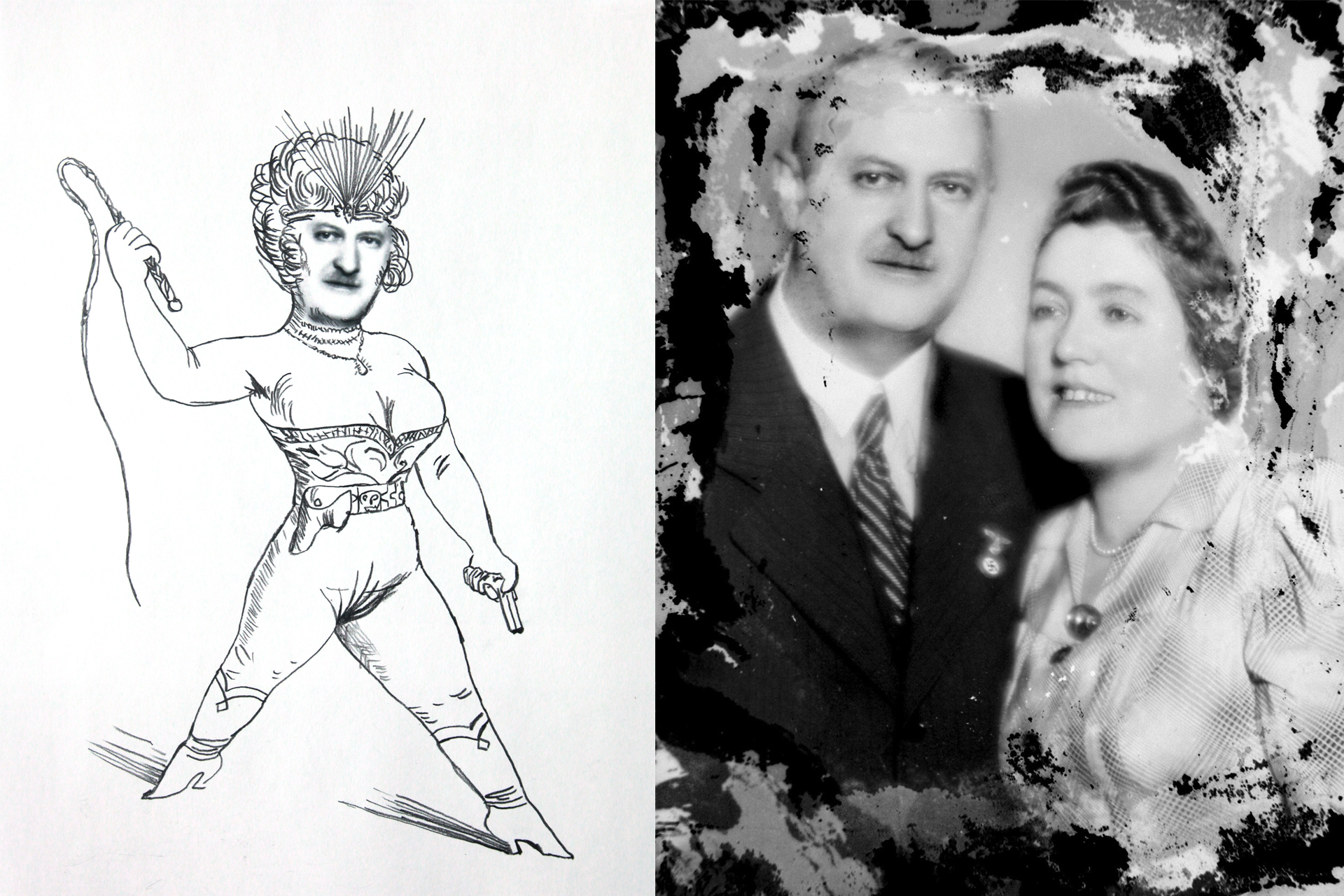
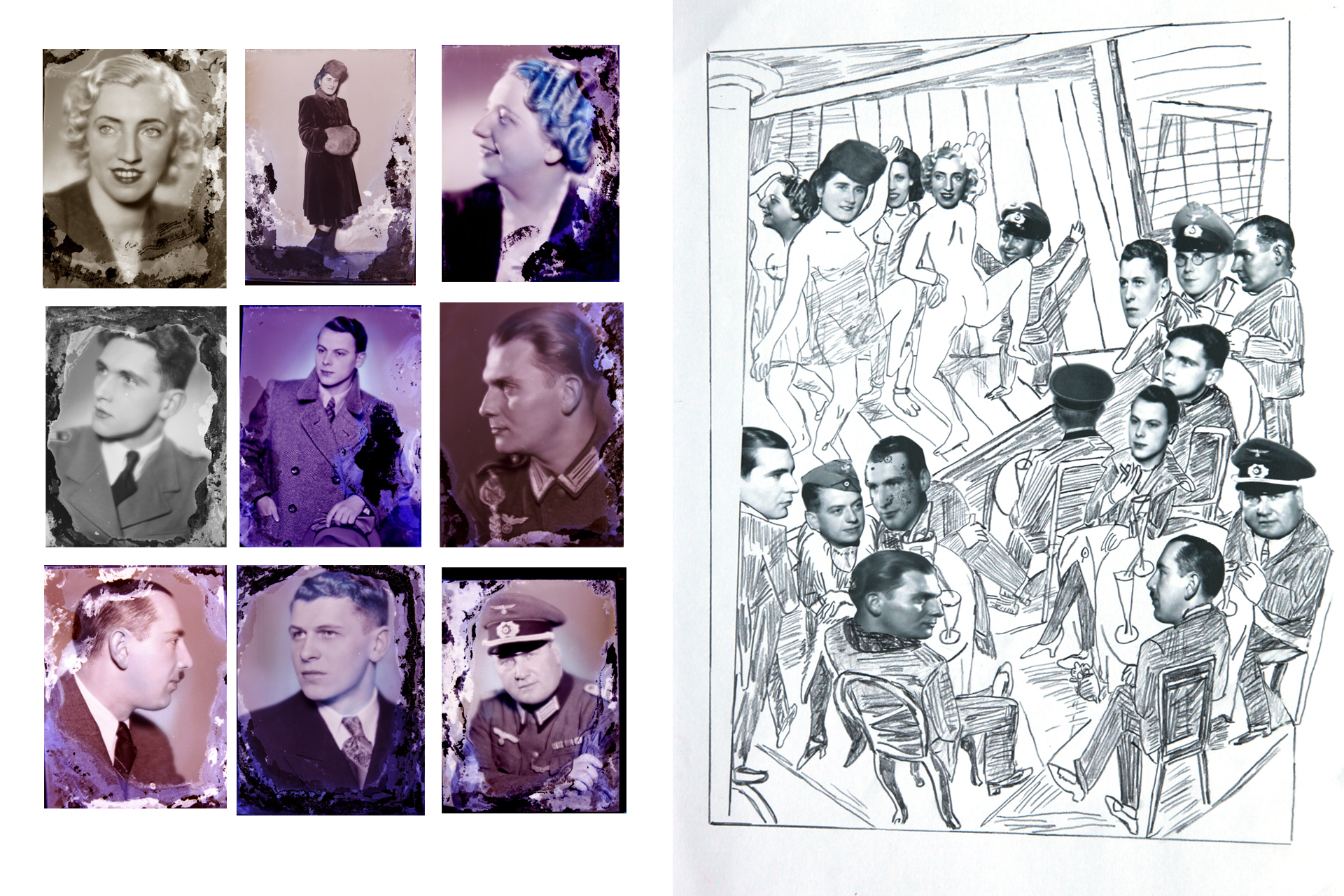
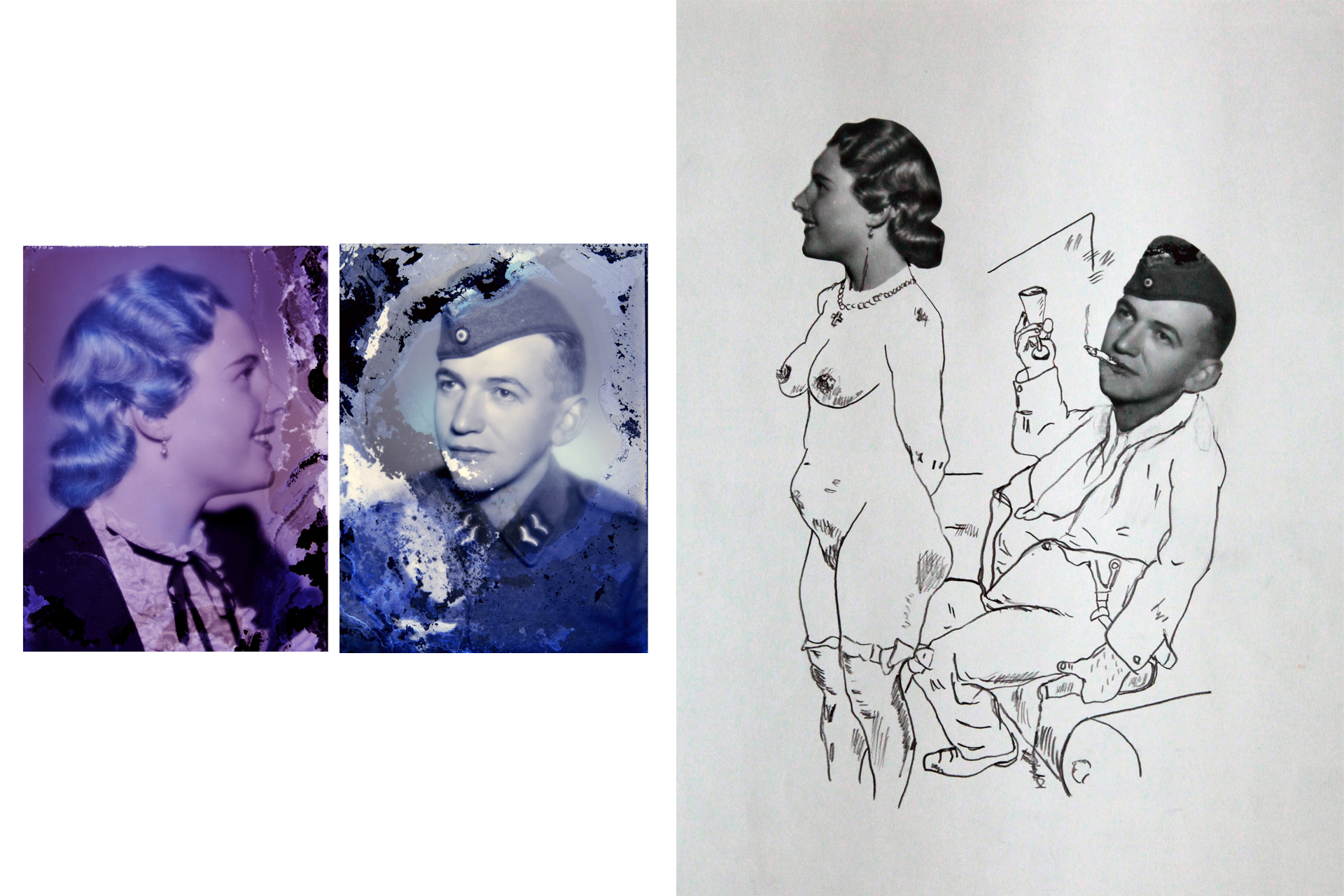
In the final part of the installation, the artist slips into the role of the “media perpetrator” in order to suggest the possibilities of playing with differences in perception (self-image versus how one is perceived by others), world view, and participation. Haider transfers individuals and groups captured in the glass negatives into drawings. Her selection is arbitrary. She juxtaposes the drawings with montages, emphasizing their montage and construction character.

“Crazy at any price!” is written in painted lettering next to the ensemble, quoting the title of a group of pictures from the Nazi exhibition “Degenerate Art” (1937) in Munich. Here, too, Haider arbitrarily chooses the subjects for her montages, which she takes from the “Degenerate Art” catalogue, reproduces as drawings, and combines with portraits of actors from the glass plate archive. She combines the offbeat, the libidinous, thematized by artists such as George Grosz and Max Beckmann and arbitrarily vilified by the Nazis, with the portraits of individuals who stand for the anonymous masses. The artist randomly picks out the faces on the montages and neatly assigns them to the original portraits. The absurdity of such an act is mixed with a certain comedy and the accuracy of a representation that quasi portrays the unconscious character of a social order in which everything is meant to be pure and virtuous.

By taking up “medial arbitrariness” in a double function, namely, as a tool for her work and a public event—the idealized photo is juxtaposed with an obviously constructed external image—the link between “Facebook” and “NS” is produced as interpretational and associational leeway.

(translation: Lisa Rosenblatt)

DE

facebook_NS_revue und Verrückt um jeden Preis!

(…) Die Matrix facebook benutzt Haider dazu, das Öffentliche mit dem Privaten zu verbinden und verweist auf das zur Verfügung stehende Wissen über die Verbindungen zwischen den öffentlichen Akteuren der damaligen Zeit. Bekannte Nazigrößen zeigten sich in der Öffentlichkeit als tugendhafte Staatsmänner und Familienoberhäupter, im Privaten warteten die heimlich Geliebten, prunkhafte Ausbauten ihrer Domizile und gemeinsame Abende vor amerikanischem Kino; Hitler weigerte sich standhaft Steuern zu bezahlen. Solche privaten Details zeigen den Unrechtsstaat von seiner banalsten Seite und entzaubern ihn gnadenlos.

Das Vermischen von Privatem und Politischem kehrt im Video facebook_NS_revue mit Wehrmachtsuniformen auf Hochzeitsfotos wieder. Hier aber nimmt sich das Politische reichlich unpassend aus, wenngleich das Private völlig unklar bleibt, das Durchblättern zum Sichten verkommt. Notgedrungen geordnet nach Äußerlichkeiten muss das Archiv vor den Augen der Betrachter durchgeklickt werden; im Takt eines rhythmischen Geräuschs, das auch ein Auslöser sein könnte.

Im letzten Teil der Installation schlüpft die Künstlerin in die Rolle der “medialen Täterin”, um die Spielmöglichkeiten mit Unterschieden in Wahrnehmung (Selbstbild versus Fremdbild), Weltsicht und Partizipation anzudeuten. Haider führt einzelne, von den in den Glasnegativen gebannten Individuen oder Gruppen in Zeichnungen über. Ihre Auswahl ist beliebig. Den Zeichnungen stellt sie Bildmontagen gegenüber, deren Montage- und Konstruktions-Charakter sie hervorstreicht.

“Verrückt um jeden Preis!” steht als gemalte Schrift neben dem Ensemble, Zitat des Titels einer Bildgruppe aus der NS-Ausstellung “Entartete Kunst” (1937) in München. Willkürlich wählt Haider auch hier die Ausgangssujets für ihre Bildmontagen, die sie dem Katalog von “Entartete Kunst” entnimmt, sie als Zeichnungen reproduziert und mit den Portraits von Akteuren aus dem Glasplattenarchiv kombiniert. Das Abseitige, Triebhafte, das von Künstlern wie George Grosz und Max Beckmann thematisiert und von den Nazis willkürlich diffamiert wurde, verbindet sie mit den Portraits von Individuen, die für eine anonyme Masse stehen. Wahllos herausgegriffen weist die Künstlerin die Gesichter auf den Montagen feinsäuberlich den Original-Portraits zu. Die Absurdität eines solchen Akts vermischt sich mit einer gewissen Komik und der Trefflichkeit einer Darstellung, die gleichsam den unbewussten Charakter einer Gesellschaftsordnung portraitiert, bei der alles rein und tugendhaft sein sollte.

Indem sie “mediale Willkür” in einer doppelten Funktion aufgreift, nämlich als Werkzeug ihrer Arbeit und öffentliches Ereignis – dem idealisierten Foto wird ein offensichtlich konstruiertes Fremdbild gegenübergestellt -, wird der Link zwischen “facebook” und “NS” als Interpretations- und Assoziationsspielraum hergestellt.

Continue reading

facebook_Ns

FACEBOOK_NS

MUSEUMSPAVILLION SALZBURG, 2011 / KUNSTVEREIN ASCHAFFENBURG, 2013

  • Open Monuments

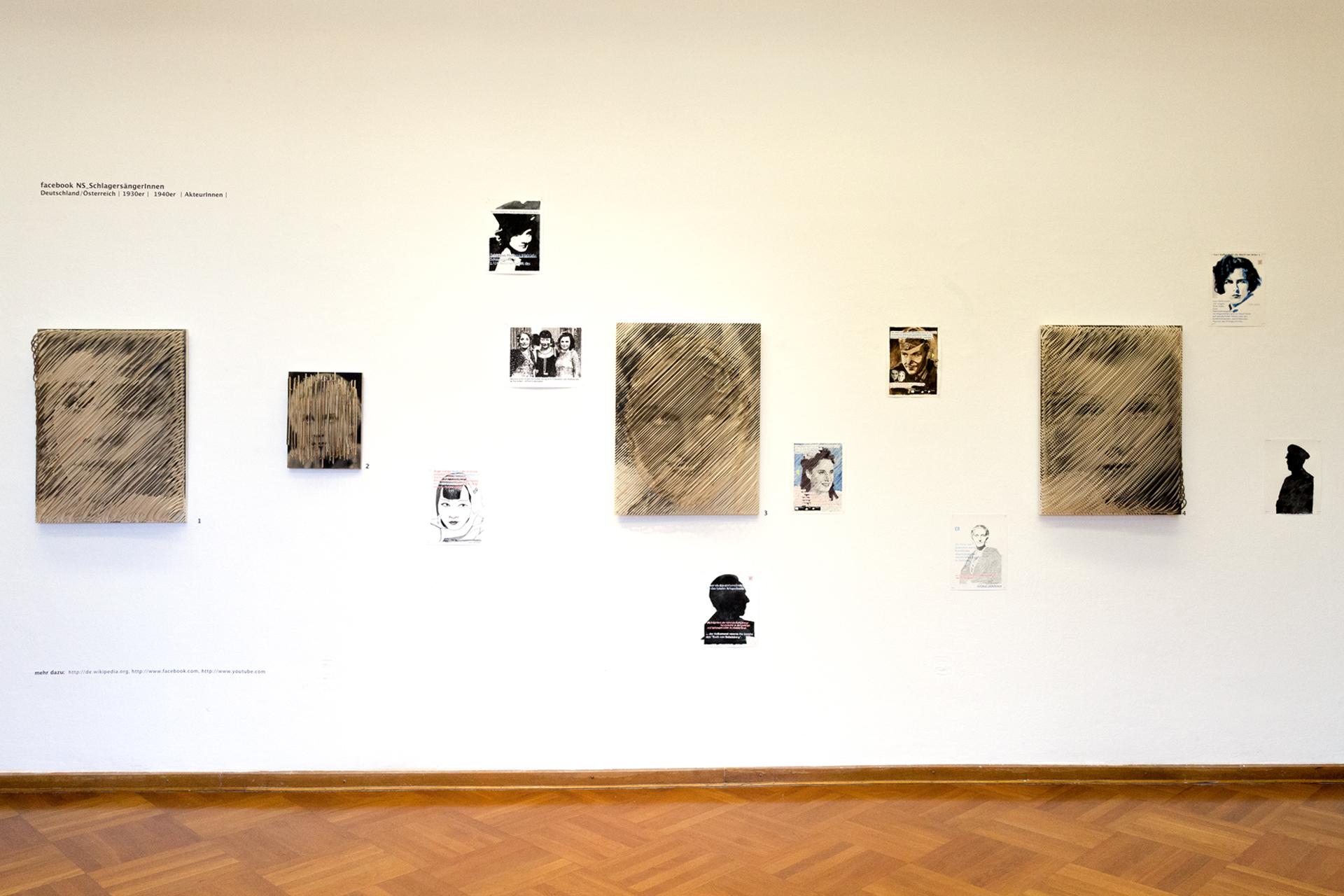
    facebook_NS_actors_hit singers / Marlene Dietrich, 2011

    32 x 24cm, watercolour

    > press release I

  • facebook_NS_Schlager Singers, 2011

    Exhibition view: facebook_NS_hit singers _cloud / Fritzi Massary, Renate Müller, Gitta Alpàr, Lilian Harvey, 2011

    Photographic emulsion on wood, watercolour and marker on paper

    photo credits: ©Ilse Haider

    > press release I

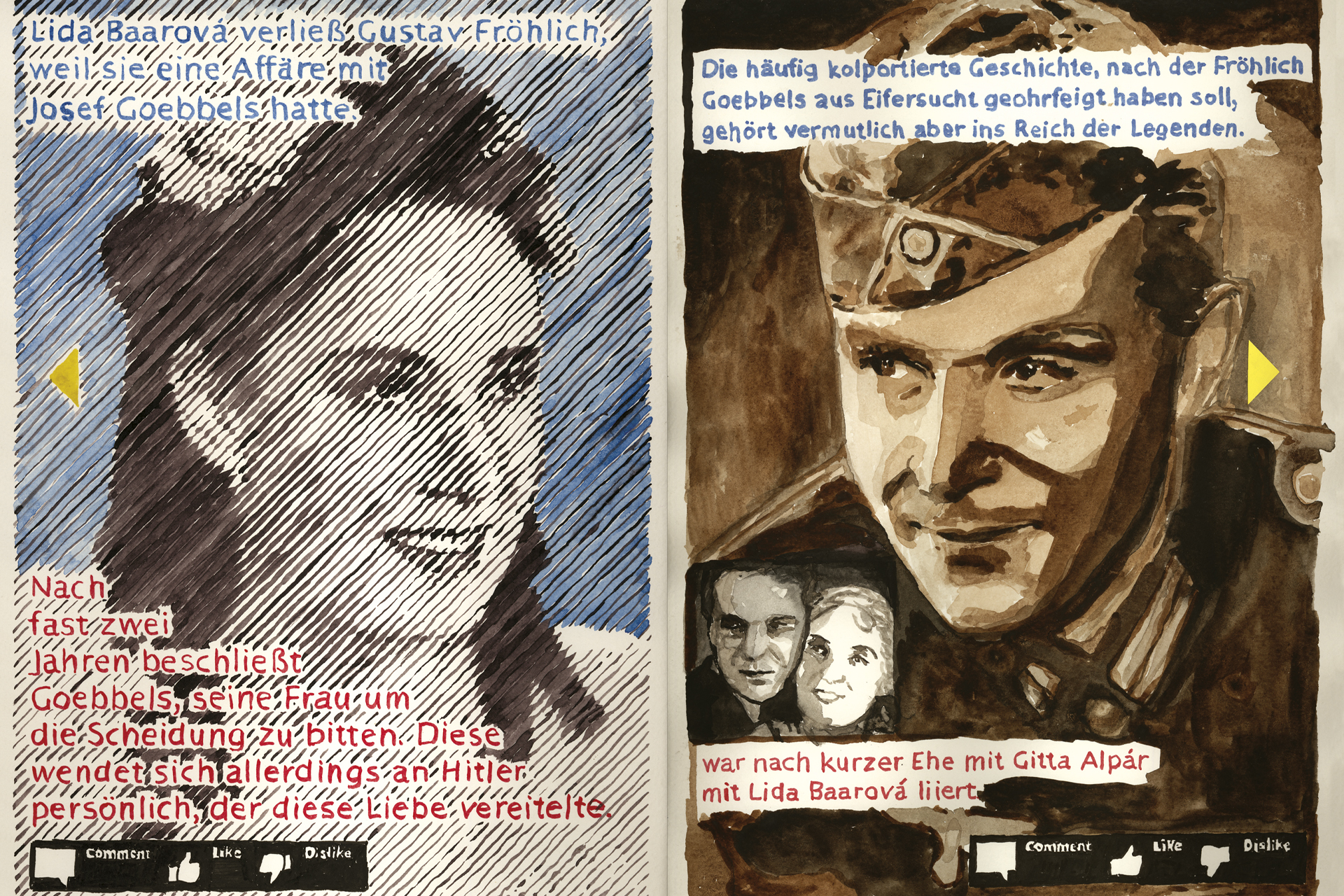
  • facebook_NS_Schlager Singers, 2011

    facebook_NS_actors_hit singers / Lida Baarová and Gustav Fröhlich, 2010/2011

    32 x 24cm, watercolour

    > press release I

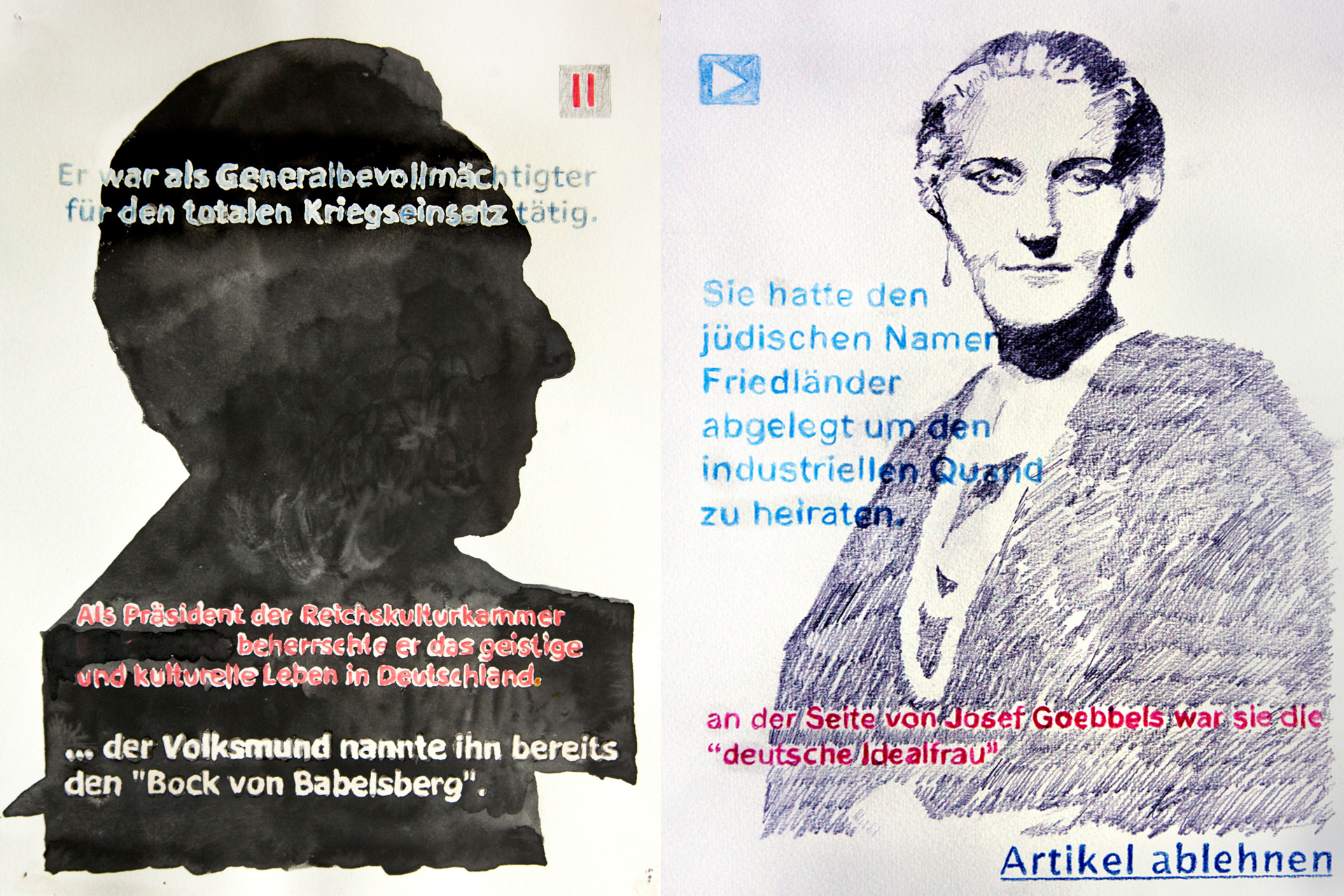
  • facebook_NS_Schlager Singers, 2011

    facebook_NS_protagonists / Joseph and Magda Goebbels, 2011

    32 x 24cm, watercolour

    > press release I

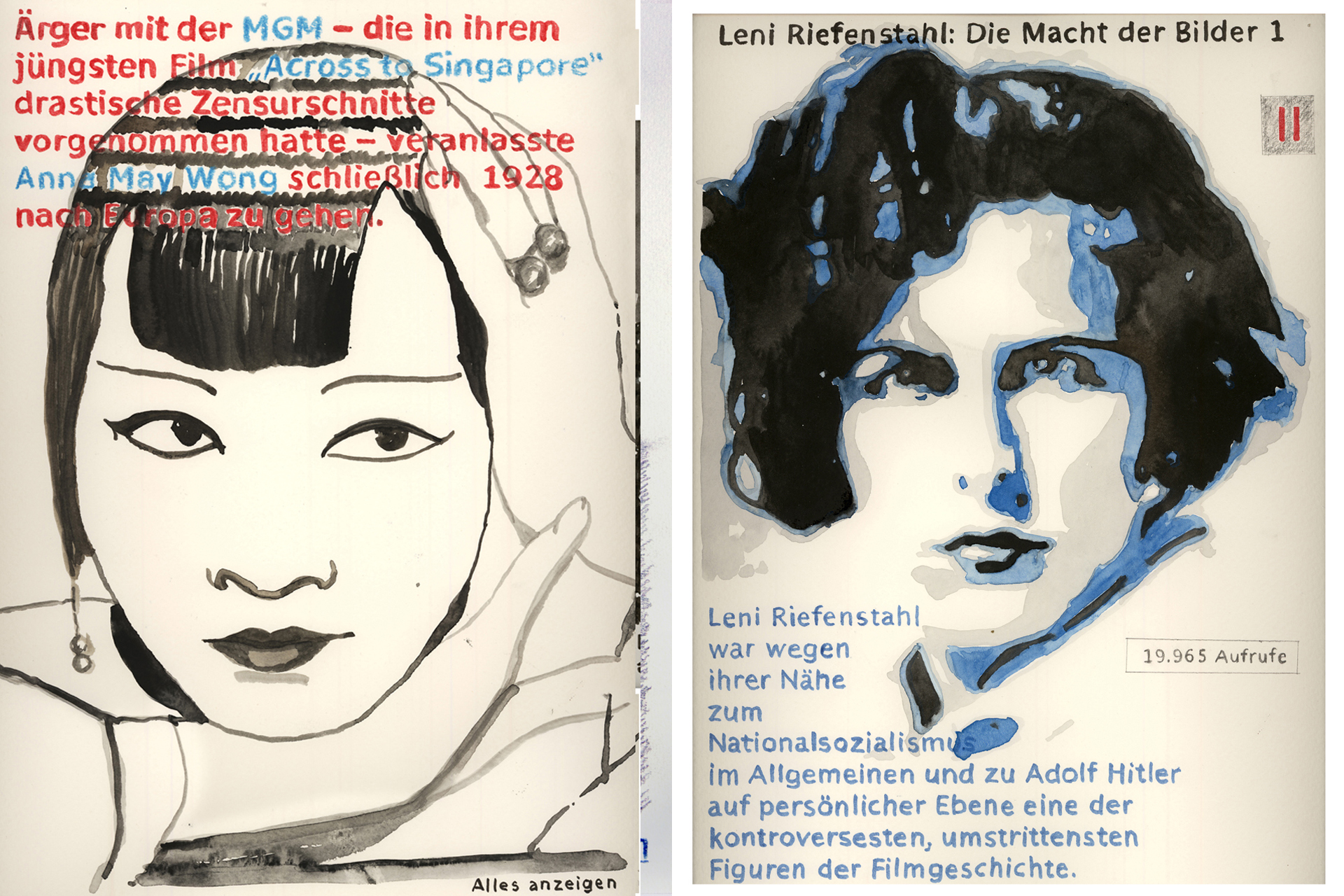
  • facebook_NS_Schlager Singers, 2011

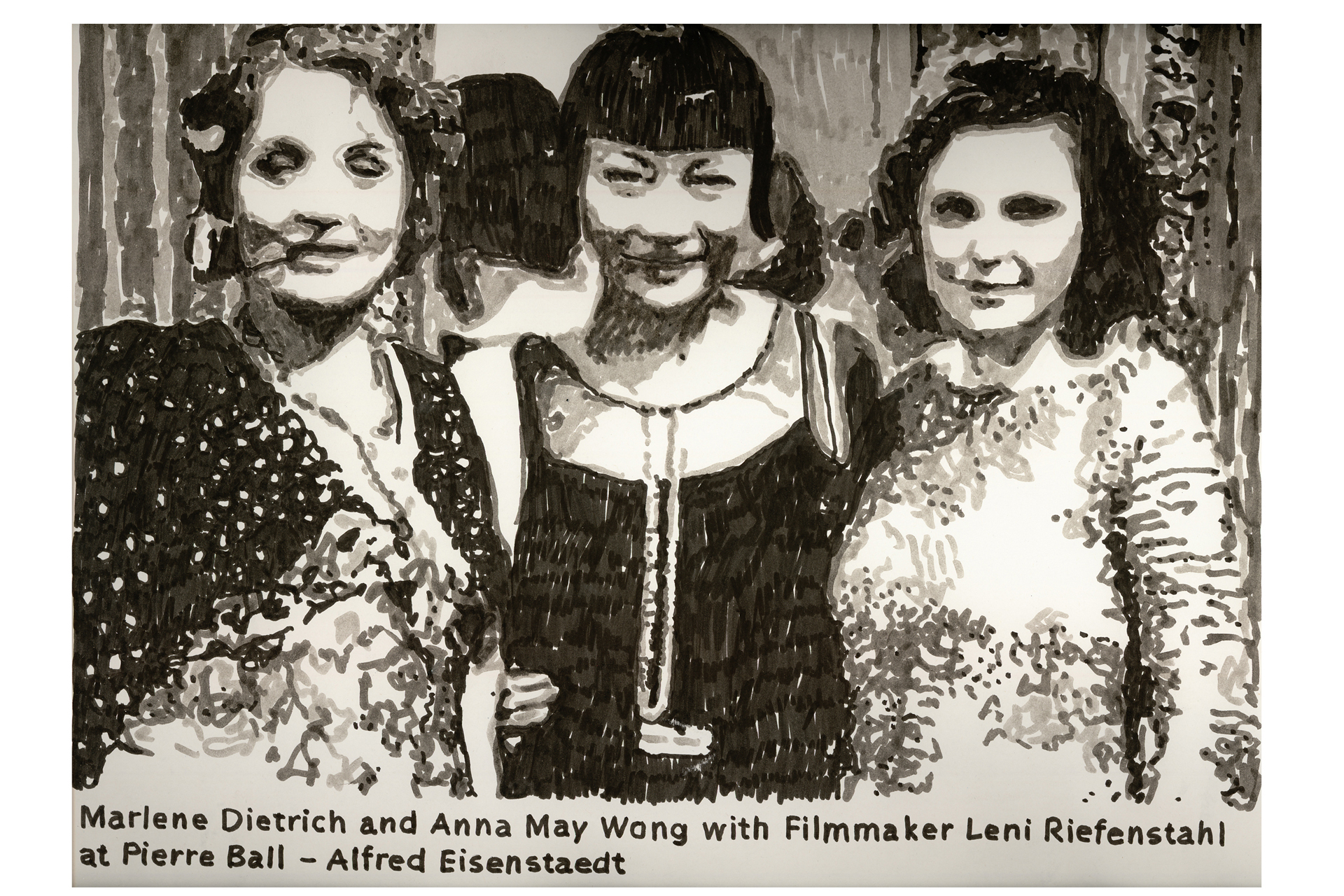
    facebook_NS_actors / Ana Mae Wong and Leni Riefenstahl, 2011

    32 x 24cm, watercolour

    > press release I

  • facebook_NS_Schlager Singers, 2011

    facebook_NS_actors_hit singers / Marlene Dietrich, Ana Mae Wong and Leni Riefenstahl, 2011

    24 x 32cm, marker on paper

    > press release I

  • facebook_NS_Schlager Singers, 2011

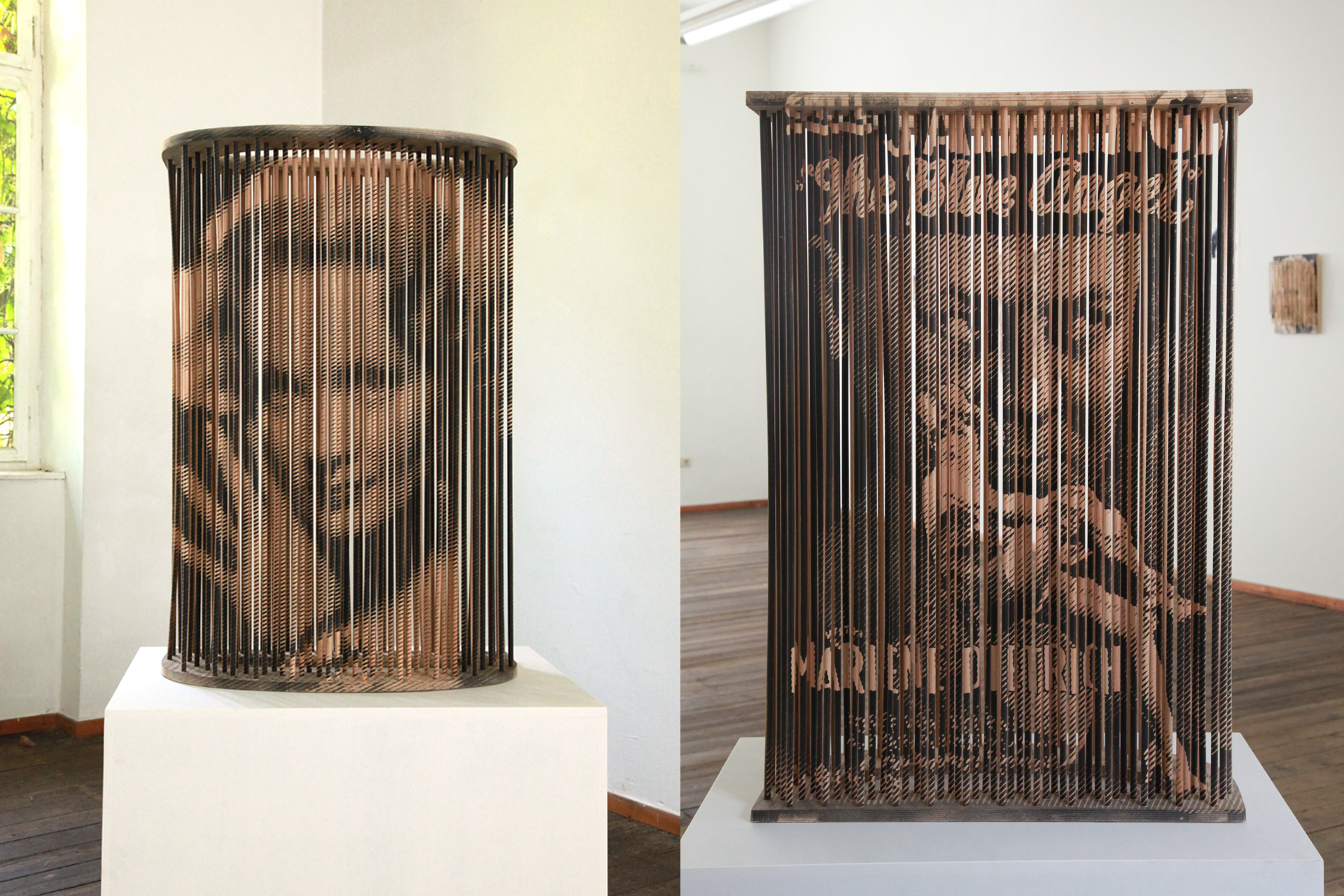
    Marlene Dietrich, 2013

    102 x 70 x 33cm, photographic emulsion on wood

    Original/side 1: M. Dietrich, 1930s, Scherl/SZ-Photo/APA-PictureDesk, Original/side 2: M. Dietrich in DER BLAUER ENGEL, 1930, film poster, photo credits: ©Ilse Haider

    > press release I

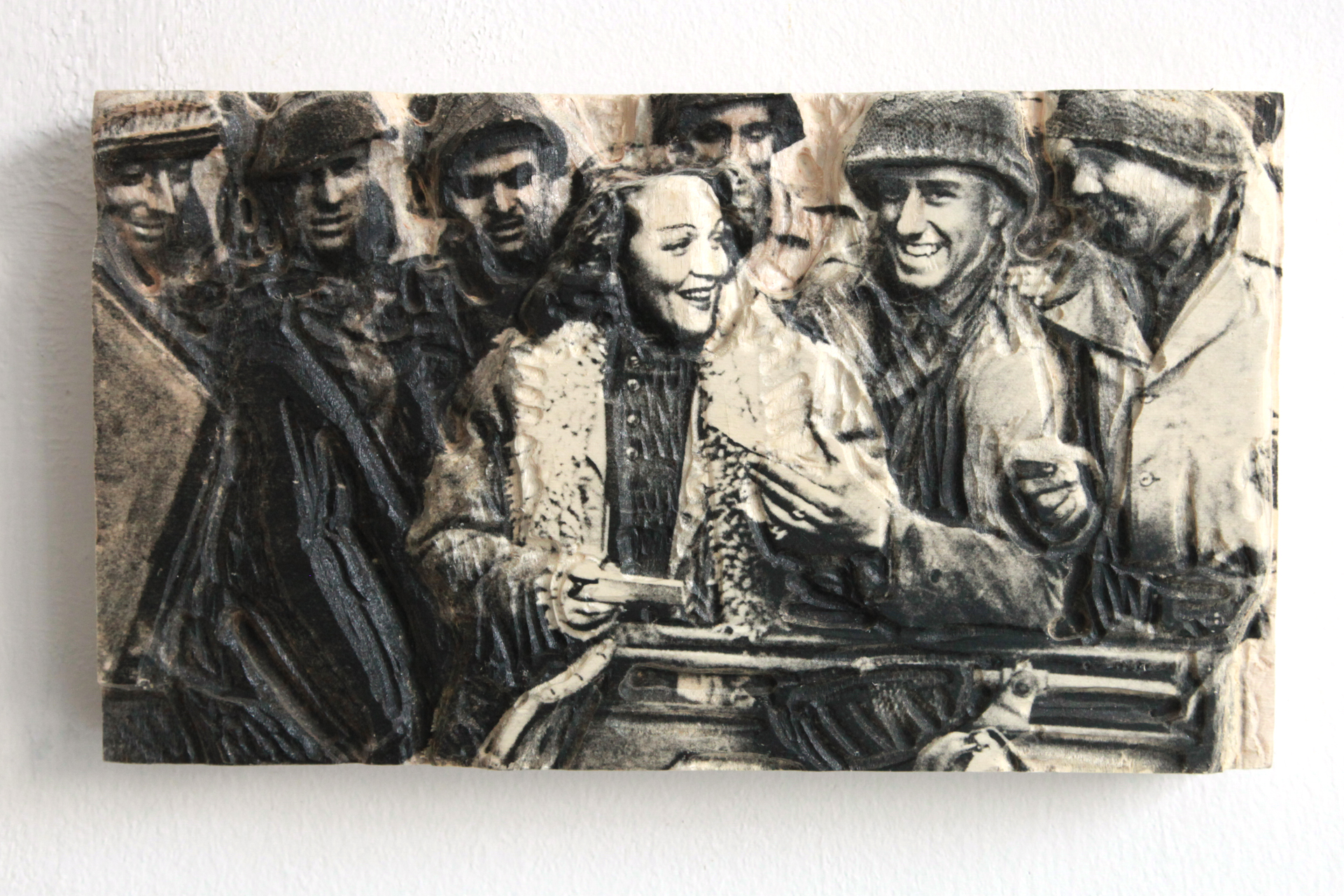
  • <b/> Marlene Dietrich with American Soldiers, 2013″></p>
<h6><b> Marlene Dietrich, </b>2013</h6>
<p>23 x 40 x 7cm, photographic emulsion on wood relief</p>
<div>
<p><strong>Original:</strong> M. Dietrich distributes her autographs to American soldiers after her appearance at the front, 1943, Scherl/SZ-Photo/APA-PictureDesk, <span>photo credits: ©Ilse Haider</span></p>
</div>
<p><a href=> press release I

  • <b/> Marlene Dietrich with American Soldiers, 2013″></p>
<h6><b> facebook_NS_actors_hit singers / Lilian Harvey  and Fritzi Massary, </b>2010/2011</h6>
<p>each 80 x 60cm, photographic emulsion on wood</p>
<div>
<p><strong>Original (l):</strong> L. Harvey in DIE DREI VON DER TANKSTELLE, 1930, IMAGNO/Brandstätter images, <strong>Original (r):</strong> F. Massary, 1920s, postcard</p>
</div>
<p><a href=> press release I

  • <b/> Marlene Dietrich with American Soldiers, 2013″></p>
<h6><b> facebook_NS_marriage candidates_hit song consumers, </b>2011</h6>
<p><b>Germany / Austria / 1930s / 1940s / protagonists</b></p>
<div>
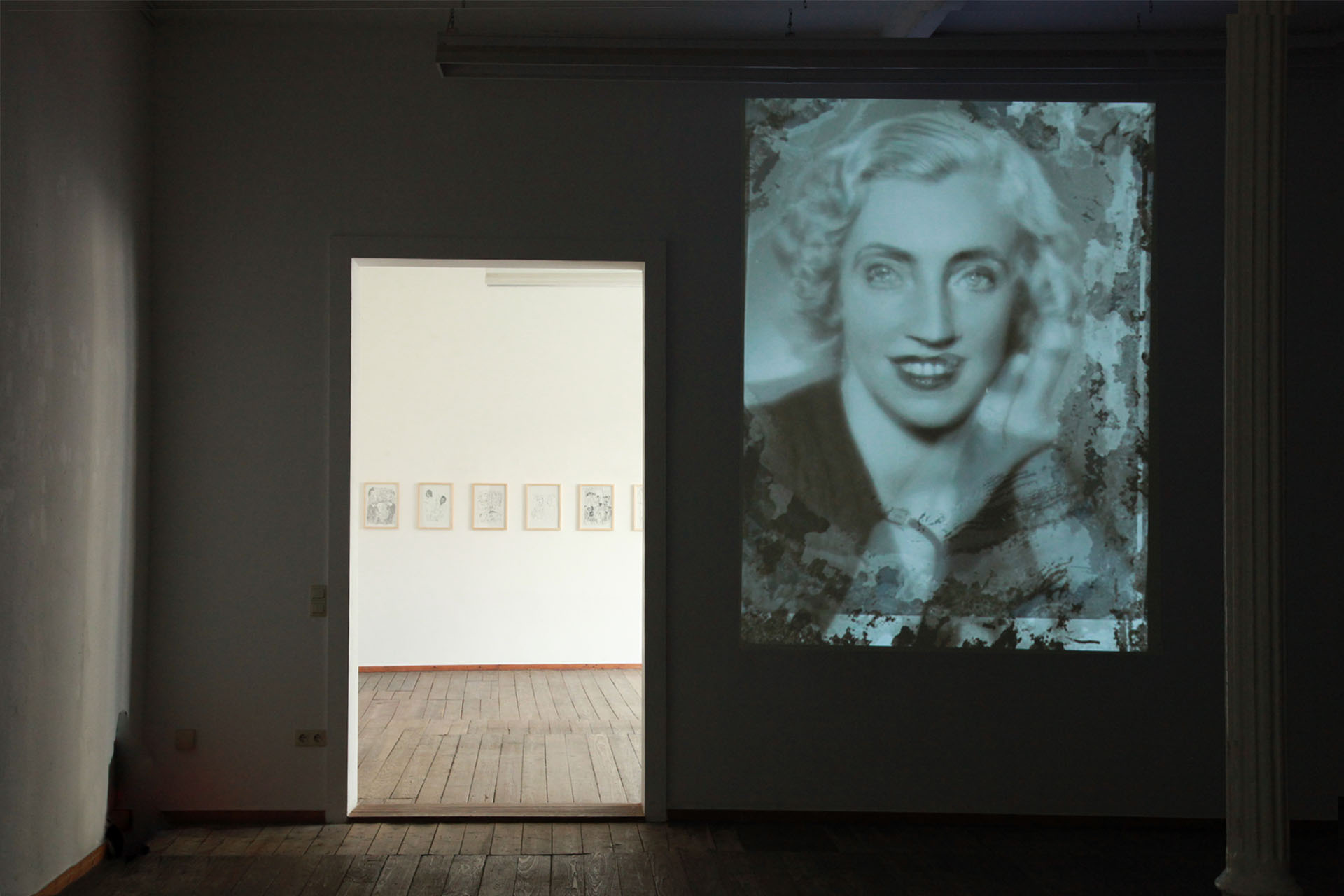
<p>A selection of glass plate negatives from the photo archive of an anonymous studio photographer was on display. The archive consists of 2,500 glass plate negatives — all professional portrait shots of women and men, and wedding photos from the 1930s and 1940s. Some were damaged by environmental influences.</p>
</div>
<p><a href=>press release II

  • <b/> Marlene Dietrich with American Soldiers, 2013″></p>
<h6><b> facebook_NS_marriage candidates_hit song consumers, </b>2011</h6>
<p><b>Germany / Austria / 1930s / 1940s / protagonists</b></p>
<div>
<p>The archive was digitized, examined, and indexed according to the criteria available. No reference to the portrait photographer was found, nor were there any references to the persons depicted.</p>
</div>
<p><a href=>press release II

  • Exhibition view: facebook_NS_revue, 2013, Germany / Austria / 1930s / 1940s / protagonists

    Film: concept/realisation: Ilse Haider, editing: Claudia Nussbaumer and Heike Nösslböck

    The portraits of one or more people in different poses are brought to life through their juxtaposition. The rhythmic sound of the mouse click refers to both the hit singers and the archival viewing of photos. The selection of images was random. photo credits: ©Ilse Haider

    >press release II

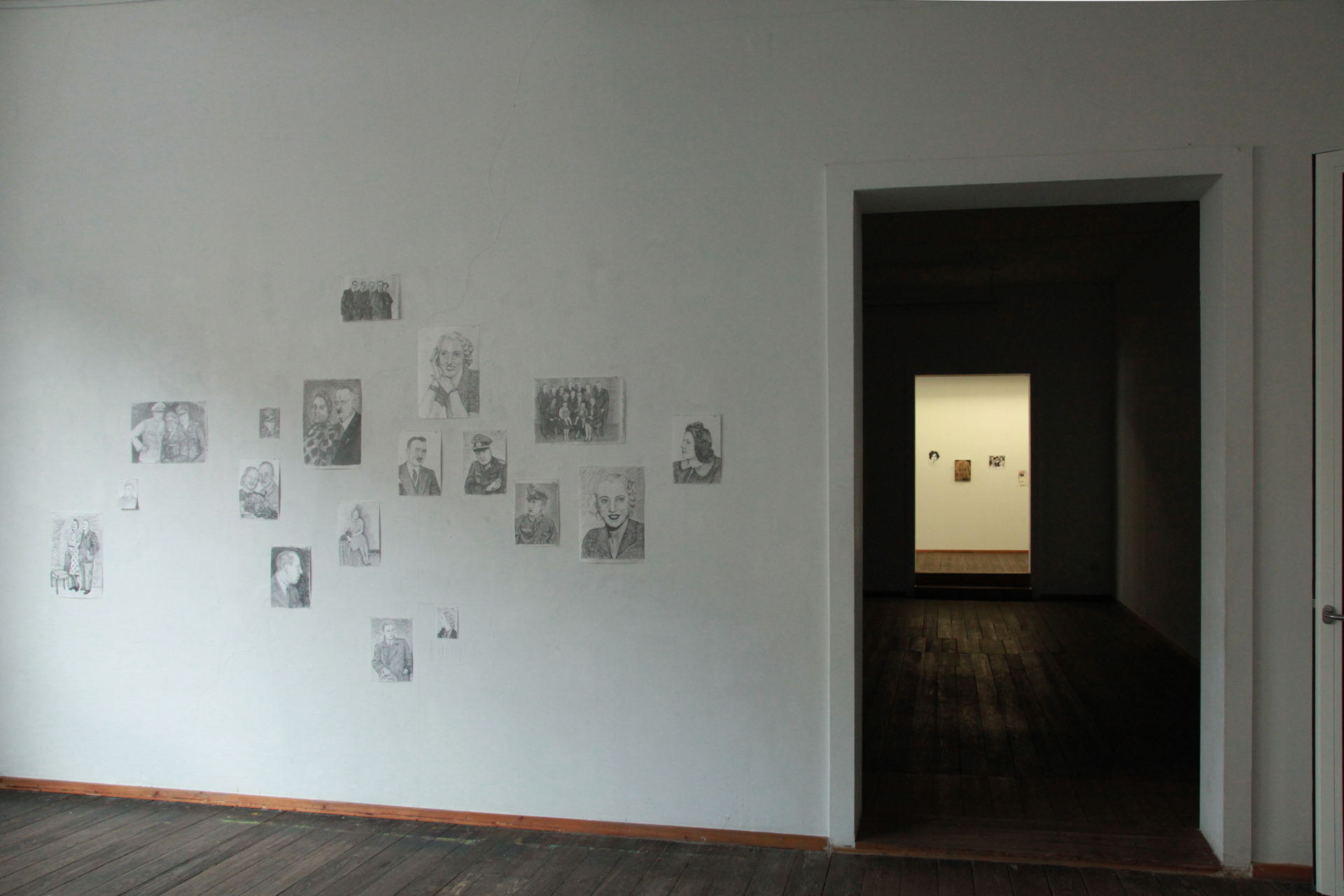
  • Exhibition view: Crazy at any price!, 2013

    Picture montages, digital prints / drawings on paper

    Picture montages with photos from the photo archive of the anonymous photographer and copies of masterpieces of art. The original masterpieces of art were confiscated by the Nazis at the time and were shown at the exhibition “Degenerate Art / Crazy at any price” in Munich, 1937. photo credits: ©Ilse Haider

    >press release II

  • After Dompteuse (Animal trainer) by Otto Dix, 2013

    Picture montage, 42 x 30cm, digital print / drawing on paper

    Picture montage of photo no. 35489 from the photo archive combined with a copy of the drawing no. 17789-E by Otto Dix: Dompteuse (Animal trainer), 1922

    >press release II

  • After Nackttanz (Nude dance) by George Grosz, 2013

    Picture montage, 42 x 30cm, digital print / drawing on paper

    Picture montage of photos no. 39996, 36451, 37319, 36114, 35321, 45896, 32543, 36005, 38546 from the photo archive combined with a copy of the drawing no. 16314 by George Grosz: Nackttanz (Nude dance), 1922

    >press release II

  • After Entkleidung (Disrobing) by George Grosz, 2013

    Picture montage, 42 x 30cm, digital print / drawing on paper

    Picture montage of photos no. 38514 and 38421 combined with a copy of the drawing by George Grosz: Entkleidung (Disrobing), 1921

    >press release II

  • <b/> Marlene Dietrich with American Soldiers, 2013″></p>
<h6>Exhibition view: <b>Crazy at any Price!</b>, 2013</h6>
<p>Drawings on paper</p>
<div>
<p>Drawings after the photographs from the photo archive, photo credits: ©Ilse Haider</p>
</div>
<p><a href=>press release II

  • <b/> Marlene Dietrich with American Soldiers, 2013″></p>
<h6><b> facebook_NS_actors_hit_singers / Gitta Alpár and Renate Müller, </b>2010</h6>
<p>80 x 60 x18cm, 30 x 25 x 8cm, photographic emulsion on wood</p>
<div>
<p><strong>Original (l):</strong> G. Alpár, 1930s, post card, <strong>Original (r):</strong> R. Müller, 1930s, IMAGNO/Brandstätter images</p>
</div>
<p><a href=>press release

facebook_NS_revue, 2013 (clip from film)
Germany / Austria / 1930s / 1940s / protagonists

The photos were taken from the photo archive of an anonymous studio photographer. The archive consists of 2,500 glass plate negatives — all professional portrait shots of women and men, and wedding photos from the 1930s and 1940s. Some were damaged by environmental influences. The archive was digitized, examined, and indexed according to the criteria available. No reference to the portrait photographer was found, nor were there any references to the persons depicted. The portraits of one or more people in different poses are brought to life through their juxtaposition. The rhythmic sound of the mouse click refers to both the hit singers and the archival viewing of photos. The selection of images was random. 

If you recognize someone, please let us know!

Continue reading

Mr. Big

Press release, Leopoldmuseum

EN

MR. BIG in the MuseumsQuartier

from 4th October in front of the Leopold Museum

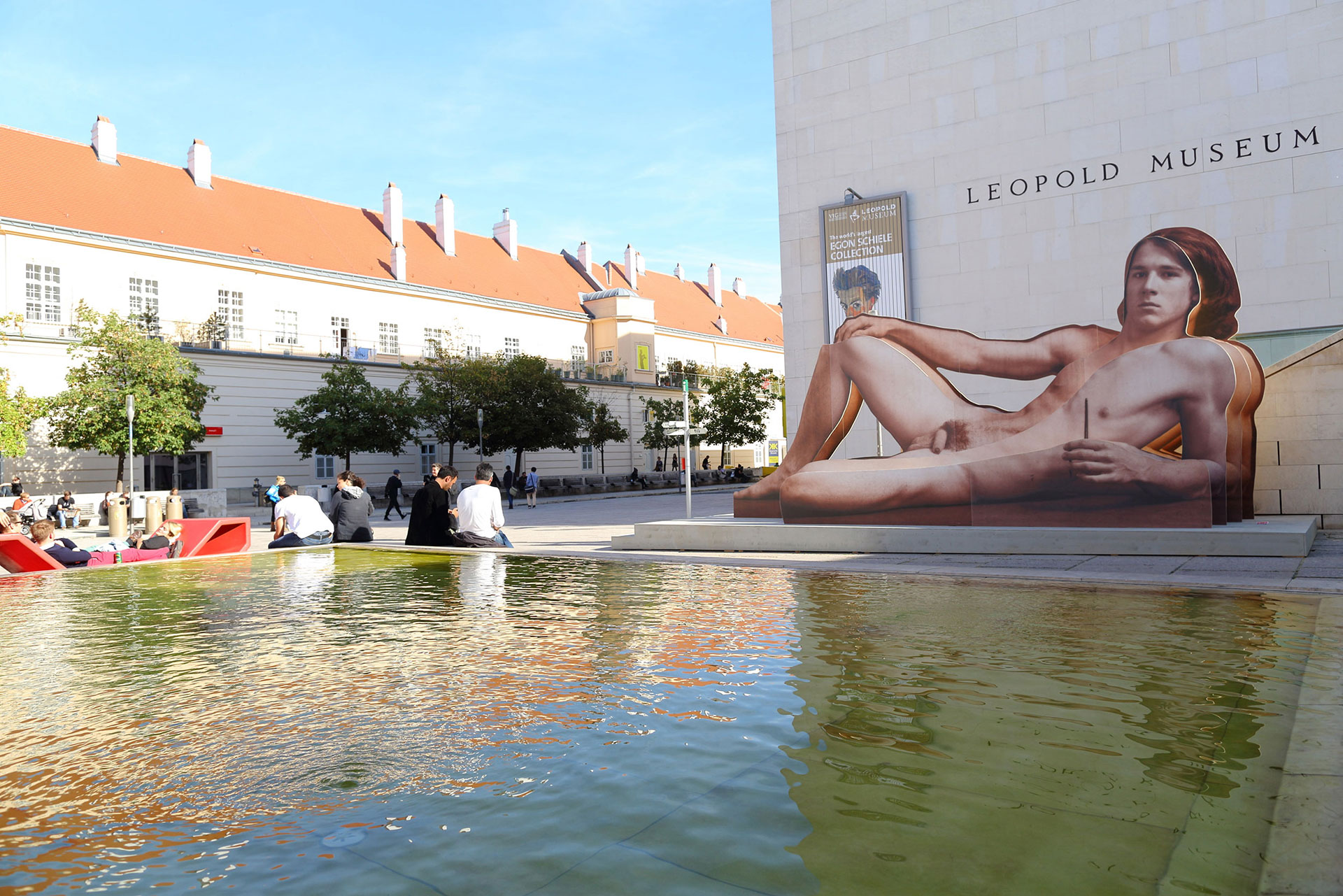
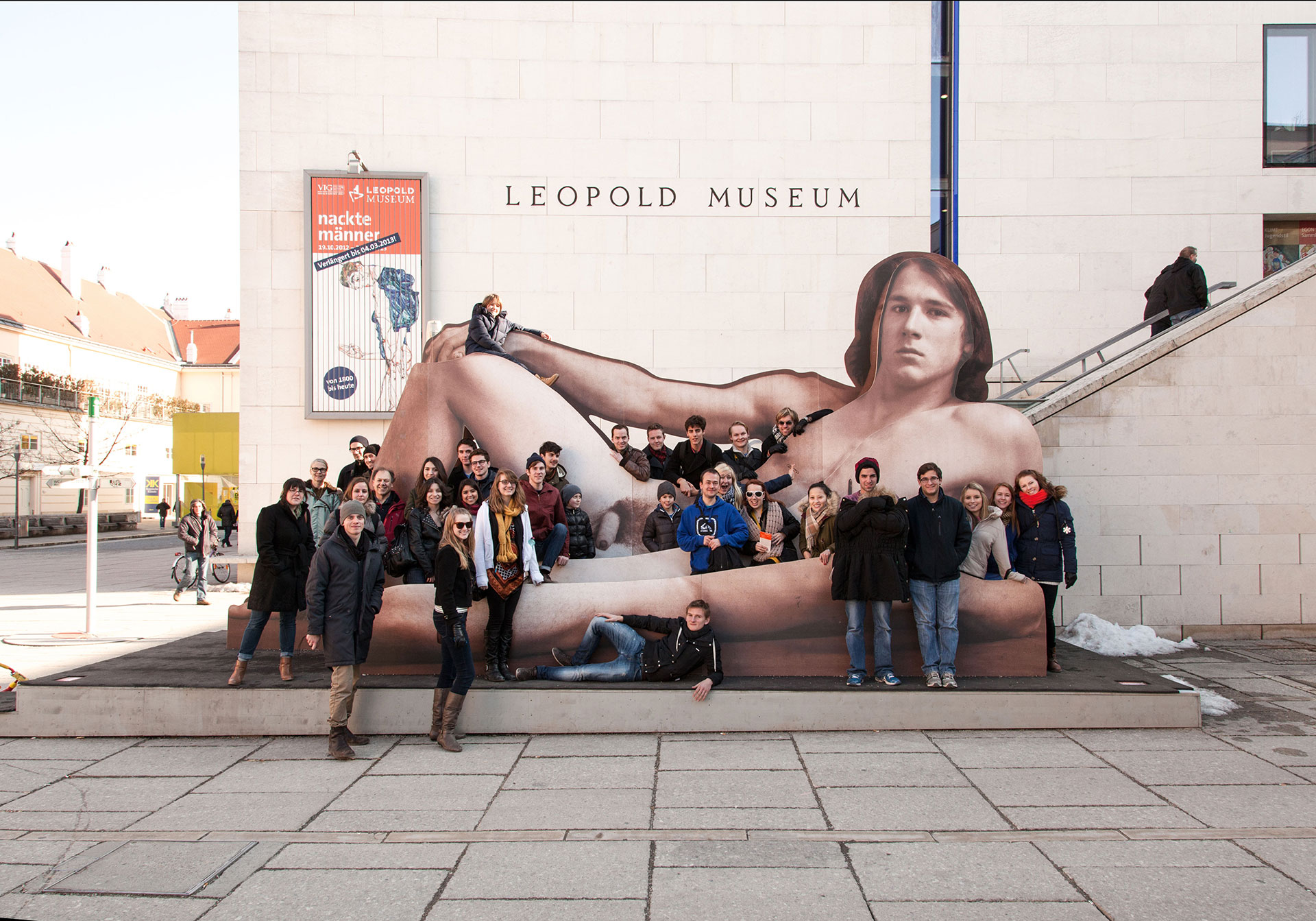
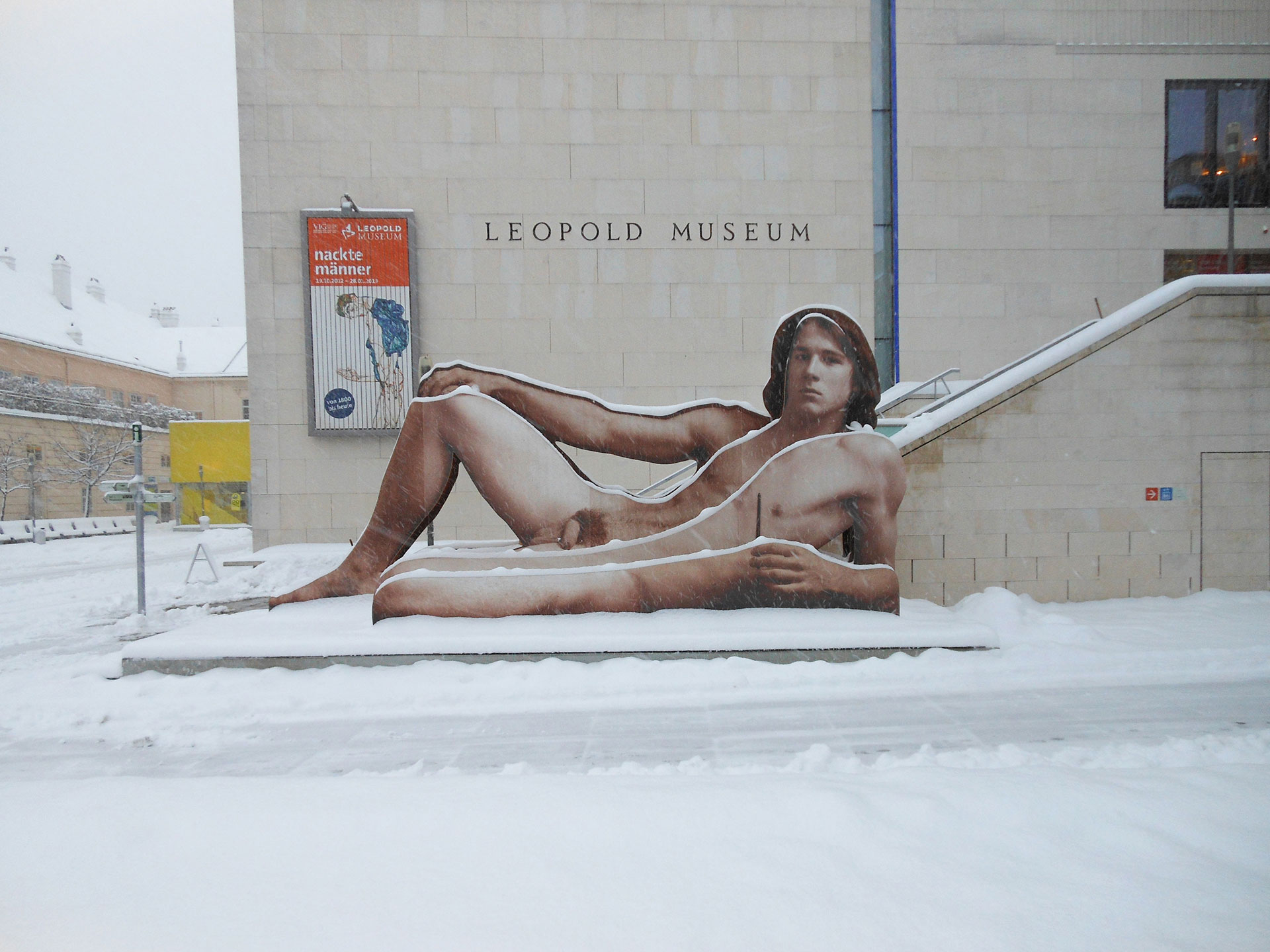
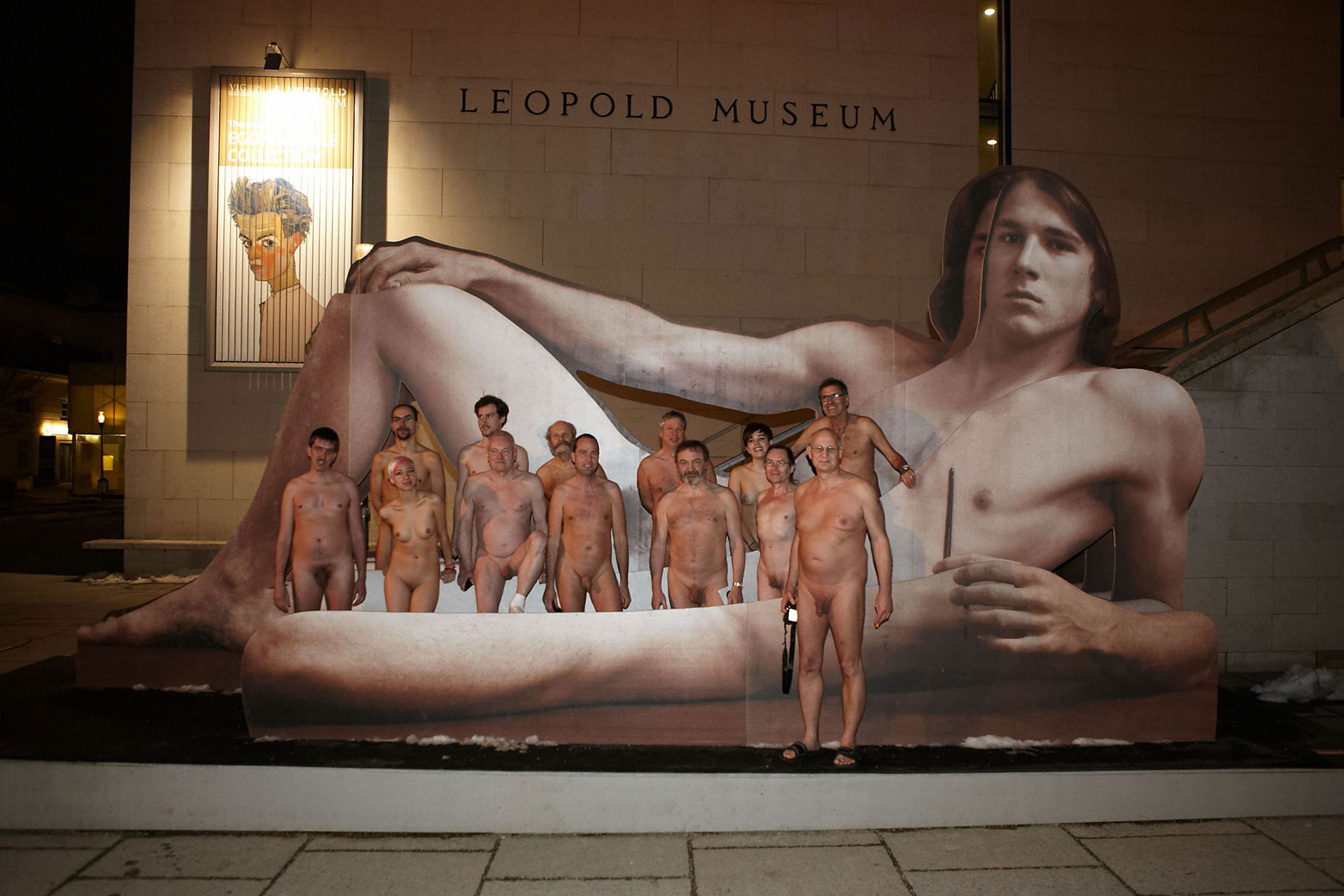
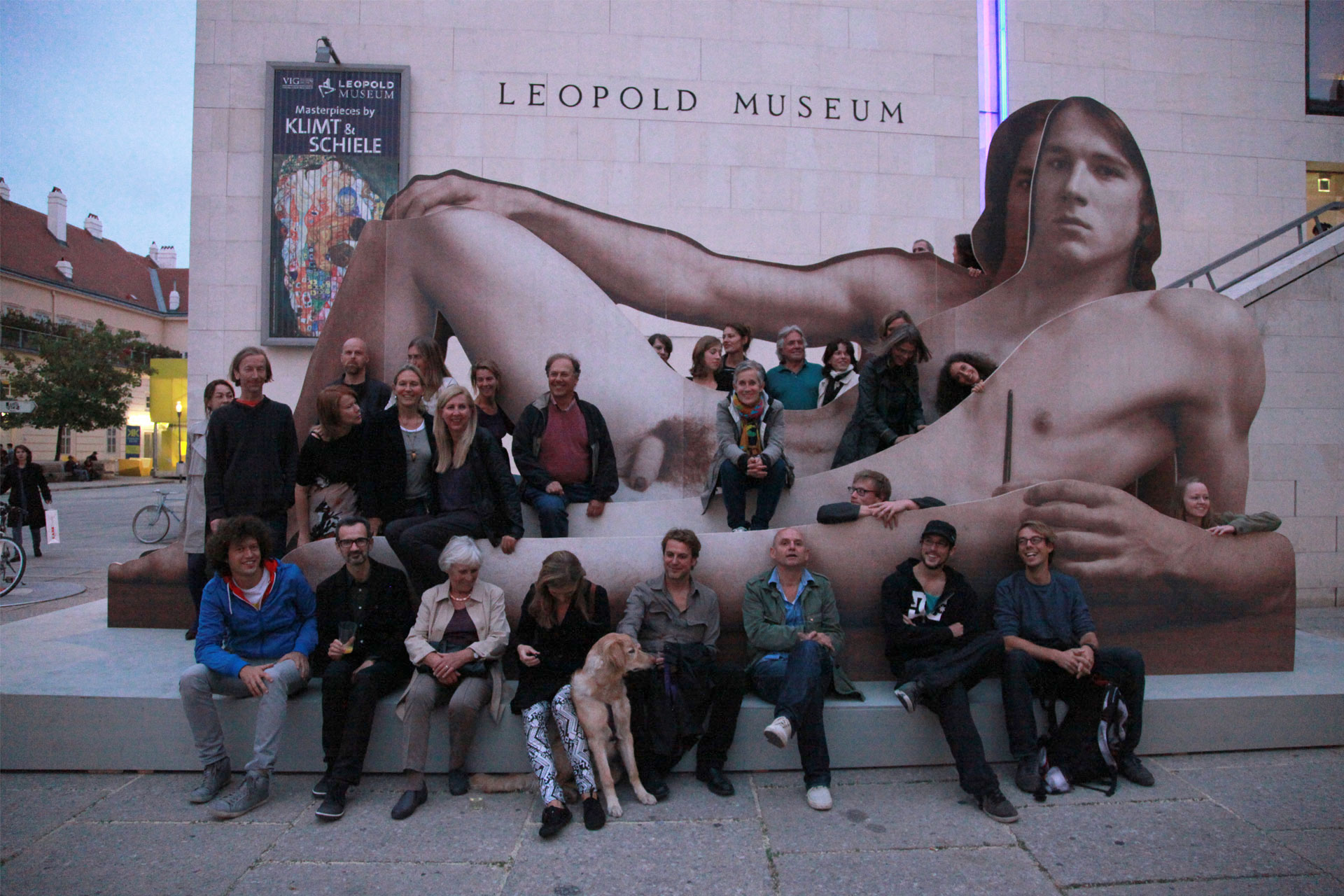
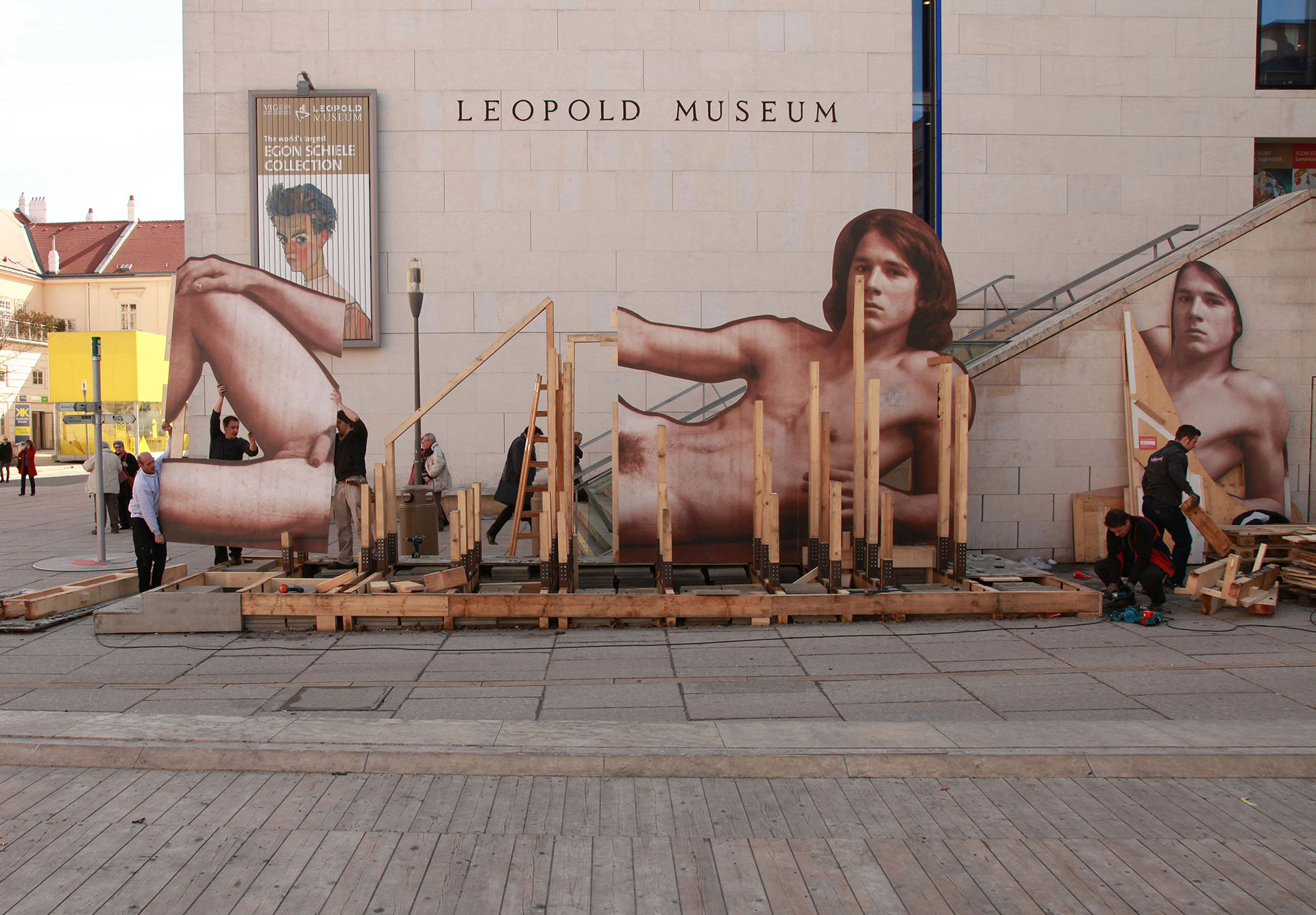
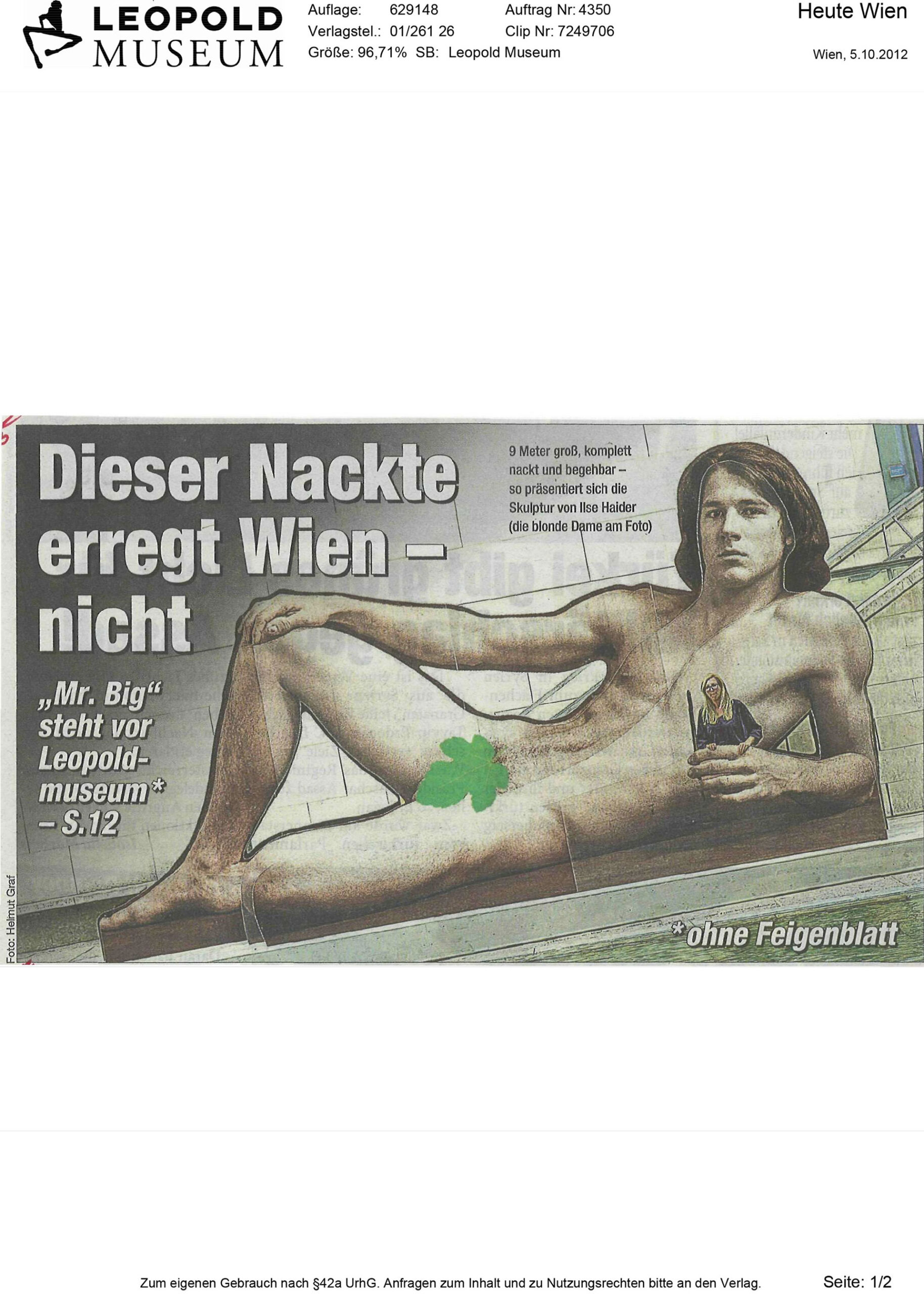
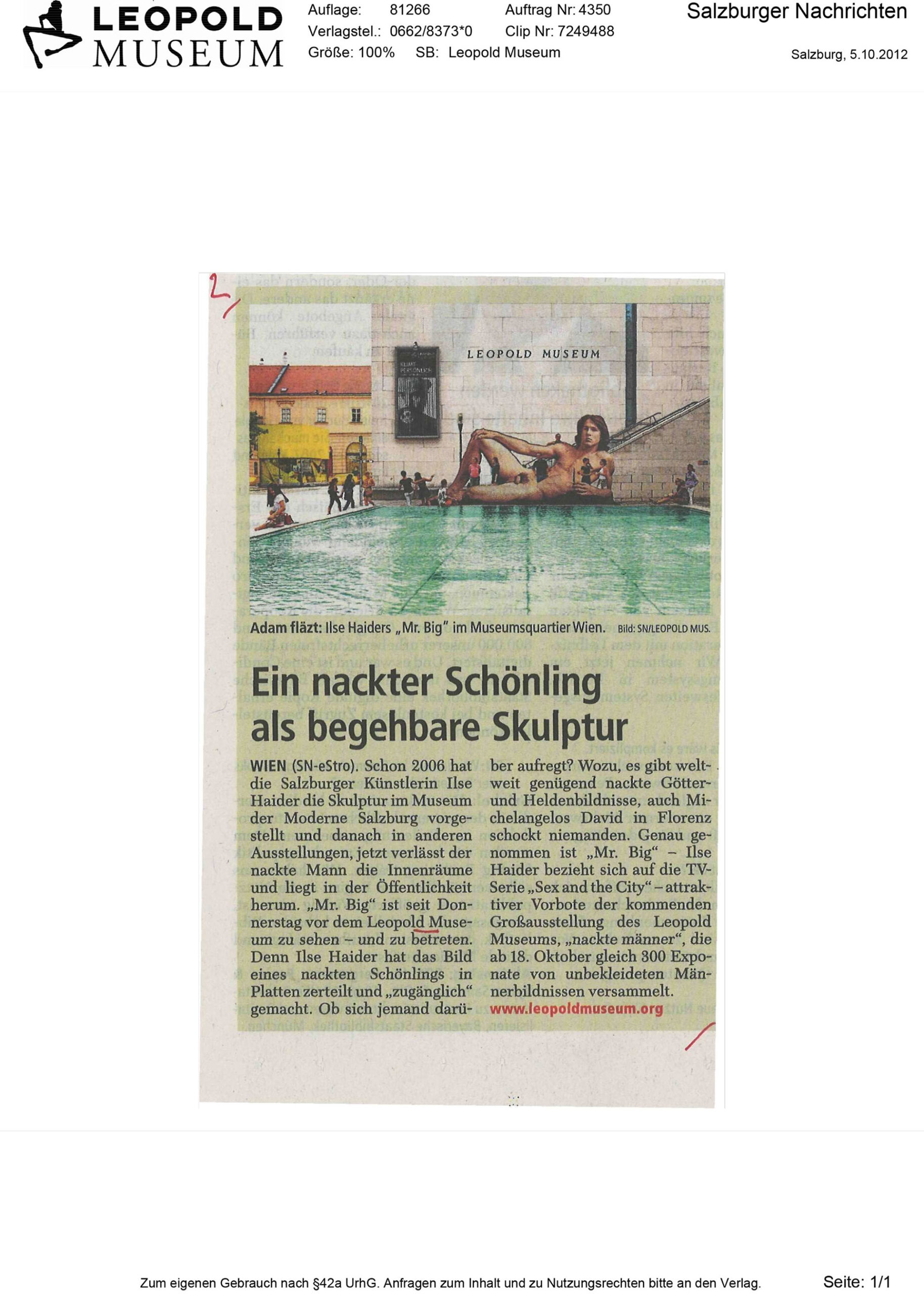
Ahead of the large-scale exhibition nude men. from 1800 to the present day the Leopold Museum unveiled the walkable sculpture Mr. Big by the Salzburg artist Ilse Haider (*1965) on 4th October in the inner courtyard of the MuseumsQuartier. The exhibition’s curators, Leopold Museum Director Dr. Tobias G. Natter and Dr. Elisabeth Leopold, took this opportunity to reveal first insights into the concept of the upcoming presentation nude men.

THE FIRST NUDE IN THE MUSEUMSQUARTIER – MORE AT THE LEOPOLD MUSEUM FROM 18TH OCTOBER

The exhibition nude men. from 1800 to the present day, an upcoming major exhibition at the Leopold Museum is already making waves. at the Leopold Museum, which comprises artworks from all over Europe and the US, affords interesting insights into the abundance and diversity of male nudes in art, with a special emphasis on the period from 1800 to the present.

Up until now, depictions of nude men have rarely featured in museums, rarer still in a related context and almost never in an explicit manner. However, this underexposure is in no way due to any shortage of male nudes, either in past or contemporary art.

The Leopold Museum wants to close this gap with its large-scale presentation nude men, which comprises an impressive range of artworks. The exhibition’s curators Tobias G. Natter and Elisabeth Leopold are keen to show the different artistic approaches to the subject, to reveal competing ideas about masculinity, changing body, beauty and value concepts, the political dimension of the body as well as the breach of conventions.

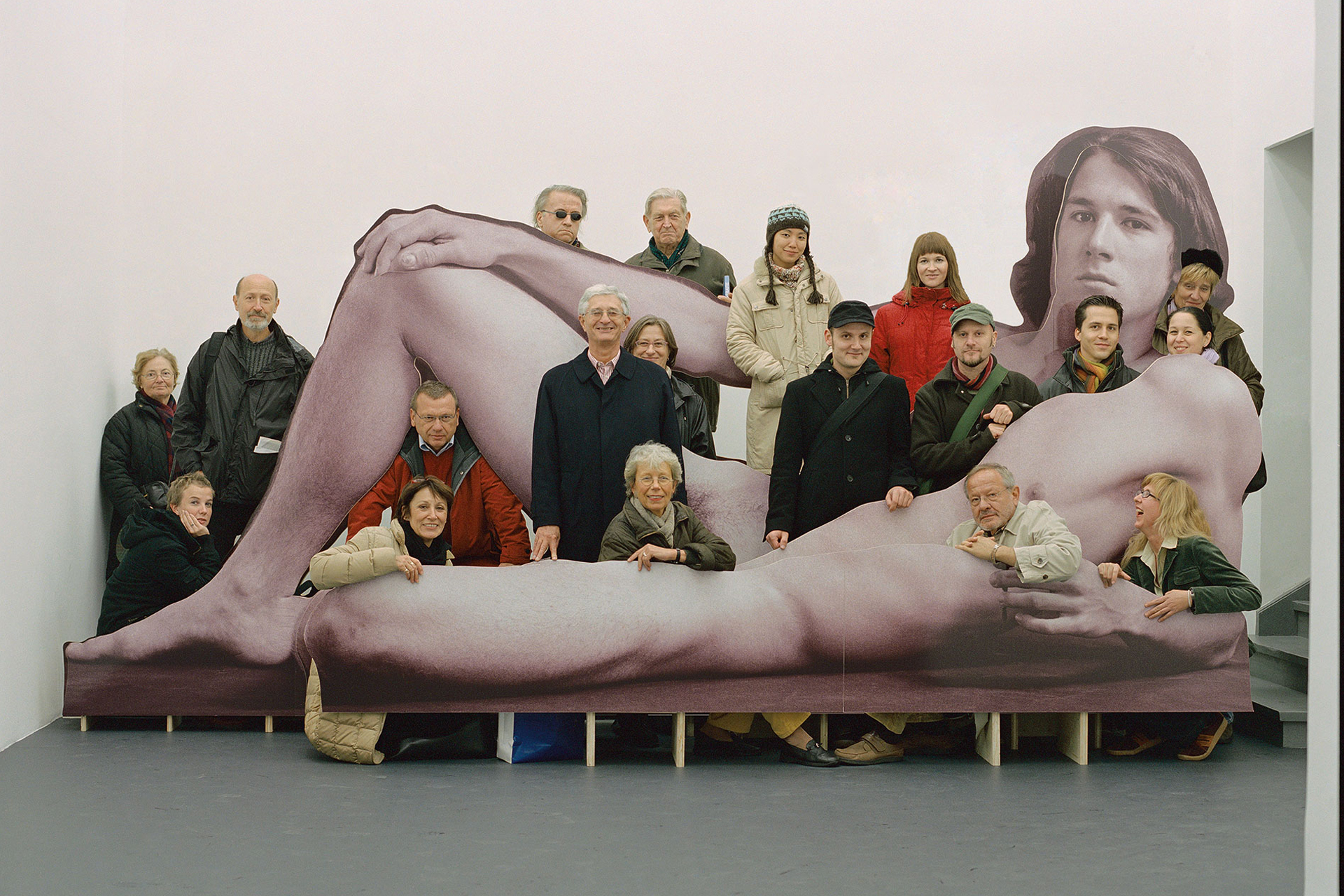
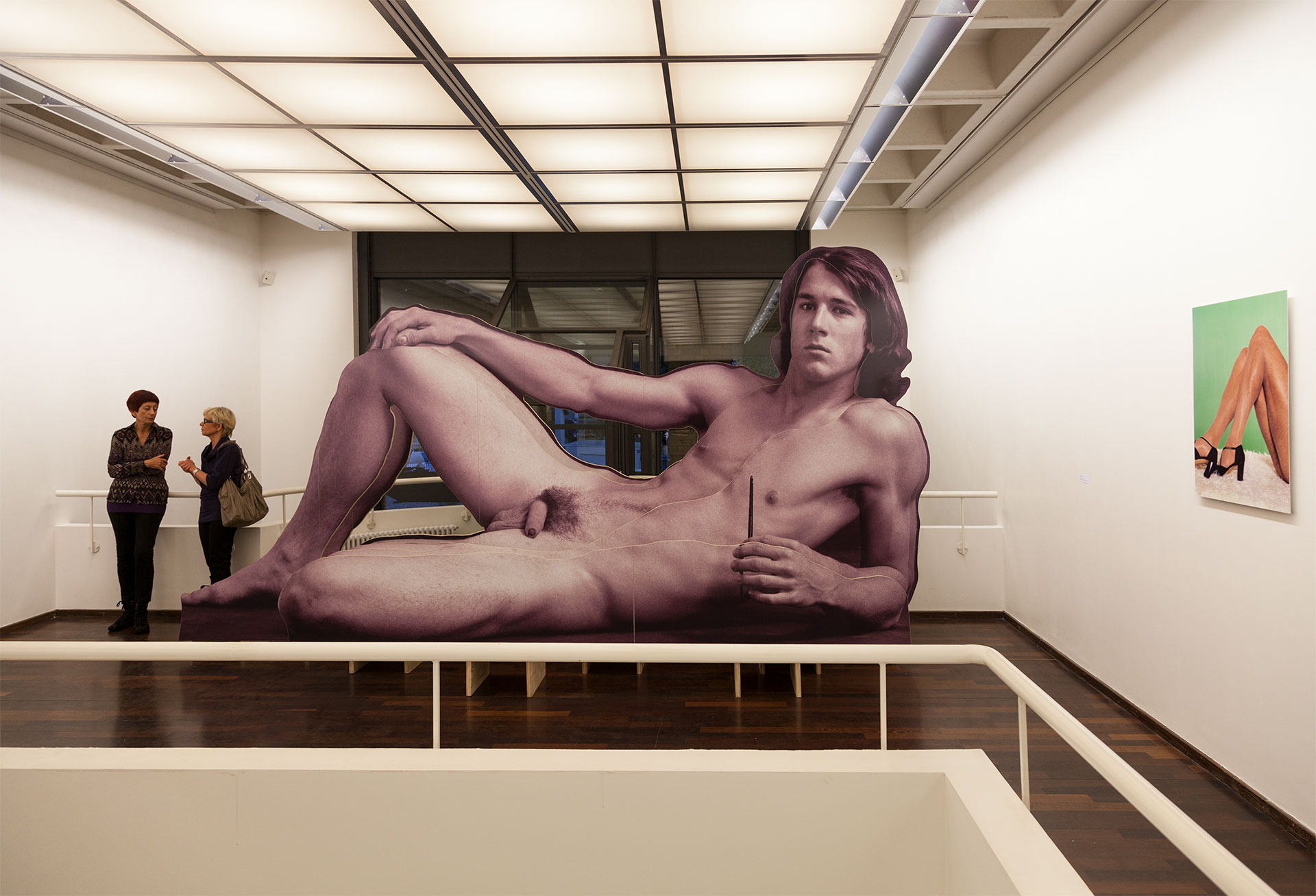
The larger-than-life sculpture Mr. Big by the Salzburg artist Ilse Haider is the first work from the exhibition to be shown in public. The 2006 sculpture, which was originally intended to be displayed inside, has already caused a stir at previous presentations (Galerie Steinek 2006, Galerie der Stadt Fellbach/ Stuttgart 2010, Museum of Modern Art Rupertinum Salzburg 2011). Now it has been adapted by the artist to be displayed outside in the courtyard of the MQ.

At the start of the presentation nude men on 8th October 2012, Mr. Big will be moved inside to form part of the exhibition’s prologue.

ILSE HAIDER’S MR. BIG INTERACTION IN THE PUBLIC SPHERE

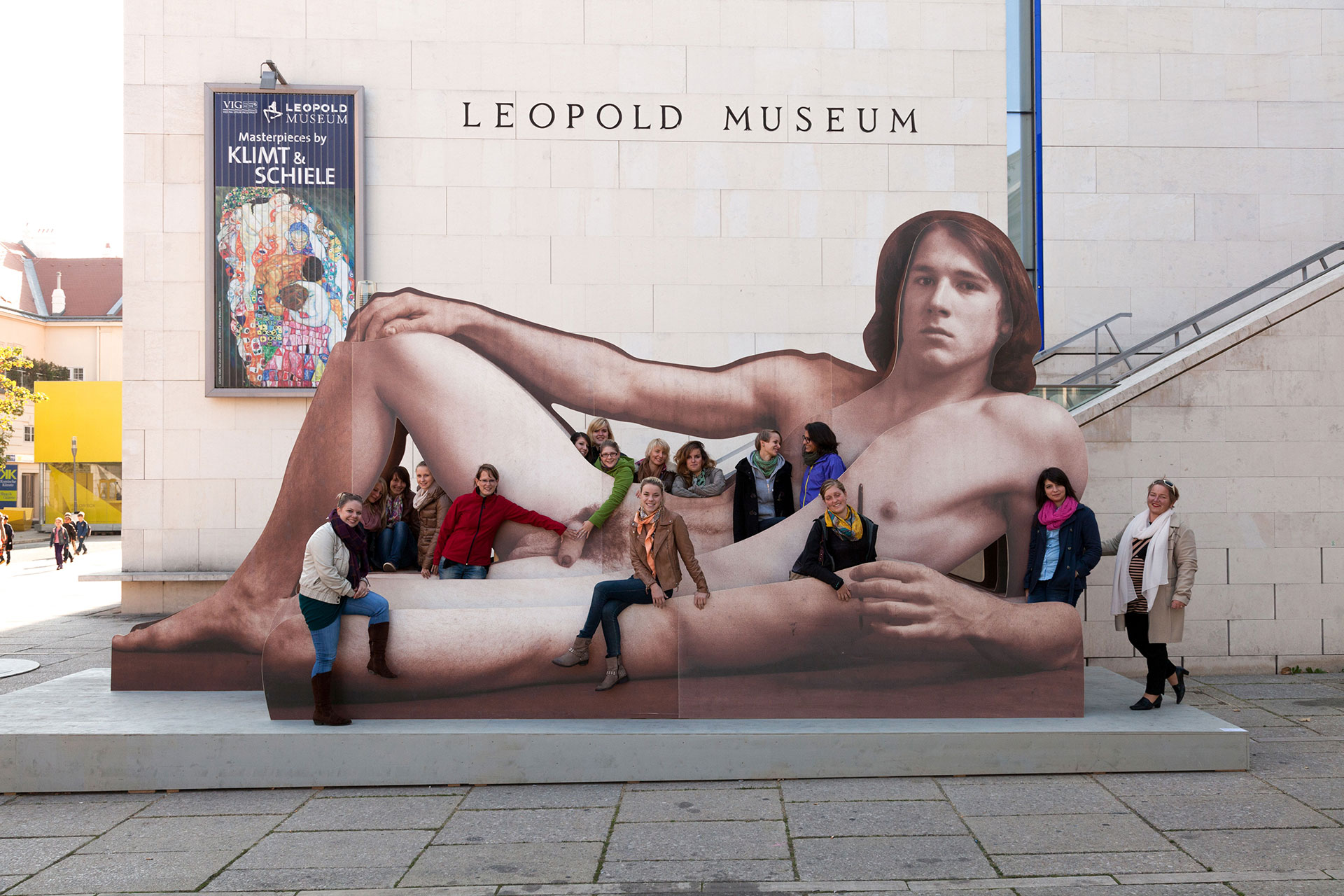
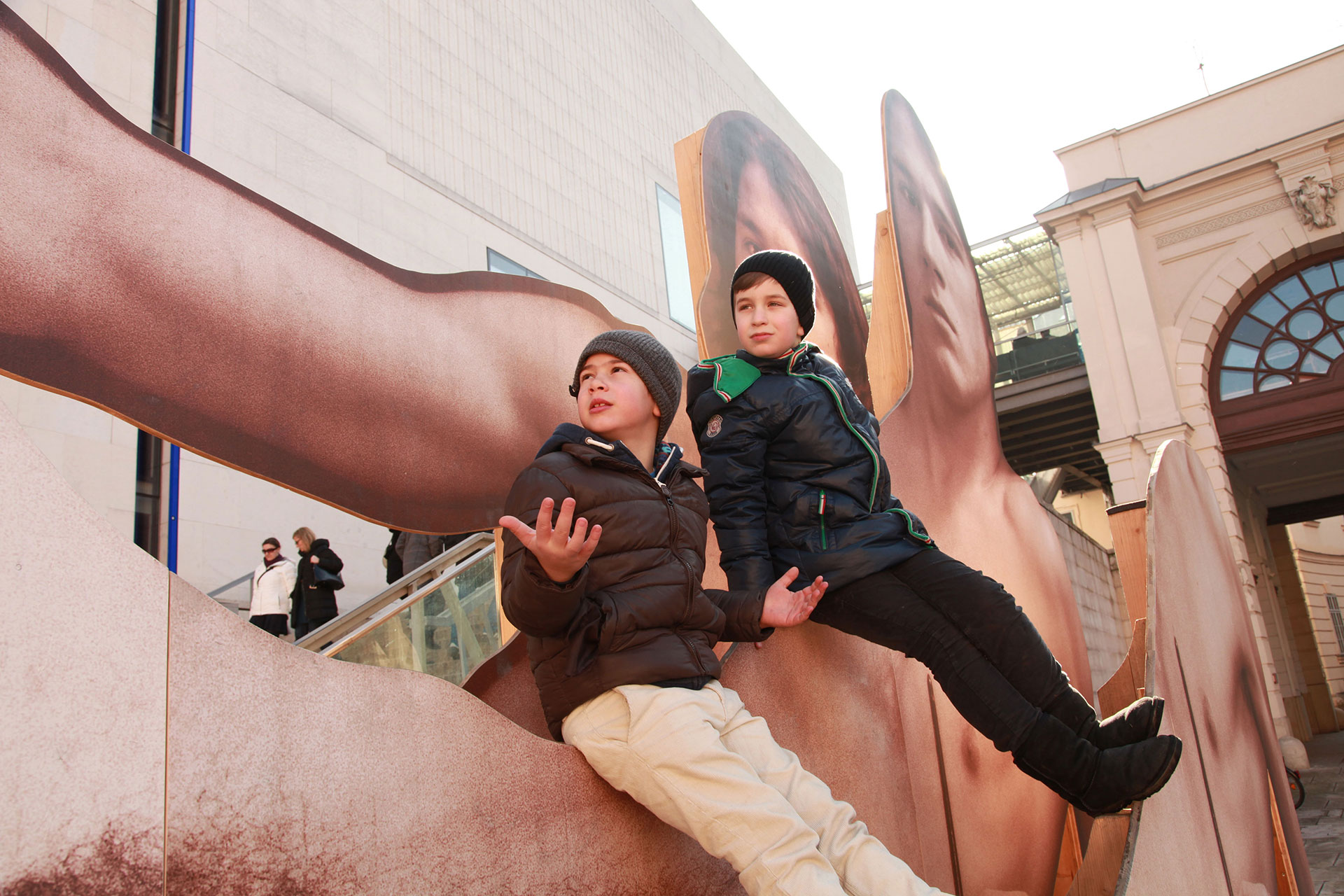
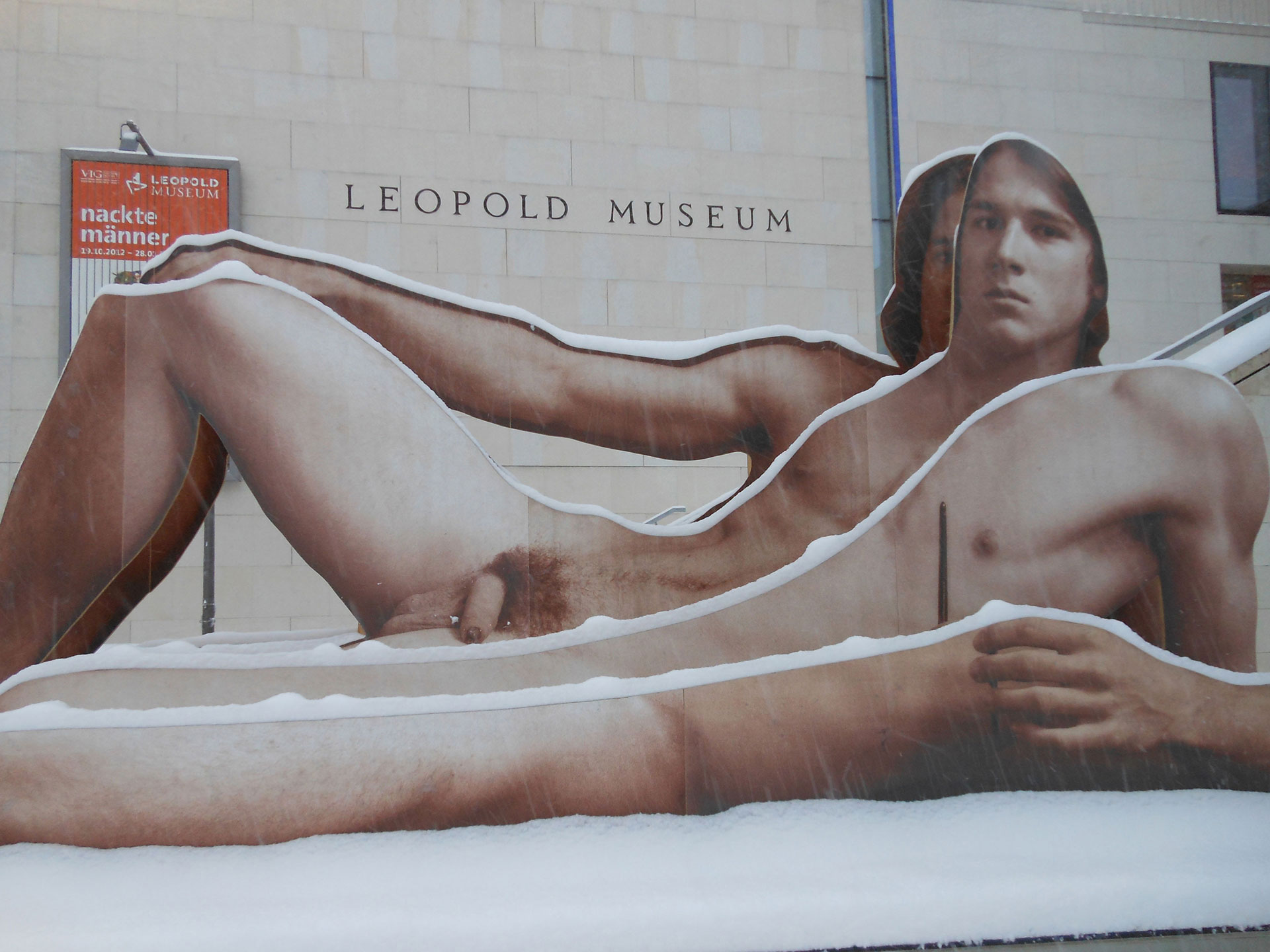
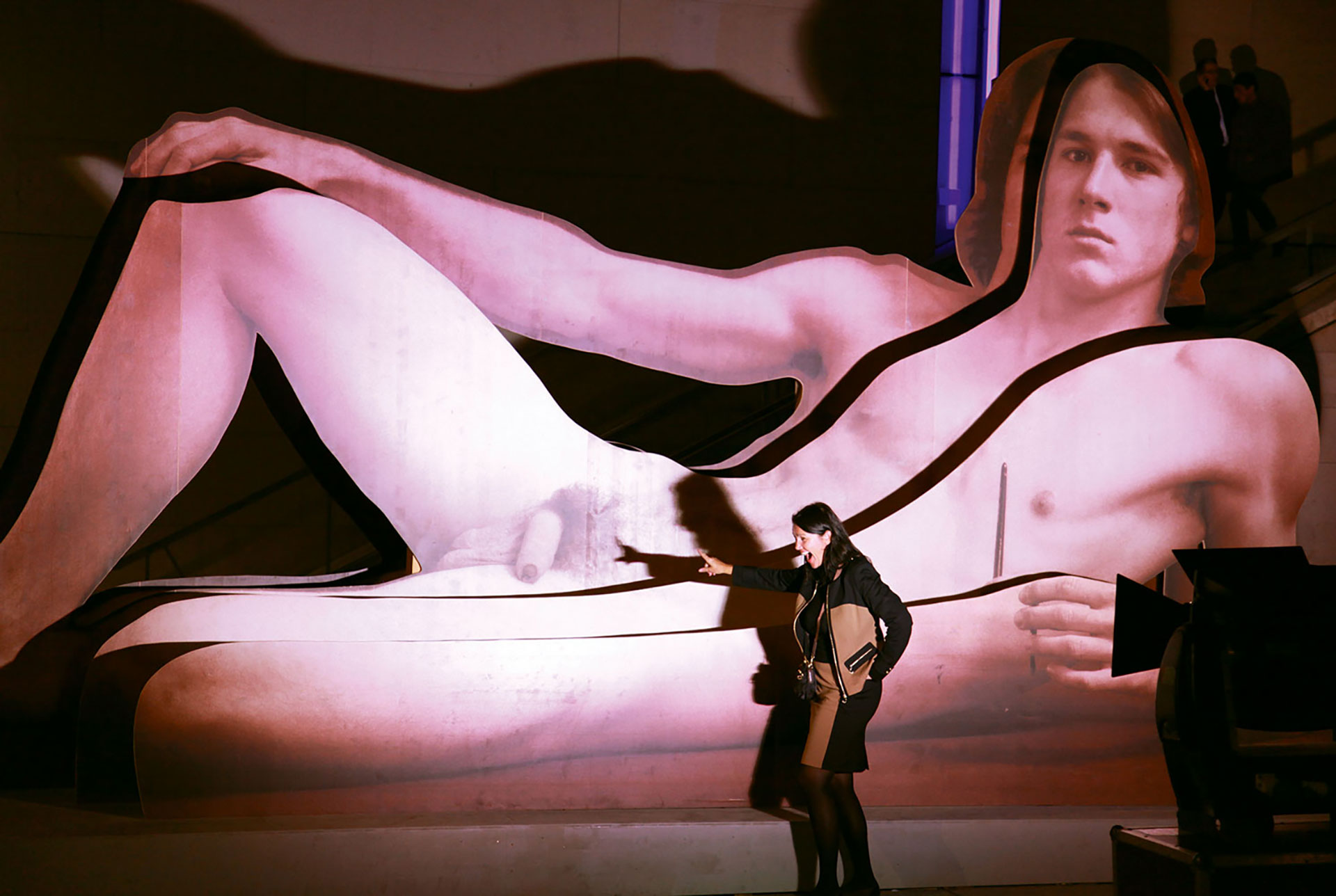
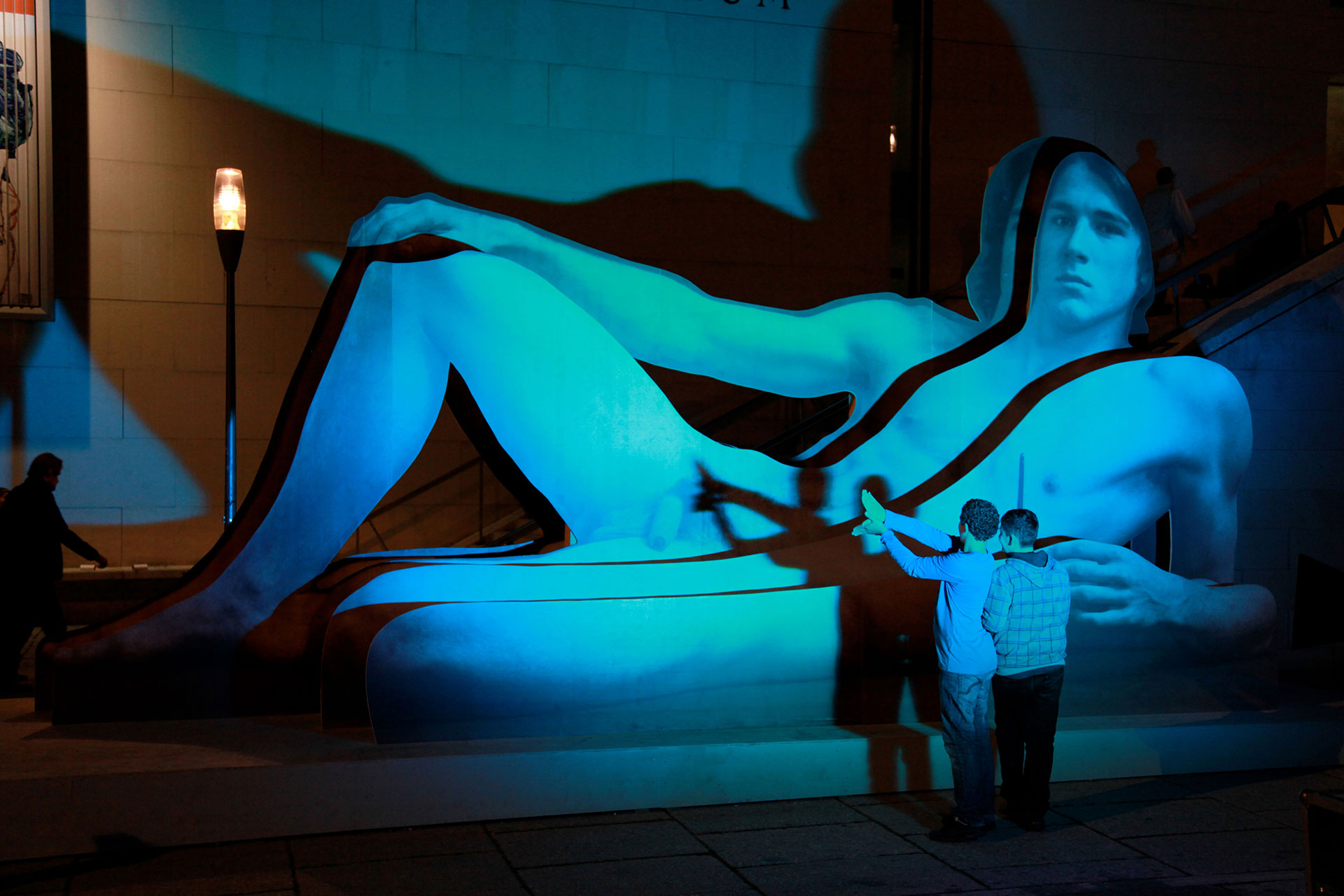
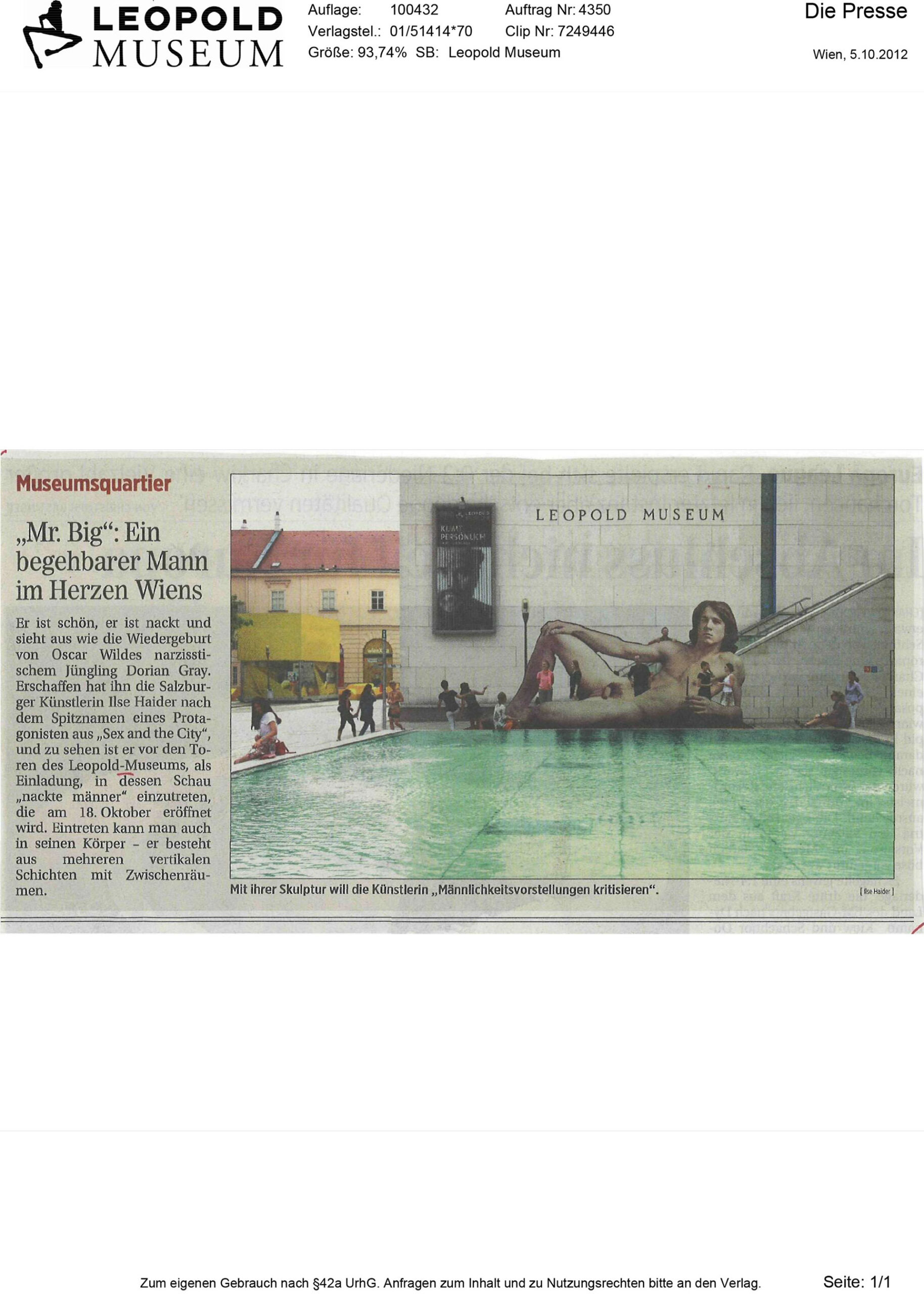
For Leopold Museum Managing Director Peter Weinhäupl, the installation in the courtyard sends “an important message to the public. A targeted use of art in the public sphere serves to enliven the cultural space, while the highest quality of the artworks has to be the main priority. We would like to thank the MuseumsQuartier for helping us with the realization of this project”. Visitors can interact with Mr. Big on different levels within the public sphere: Broken up into various segments, the image of the male youth protrudes into space. As the artwork is walkable, visitors can wander around the installation or walk in the spaces between the individual segments. The three-dimensional effect created by the different layers, however, can only be perceived from a central perspective.

PLAYING WITH CLASSICAL EXAMPLES

The sculpture has been erected in front of the steps leading up to the Leopold Museum. This positioning behind the MQ’s water feature is an allusion to classical art historical examples.

Mr. Big’s pose is reminiscent of antique statues, evoking the river gods of Greek and Roman mythology or the relaxed attitude of the Hellenic sculpture of the sleeping Barberini Faun.

CRITICISM AGAINST IDEAS OF MASCULINITY

This larger-than-life depiction of a reclining male nude is one of a series of works by Ilse Haider that saw her turn photographs into sculptures. Along with the interest in the depiction, the desire and the appropriation of the image by the artist and the beholders, Haider’s main aim is to level criticism against prevailing ideas of masculinity. The concepts of man and masculinity are rendered as an oversized projection surface, as an idealization and expression of narcissistic self-centeredness. The sculpture’s colossal size serves to highlight the ambivalence of the cultural construction of masculinity – monumental and highly desirable on the one hand, and aloof and self-centered on the other. The appropriation of the figure by the artist and the visitors undermines this idealization in a sensual manner. For audiences can not only interact with the sculpture in front of it, but also on it and inside it. There are paths between the sculpture’s individual segments which invite viewers to enter Mr. Big’s body and to sit on it. The resulting images as seen from the front become the subject of photographic stagings, as visitors pose on the man while taking photographs of each other. Beholders engage with the man, with the heroic, withdrawn, unattainable construct, first interacting with it visually before entering it. Thus, the work constantly evolves, changing with the visitors, their actions and according to the perspective chosen to view this prototype and ideal image of a man.

Tobias G. Natter sees Mr. Big also as a reminder of the relativity of beauty: “Visitors can approach Mr. Big from many different angles, but only one of them will they perceive as ‘ideal’. For beauty always lies in the eye of the beholder.”

DE

MR. BIG im MuseumsQuartier

ab 4. Oktober vor den Toren des Leopold Museum

AUFTAKT ZUR AUSSTELLUNG NACKTE MÄNNER IM LEOPOLD MUSEUM

Die Großausstellung nackte männer. Von 1800 bis heute wirft Ihre Schatten voraus (Leopold Museum, 19.Oktober 2012 bis März 2013). Ab 4. Oktober präsentiert das Leopold Museum im Hof des MuseumsQuartier die Skulptur »Mr. Big«, eine Arbeit der Salzburger Künstlerin Ilse Haider (*1965). Gleichzeitig geben die Kuratoren der Ausstellung, Leopold Museum-Direktor Dr. Tobias G. Natter und Dr. Elisabeth Leopold erste Einblicke in das Konzept der Herbstausstellung des Leopold Museum.

NACKTE MÄNNER UND ILSE HAIDERS MR. BIG: ERSTER NACKTER MANN IM MQ

Ziel des Ausstellungsprojektes nackte männer ist es, einen repräsentativen Einblick in die Fülle der Darstellungen von nackten Männern aus der Zeit von 1800 bis heute zu ermöglichen. Dabei geht es den Kuratoren Tobias G. Natter und Elisabeth Leopold um unterschiedliche künstlerische Zugänge,

konkurrierende Männlichkeitsmodelle und den Wandel von Körper-, Schönheits- und Wertvorstellungen. Mit der neun Meter langen Skulptur bringt Ilse Haider erstmals einen nackten

Mann in den Hof des MuseumsQuartier. Für Tobias G. Natter funktioniert Mr. Big auch als Hinweis auf die Relativität von Schönheit. Natter: „Besucher und Besucherinnen können viele Standpunkte zu Mr. Big einnehmen, aber nur von einem Punkt aus wird er „ideal“ sein. Schönheit liegt immer auch im Auge des Betrachters“.

SPIELEN MIT KLASSISCHEN VORBILDERN

Die Skulptur wird vor dem Treppenaufgang des Museums aufgestellt. Die Positionierung der Skulptur am Wasserbecken spielt mit klassischen Vorbildern der Kunstgeschichte. Die Pose von Mr. Big lässt an antike Statuen denken, etwa die Flussgötter der griechischen und römischen Mythologie oder die relaxte Haltung in der hellenistischen Skulptur des schlafenden Barberinischen Faun.

KRITIK AN MÄNNLICHKEITSVORSTELLUNGEN

Mit dieser überlebensgroßen Darstellung eines nackten, liegenden Mannes schließt Ilse Haider an eine Reihe von Arbeiten an, bei der sie fotografische Vorlagen plastisch umgesetzt hat. Neben der Lust an der Darstellung, dem Begehren und der Aneignung durch die Künstlerin und die Rezipienten, steht für die Künstlerin die Kritik an Männlichkeitsvorstellungen im Zentrum ihrer Arbeit. Der Mann und Männlichkeit als überdimensionale Projektionsfläche, als Idealisierung und narzisstische Selbstbezogenheit. Die weit überlebensgroße Dimension der Skulptur bringt dabei die Ambivalenz der kulturellen Konstruktion von Männlichkeit zum Ausdruck: das Überdimensionale, Begehrenswerte schlechthin und gleichzeitig Unnahbarkeit, Selbstbezogenheit. Die Aneignung der Figur durch Besucher und Künstlerin stellt ein lustvolles Untergraben dieser Idealisierung dar.

INTERAKTION IM ÖFFENTLICHEN RAUM

Die Besucher können im öffentlichen Raum auf verschiedenen Ebenen mit Mr. Big interagieren: Die Abbildung des Jünglings ragt – in mehrere Schichten zergliedert – in den Raum. Das Kunstwerk ist begehbar, man kann es umrunden oder sich in den Räumen zwischen den einzelnen Wänden bewegen. Der dreidimensionale Effekt der verschiedenen Schichtungen lässt sich allerdings nur aus der zentralen Perspektive wahrnehmen. Die Interaktion findet nicht nur vor der Skulptur, sondern auch auf ihr selbst statt: zwischen den Schichtungen befinden sich Gänge, die dazu einladen, den Corpus von Mr. Big zu begehen und auf ihm Platz zu nehmen. Das Bild, das sich dabei von vorne ergibt, wird schließlich Motiv von Fotoinszenierungen. Besucher posieren auf dem Mann und fotografieren sich dabei gegenseitig. Der Betrachter tritt in Interaktion mit dem Mann, dem heroischen, verschlossenen, unerreichbaren Konstrukt, mit dem man zuerst visuell interagiert um dann in ihn hinein zu gehen. Das Werk erneuert sich somit kontinuierlich, wandelt sich mit den Akteuren, ihren Aktionen und dem gewählten Blickwinkel auf den Prototyp, das Idealbild eines Mannes.

DER ERSTE NACKTE IM MUSEUMSQUARTIER- VIELE WEITERE AB 18. OKTOBER IM LEOPOLD MUSEUM

Die 2006 entstandene Skulptur war ursprünglich für Innenräume konzipiert und erregte schon bei verschiedenen Ausstellungen Aufmerksamkeit (Galerie Steinek 2006, Galerie der Stadt Fellbach/ Stuttgart 2010, Museum der Moderne Rupertinum Salzburg 2011). Nun im Außenraum des MQ. Mit Mr. Big erstmals ein nackter hier zu Gast. Mit der Eröffnung der Ausstellung nackte männer ab 18. Oktober 2012 werden im Leopold Museum in zwei Wochen zahlreiche weitere folgen.

NACKTE MÄNNER: 230 WERKE VON HUNDERT KÜNSTLERINNEN UND KÜNSTLERN

Ausgehend von der Grundthese, dass die Kategorien Männlichkeit, Nacktheit und Öffentlichkeit heute auf breiter Basis in Fluss geraten sind, präsentiert das Leopold Museum in der Ausstellung nackte männer. Von 1800 bis heute insgesamt mehr als 230 Werke von fast hundert Künstlerinnen und Künstlern. Der weit ausholende Ansatz spannt einen Bogen von ca. 1800 bis heute mit einem Prolog – einem Streifzug- vom alten Ägypten bis zur Gegenwart (siehe Vorabzug aus dem Katalog anbei). Tobias G. Natter: “Unsere kuratorische Absicht war es, das Publikum im Rahmen dieses Prologs mit wenigen Schritten mehr als vier Jahrtausende abendländischer Bildhauerkunst durchlaufen zu lassen. Der Hauptteil der Ausstellung wird von drei Hauptthemen dominiert. Im engen Sinn setzt die Ausstellung im späten 18. Jahrhundert ein, mit der kunsthistorischen Epoche des Klassizismus dem Zeitalter von Aufklärung und Vernunft- ein weiterer Themenschwerpunkt ist der Klassischen Moderne gewidmet und der dritte Fokus liegt auf den rasanten Entwicklungen nach 1945 mit der Verschiebung der Geschlechterrollen und alternativen Lebensmodellen”.

Continue reading

Mr. Big

  • Open Monuments

    Mr. Big, 2012

    9 x 3 x 4,2m, digital print on wood

    On the occasion of the exhibition nude men. from 1800 to the present day, Leopold Museum, Vienna, photo credits: ©Ilse Haider

    > press release I

  • Open Monuments

    Mr. Big, 2012

    9 x 3 x 4,2m, digital print on wood

    On the occasion of the exhibition nude men. from 1800 to the present day, Leopold Museum, Vienna, photo credits: ©Ilse Haider

    > press release I

  • Open Monuments

    Mr. Big, 2012

    9 x 3 x 4,2m, digital print on wood

    Field trip of the Pedagogical University Salzburg, Leopold Museum, Vienna, photo credits: ©Ilse Haider

    > press release I

  • Open Monuments

    Mr. Big, 2013

    9 x 3 x 4,2m, digital print on wood

    Photo session with friends and tourists visiting, Leopold Museum, Vienna, photo credits: ©Ilse Haider

    > press release I

  • Open Monuments

    Mr. Big, 2013

    9 x 3 x 4,2m, digital print on wood

    Friends and tourists still around, Leopold Museum, Vienna, photo credits: ©Ilse Haider

    > press release I

  • Exhibition view: Mr. Big, 2006

    5,2 x 2,8 x 1,2m, digital print on chipboard

    Group photo with exhibition visitors, Galerie Steinek, Vienna, photo credits: ©Ilse Haider

  • Open Monuments

    Exhibition view: Mr. Big, 2006

    5,2 x 2,8 x 1,2m, digital print on chipboard

    Galerie der Stadt Fellbach, Stuttgart, 2010, photo credits: ©Ilse Haider

  • Exhibition view: Mr. Big, 2006

    5,2 x 2,8 x 1,2m, digital print on chipboard

    Rupertinum/MdM, Salzburg, 2011, photo credits ©Ilse Haider

  • Open Monuments

    Mr. Big, 2013

    9 x 3 x 4,2m, digital print on wood

    Big, lonely, naked, cold, Leopold Museum, Vienna, photo credits: ©Ilse Haider

    > press release I

  • Open Monuments

    Mr. Big, 2013

    9 x 3 x 4,2m, digital print on wood

    Still cold, Leopold Museum, Vienna, photo credits: ©Ilse Haider

    > press release I

  • Open Monuments

    Mr. Big, 2012

    9 x 3 x 4,2m, digital print on wood

    At the opening of the exhibition nude men. from 1800 to the present day, Leopold Museum, Vienna, photo credits: ©Ilse Haider

    > press release I

  • Mr. Big, 2013

    9 x 3 x 4,2m, digital print on wood

    On the occasion of Nacktabend/Nude Evening, Leopoldmuseum, Vienna, photo credits: Leopold Museum/APA-Fotoservice/©Katharina Rossboth

    > Press release II

  • Mr. Big, 2012

    9 x 3 x 4,2m, digital print on wood

    Group photo at the presentation of Mr. Big, Leopold Museum, Vienna, photo credits: ©Ilse Haider

    > press release I

  • Open Monuments

    Mr. Big, 2012

    9 x 3 x 4,2m, digital print on wood

    At the opening of the exhibition nude men. from 1800 to the present day, Leopold Museum, Vienna, photo credits: ©Ilse Haider

    > press release I

  • Open Monuments

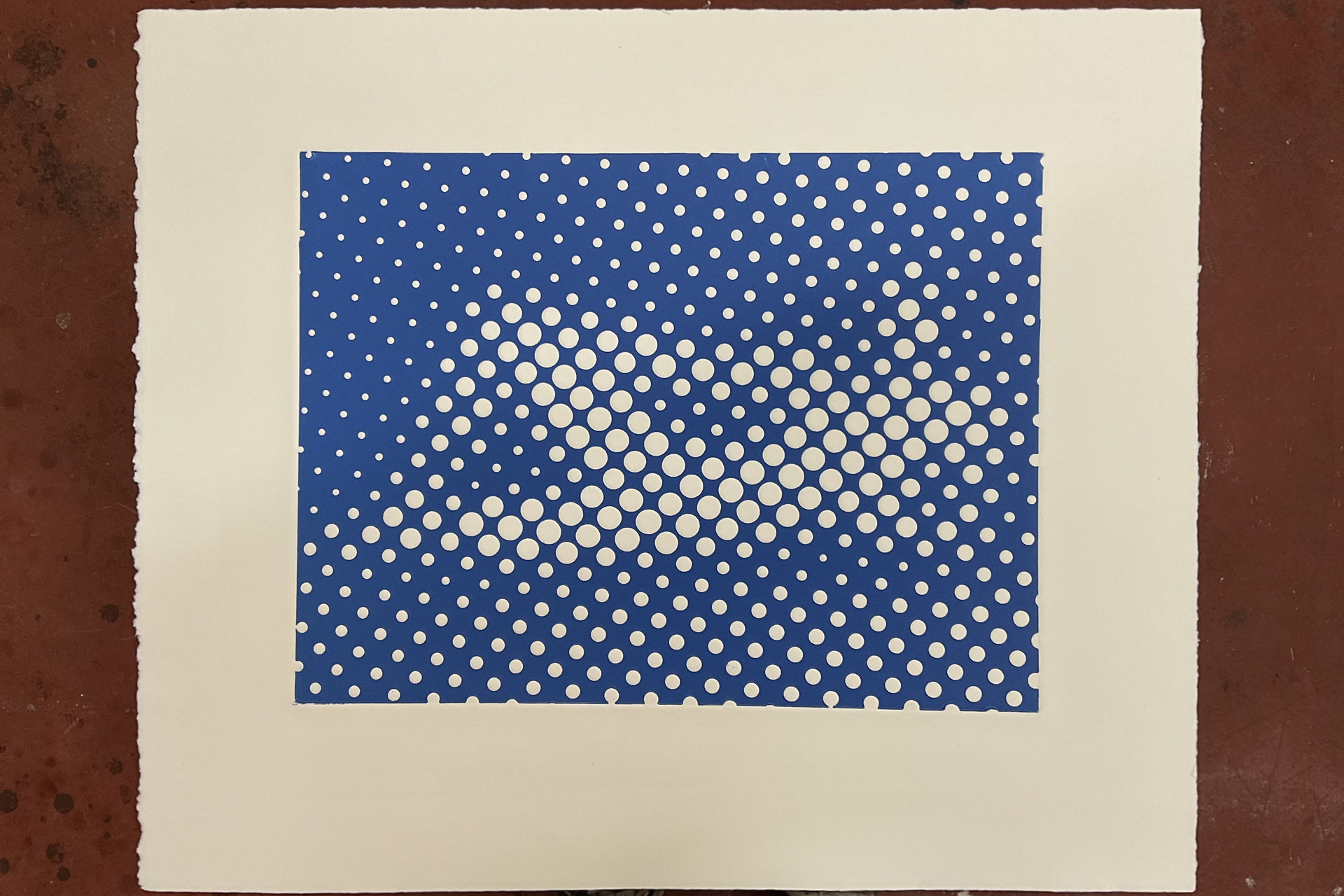
    Mr. Big _ take away (AE), 2012

    40 x 30cm, letterpress print with embossing, printed by: Eva Möseneder, Salzburg

    Special edition of the Leopold Museum, Vienna, limited and signed letterpress prints with embossing in 4 colors of 25 pieces, photo credits: ©Ilse Haider

  • Open Monuments

    Mr. Big, 2013

    9 x 3 x 4,2m, digital print on wood

    Deconstruction of Mr. Big, Leopold Museum, Vienna, photo credits: ©Ilse Haider

  • Open Monuments

    Exhibition view Mr. Big refurnished, 2015

    Kitchen: 4,2 x 2 x 2m, shelfs, digital print on wood

    Galerie Steinek, Vienna, photo credits: ©Ilse Haider

    > press release

Press reviews

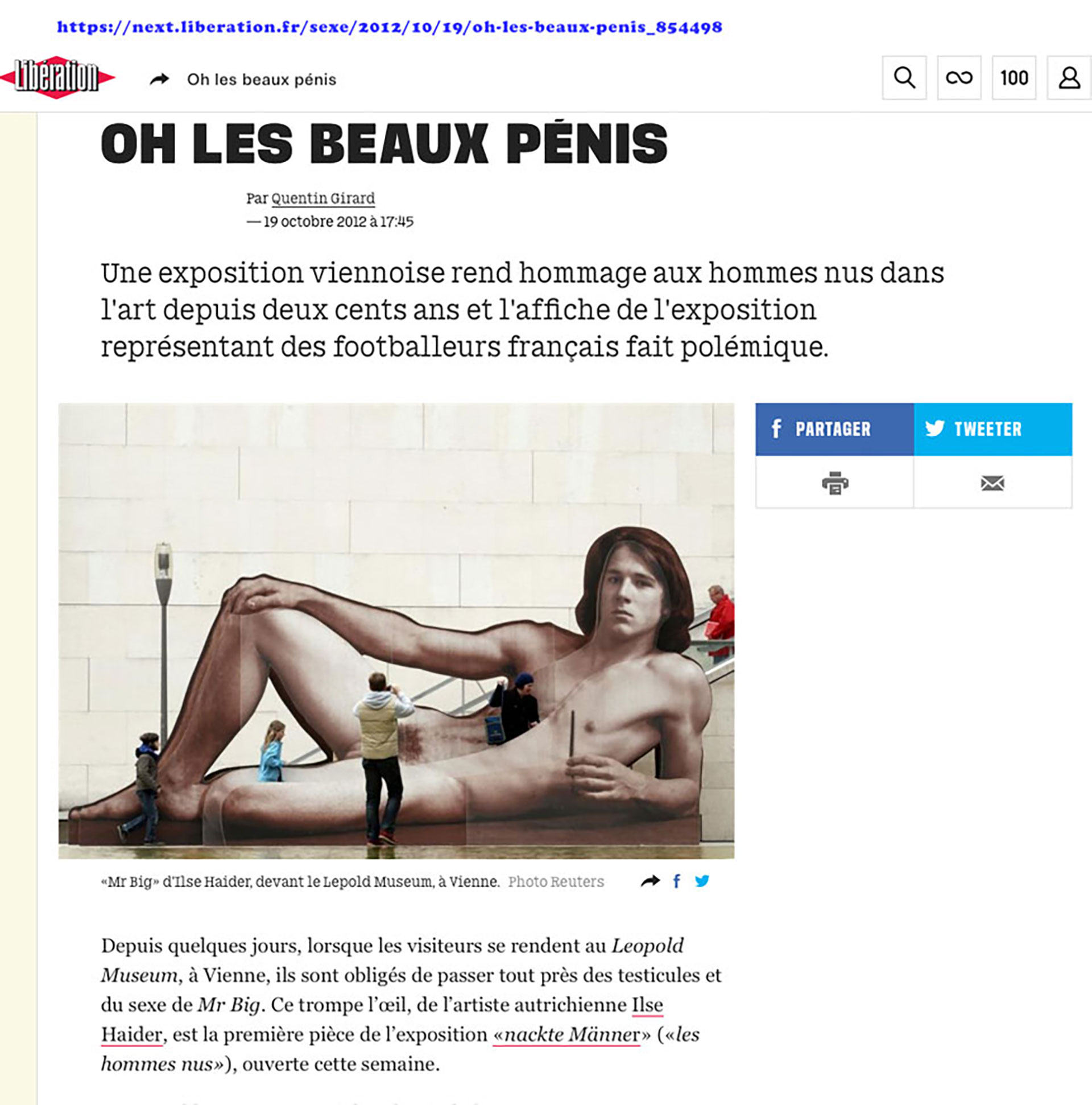
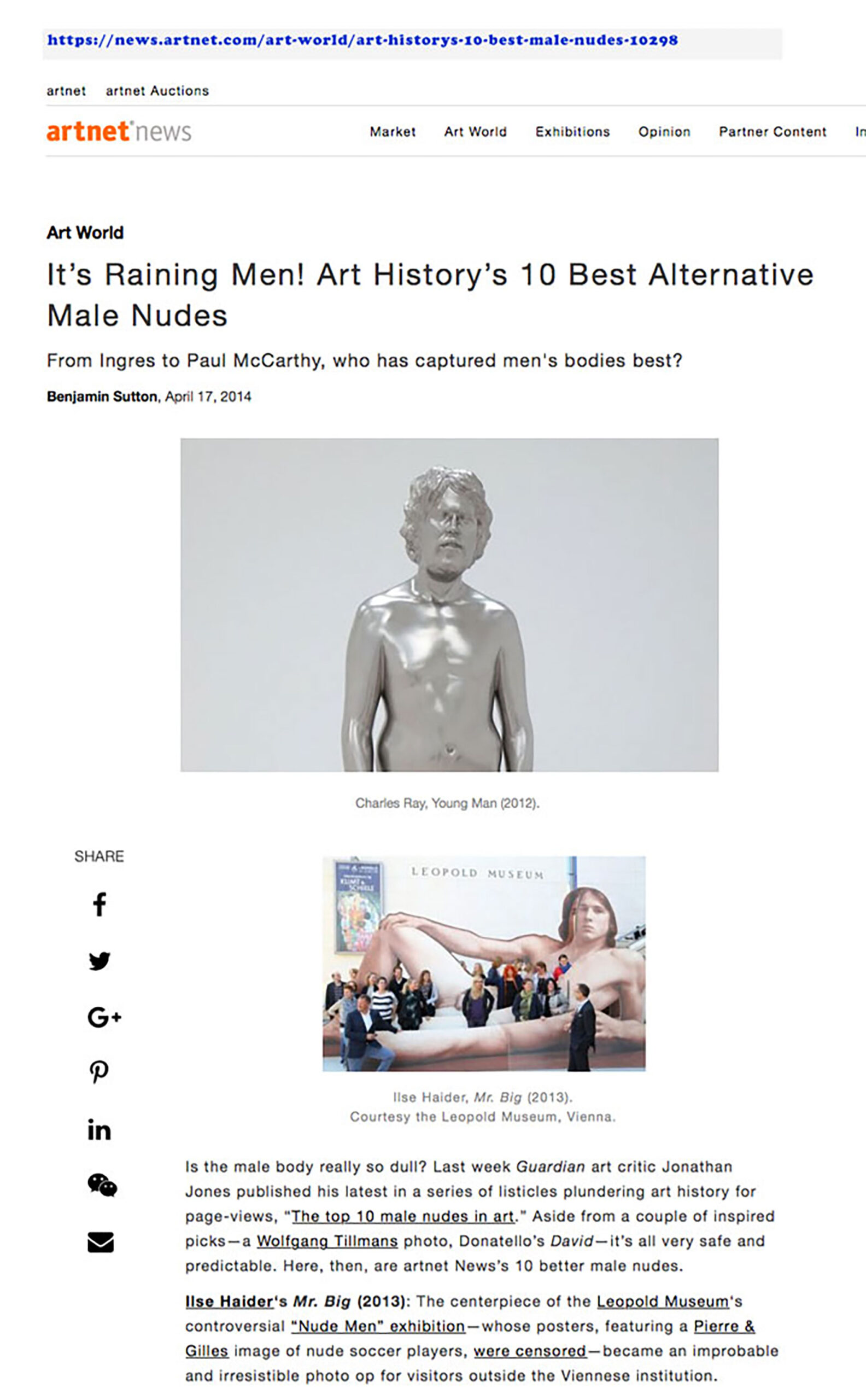
  • Liberation

  • Open Monuments

    Film Boards

    30 x 40 cm Photographic emulsion on wood

    Original: Ossessione / Luchino Visconti, Roma cità aperta / Roberto Rossellini, Der Verlorene / Peter Lorre, Paisà / R. Rossellini, Ladri di biciclette/ Vittorio de Sica, Stromboli / R. Rossellini, Riso amaro / Giuseppe De Santis, La Paura / R. Rossellini, Germania anno zero / R. Rossellini

    ORIGINAL TEXT CLICK HERE

  • Open Monuments

    Anna Magnani, 2018

    123 x 130 x 30cm, Photographic emulsion on wood and acrylic paint

    Original: 1950s, Everett Collection / picturedesk.com.

    > text

  • Open Monuments

    Anna Magnani, 2018

    123 x 130 x 30cm, Photographic emulsion on wood and acrylic paint

    Original: 1950s, Everett Collection / picturedesk.com.

    > text

  • Open Monuments

    Film Boards

    30 x 40 cm Photographic emulsion on wood

    Original: Ossessione / Luchino Visconti, Roma cità aperta / Roberto Rossellini, Der Verlorene / Peter Lorre, Paisà / R. Rossellini, Ladri di biciclette/ Vittorio de Sica, Stromboli / R. Rossellini, Riso amaro / Giuseppe De Santis, La Paura / R. Rossellini, Germania anno zero / R. Rossellini

    > text

Continue reading